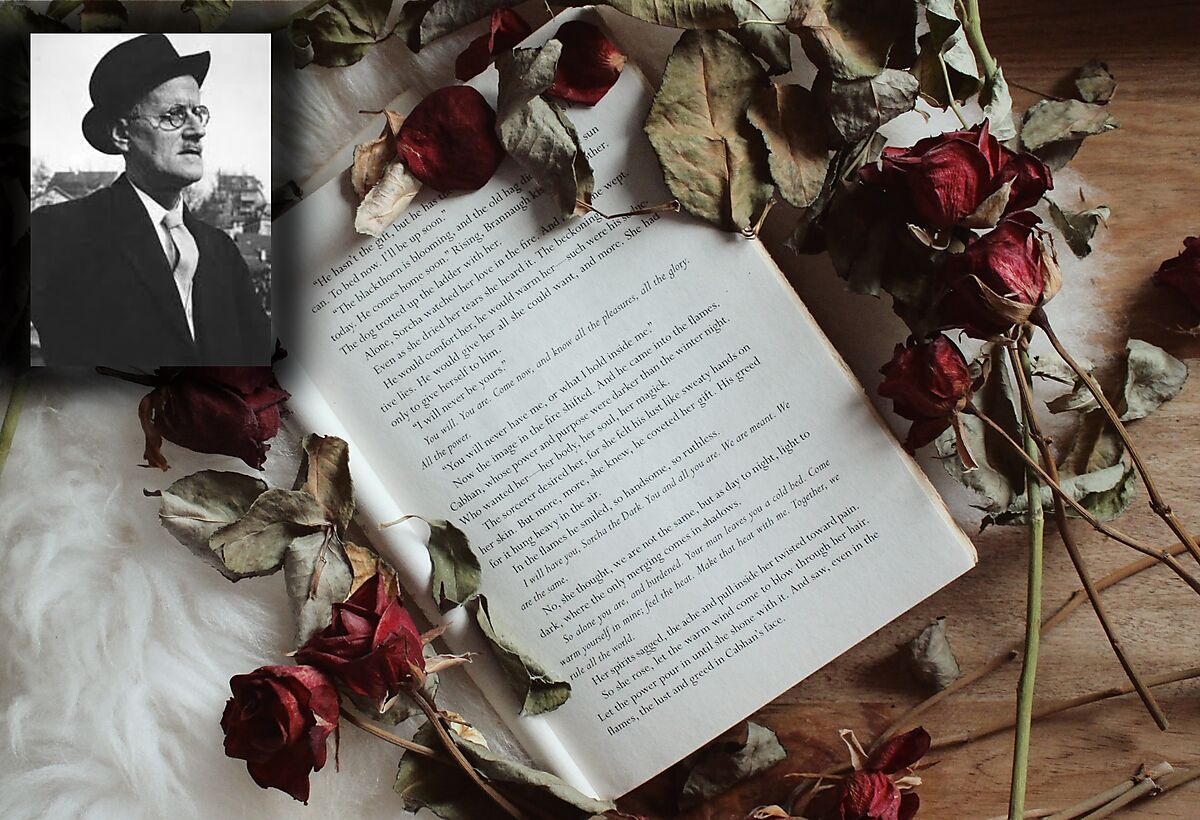
This work, ‘James Joyce, Book, Roses’, is a derivative of ‘James Joyce’, ‘Beauty and the Book’ used under CC BY. ‘James Joyce, Book, Roses’ is licensed under CC BY SA 4.0 by The Cultural Me
Stream of Consciousness and Paranoia in James Joyce’s ‘Ulysses’ (1922)
One August evening in 1909, a miserable James Joyce wrote to Nora, his wife, ‘at the time I used to meet you, […] you kept an appointment with a friend of mine […] What else did you do together?’1 The betrayal Joyce suspected was untrue, but his paranoia would resurface in his masterpiece Ulysses (1922). The novel follows 38-year-old Leopold Bloom on a single day, wandering Dublin, paranoid that his wife, Molly, is having an affair.
Joyce’s writing in Ulysses is also notable for portraying the inner workings of the mind. Through the novel, Joyce was responding to his changing cultural landscape. In an increasingly modern world, and influenced by the discoveries of Sigmund Freud, people wanted to understand what made them human, what separated them from the machines now beginning to dominate urban life. Psychologist William James had coined the phrase ‘stream of consciousness’ (1890) to describe how conscious thought ‘does not appear chopped up in bits’ but flowed as a ‘river’.2 Critics applied this term to the emerging modernist literature where the narration incorporated the experiencing of thinking.
In Chapter 13, Bloom’s watch stops. His jumbled thoughts are revealed to the reader as he speculates whether the frozen moment ‘was about the time’3 Molly had committed adultery back in the marital home. By hearing Bloom’s thought processes, the reader understands how deeply this betrayal has cut, how it will be felt in even the smallest details of his life.
Stream of consciousness allowed modernist writers to realistically depict human behaviour. Nora was Joyce’s muse and once claimed that Joyce wanted her ‘to go with other men’ so that he could have something to write about.4 Joyce’s masterpiece emerged from those dark emotions, moments of paranoid jealousy and irrationality combining to produce an exhilarating insight into the human condition.
Richard Ellman. Selected Letters of James Joyce. London: Faber and Faber. 1992. 469
William James. ‘The Stream of Consciousness’ in Psychology XI. New York: World. 1892
James Joyce. Ulysses. Oxford: Oxford University Press. 1998. 356
Frank Budgen. Myselves When Young. London: Oxford University Press. 1970. 188
Elise Czyzowska
London, UK
Joyce is an author who has given me great enjoyment. I intensely remember reading the final 300 pages of Ulysses in one sitting because of how much I was enjoying it. Whether you’re reading his work analytically, or just for pleasure, I love the way that every line leaves you with a million things to think about.