
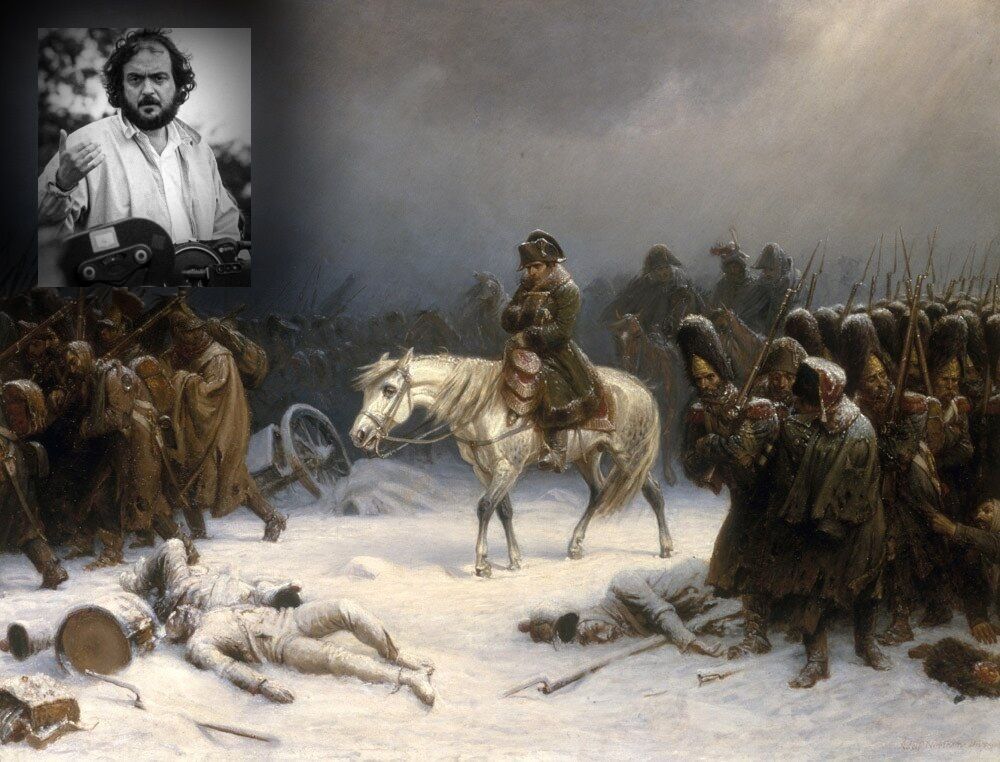
Adolph Northen, Napoleon’s retreat from Moscow (1851) and Stanley Kubrick (inset)
Stanley Kubrick’s Unrealised Film Project ‘Napoleon’ — The Cost of Perfectionism amidst the Shifting Sands of Hollywood
Whilst working on A Clockwork Orange (1971), the film’s lead actor Malcom McDowell sat down for dinner with director Stanley Kubrick. McDowell noticed that Kubrick had a peculiar habit of eating both his main course and his desert at the same time. Kubrick explained ‘It’s all food. This is how Napoleon used to eat.’1
Stanley Kubrick (1928–99) initially began his career in photography and chess before transitioning to filmmaking in the early 1950s, ultimately emerging as one of the most prominent figures in American filmmaking history. He, like Napoleon (someone he admired immensely), was an exacting craftsman. Following the commercially successful yet critically divisive 2001: A Space Odyssey (1968), Kubrick was given carte blanche by film studio MGM, allowing him the creative freedom to pursue any project.2 What he wanted most was to make a comprehensive film of Napoleon, as he believed that there had never been ‘a good or accurate’ film on the subject. Kubrick went so far as to describe Abel Gance's five-hour silent epic Napoléon (1927) as ‘really terrible’ and ‘a very crude picture.’3
Kubrick was fascinated by Napoleon the man — the intricacies of his thought process, his unique position as an outsider within the French nobility due to his humble foreign origins, and his passionate love affair with Joséphine de Beauharnais. Additionally, the prospect of creating the battle scenes, which he called ‘violent ballets’, also excited him.4 Kubrick would undertake a vast amount of research into his central character and the historical period, compiling masses of books, historical records, and photographic material. In an extraordinary commitment to authenticity, he dispatched his longtime assistant, Andrew Birkin, to Paris in May 1968 (unfortunately coinciding with the student riots) to find objects associated with Napoleon. Birkin brought back both Napoleon’s portable toilet and soil from the field of Waterloo, to help recreate the colours and texture of the earth. They categorised the information in a filing system consisting of paper cards, each listing in bullet points exactly what Napoleon was doing on a given date.5
By about 1970, production and planning had progressed to the point where Kubrick was adapting the technology he had previously used for the iconic ape sequence in 2001 to meticulously recreate Versailles. As a cost-effective measure, he had also begun drafting in extras from the Romanian and Yugoslavian military for the elaborate battle sequences.6 Around this time, just as Kubrick was beginning to realise his creative vision, the Hollywood studio system that had defined American filmmaking from 1910 to 1960 was beginning to fall apart.
The studio system involved the five main Hollywood studios (MGM, Warner Brothers, Paramount, 20th Century Fox, and RKO) controlling every aspect of the filmmaking process, spanning production, distribution, exhibition, and even the contractual details of big-name performers. This approach ushered in an era of assembly-line filmaking where the actors were treated more like employees than stars. Whilst the signs of decline were already already apparent by the late 1940s, starting with The United States vs Paramount Pictures Inc case where Paramount was found guilty of antitrust violations related to cinema ownership, and deteriorating further when stars, such as Jimmy Stewart, renegotiated their contracts for a cut in box office profits, it was the advent of television that definitively brought the studio era to an end.7 Television’s distinctive appeal, offering the convenience of home viewing, unnerved Hollywood executives into allocating larger budgets to mass-appeal genres like historical epics and musicals in an attempt to entice audiences out of their homes. Yet, these expensive films were hitting the screens amid a shifting demographic — a younger, more politicised audience seeking more intellectually challenging material.
If one were to highlight any single film as evocative of this change, Arthur Penn’s Bonnie and Clyde (1967) stands out, a work cited by many critics as ushering in the new Hollywood era, with its bold use of sex, violence, and anti- establishment themes; the film was a box office sensation, raking in $70 million on a mere $2 million budget. The success of Bonnie and Clyde not only contributed to the collapse of the studio system, but was also pivotal in the demise of the Hays Code, a series of self-imposed censorship guidelines which limited portrayal of taboo topics, sexual imagery, and offensive language.
Kubrick’s obsession with research and detail had left his dream project at the mercy of shifting trends in Hollywood. Studios were increasingly turning to younger filmmakers, whose productions demanded less financial investment while holding the promise of substantial returns. Amongst this emerging cohort were Martin Scorsese, Arthur Penn, Hal Ashby, Stephen Spielberg, Francis Ford Coppola, George Lucas, and Bob Rafelson. The studios had realised that this group was creating films that resonated with younger audiences, all at a fraction of the budget required for a director of Kubrick’s stature. The final nail in the coffin for Kubrick’s Napoleon project came with the release of Waterloo (1970), a sweeping historical epic on the same subject. Produced by Dino De Laurentis and directed by Sergei Bondachurk, the film failed to make a profit and furthermore divided critical opinion. In the end, a change of ownership at MGM meant that the studio was unwilling to meet Kubrick’s asking price of $5.2 million. Since Kubrick only had a pre-production agreement in place, MGM took the opportunity to mercilessly abandon the film.8
Kubrick would go on to make five more films: A Clockwork Orange (1971), Barry Lyndon (1975), The Shining (1980), Full Metal Jacket (1987), and Eyes Wide Shut (1999) — all of which divided critical opinion at the time but are now considered classics for their unflinching and measured interrogations of human psychology. Elements of his unrealised Napoleon project can be seen in Barry Lyndon, a period drama set in a similar timeframe, which explores many of the themes that Kubrick had envisioned for Napoleon. Kubrick did try to revive the Napoleon project many times throughout his career but the missed opportunity with MGM was the closest he came to realising his vision.9
Notwithstanding his failed projects, Kubrick’s influence on the next generation of filmmakers is unquestionable. Whether it be the Movie Brats of the 1960s and 70s or the indie movements of the 1980s and 90s, Kubrick’s influence on fellow directors in both America and Europe is clearly evident. Renowned filmmakers Martin Scorsese, Ridley Scott, Gaspar Noe, Christopher Nolan, David Lynch, and Michael Mann amongst others acknowledge him as a pivotal influence. Fittingly Ridley Scott would go on to make Napoleon (2023) — a successful cinematic treatment of Napoleon’s life. However, a Napoleon film on Kubrick’s own terms will sadly never see the light of the day because his unique sensibility simply cannot be replicated.
References
- Glen Falkenstein. "Napoleon: Kubrick and his lost film". FalkenScreen. 2015
- Darryl Mason. "The greatest movie Stanley Kubrick never made". Salon. 2000
- Katherine Bayford. "Napoleon can’t conquer the silver screen". Engelsberg ideas. 2024
- FixiousMaximus. "Lost Kubrick- The Unfinished Films of Stanley Kubrick". YouTube. 2014
- FixiousMaximus. "Lost Kubrick - The Unfinished Films of Stanley Kubrick". YouTube. 2014
- Darry Masonl. "The greatest movie Stanley Kubrick never made". Salon. 2000
- Gilbert Cruz. "A Brief History of the Screen Actors Guild". Time. 2008
- FixiousMaximus. "Lost Kubrick - The Unfinished Films of Stanley Kubrick". YouTube. 2014
- FixiousMaximus. "Lost Kubrick - The Unfinished Films of Stanley Kubrick". YouTube. 2014

Stanley Kubrick’s life and work has fascinated me ever since I first saw Full Metal Jacket at about the age of twelve. Kubrick’s relentless pursuit of perfection, his eye for detail, and his equally obsessive yet enigmatic personality is something that I find myself captivated by — both as a writer and as a cinema enthusiast. Kubrick’s range of unmade projects are equally as famous as the films that he did manage to complete. The story of his unrealised attempt at turning the life of Napoleon Bonaparte into a feature film in the late 1960s–early 1970s is the best possible encapsulation of Kubrick the man and the artist.— Simon Thompson