
Colombia’s FIFA World Cup Run 2014
Sport and Conflict — Colombia’s Troubled Past and their 2014 Football World Cup Run
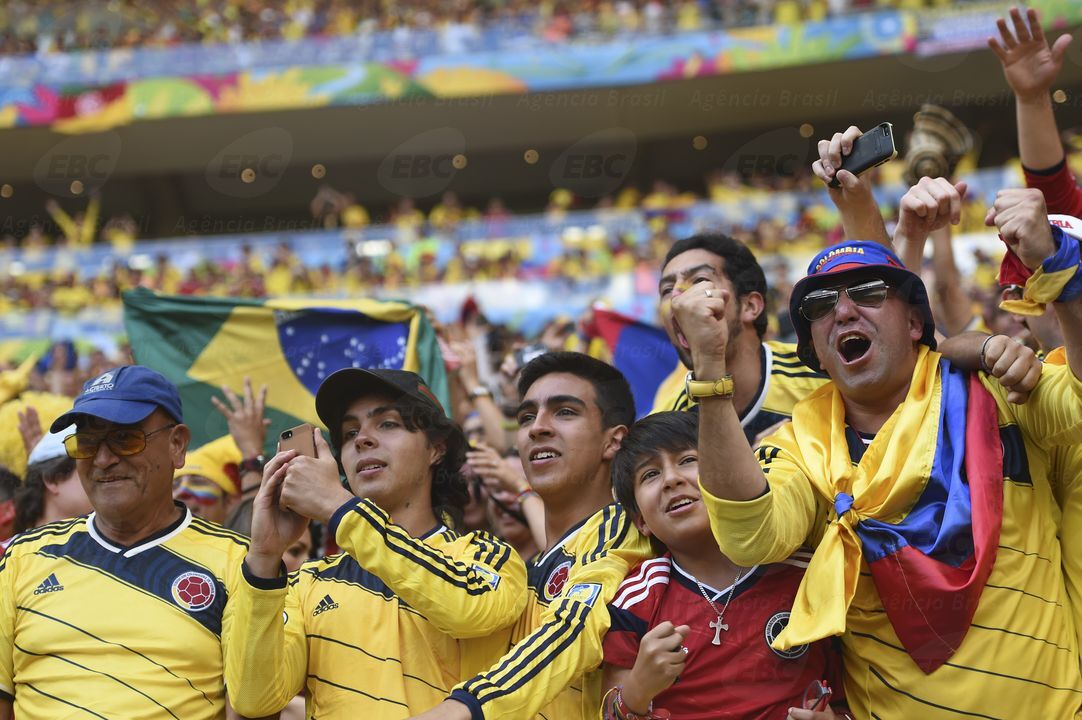
In June 2014 thousands of Colombians poured onto the streets to celebrate their men’s football team beating Greece 3–0 in the group stage of the FIFA World Cup. Yellow shirts were visible across the cities of Colombia as people cheered, blew horns, danced, and hugged in scenes of elation. These celebrations continued as Colombia beat Ivory Coast 2–1 and Japan 4–1, winning the group stage. Their World Cup came to an end after Brazil defeated them 2–1 in the quarter-finals. However, the unprecedented success of the Colombian men’s football team continued to be a significant cause for celebration.
Colombia at the time, however, was a violently divided country. The political violence had its roots in the period known as La Violencia (1948–1958) — a conflict between the Liberals and Conservatives which resulted in an estimated 200,000 deaths. Eventually, in 1964, two guerrilla movements, the Revolutionary Armed Forces of Colombia (FARC) and the Army of National Liberation (ELN) emerged from the conflict.
Both FARC and ELN were leftist groups, claiming to represent the rural population against the Colombian elite. FARC drew its members mostly from the peasant communities, while ELN attracted students and left-wing intellectuals. Both groups engaged in armed conflict with Colombian authorities, in turn triggering the emergence of opposing right-wing paramilitary groups in the 1980s. These were formed from the country’s landowners and business leaders who, with the support of the Colombian state, united to protect themselves from the FARC and ELN. The most prominent was the United Self-Defense Forces of Colombia.
To add to the mix, drug cartels gained a foothold on power in the mid-1970s, earning Colombia the label of a ‘narco state’.1 The country thus found itself mired in armed conflict between the leftist guerrillas, the state-sponsored paramilitary groups, and the drug cartels. Kidnappings, murder, and extortion became commonplace. In the period 1985–93 homicides nearly doubled, making it the leading cause of death in Colombia.2
On 26 May 2002 Álvaro Uribe Vélez was elected president on the premise of ending the conflict and restoring peace. Peace talks began between the government and FARC in August 2011. Despite the decrease in the number of crimes, kidnappings, and terrorist attacks instigated by FARC, Colombia remained in a state of tension and uncertainty as a cycle of cease-fires interrupted by violence recurred over the following years.
It was against this backdrop that the FIFA World Cup took place.
There are well-known examples of sport facilitating reconciliation in divided societies. In South African in 1995 Nelson Mandela, who had spent 27 years in prison before being elected president, watched his national rugby team, the Springboks, win the world cup. In an iconic moment, Mandela, dressed in a Springbok jersey, handed the cup to captain Francois Pienaar, before pumping his fists delightedly in the air. Rugby was played mostly by the white minority, whose government had imprisoned him, and this was a moment of national reconciliation.
In Côte d’Ivoire, in 2005, the national football team, Les Elephants, had qualified for the FIFA World Cup for the first time. At the time, the country was embroiled in a civil war between the largely Christian government and Muslim rebels. Les Elephants, however, was composed of both Christian and Muslim players. After beating Sudan 3–1 to qualify for the FIFA World Cup, and amidst the jubilation, Côte d’Ivoire striker Didier Drogba spoke directly into the television cameras urging the warring sides to lay down their weapons. His teammates joined in singing ‘we want to have fun; stop firing your guns!’3 Although the government and the rebels were already on the path to peace, this episode has gained widespread recognition for the role of sport in helping the causes of peace.
During the Cold War, in April 1971, Zhou Enlai, the Premier of China, extended an invitation to the United States ping pong team amidst frosty relations. They were the first American delegation to visit Beijing since the communist revolution of 1949. Less than a year later, President Nixon would visit China and sign the Shanghai Accord with Chairman Mao, which included wishes to expand contacts between the two countries.
In Colombia in 2014, inner city, societal, and regional rivalries had divided the country. However, the World Cup eliminated these divisions as people came together to celebrate a common cause. For the first time in decades, the country appeared to be unified. This was a significant moment for Colombians who were suddenly provided with a sense of hope and optimism that Colombia could overcome decades of violence and look forward to a more peaceful future.
However, the question of whether peace has been achieved is debatable. In November 2016, President Juan Santos’s government and FARC signed a peace agreement after five years of negotiations. By 15 August 2017, FARC had handed over the last of their accessible weapons to the United Nations, signalling an official end to their conflict with the government. While this did reduce violence from previous levels, a considerable number of non-state actors continued to operate in rural areas, threatening local populations. Attacks on community leaders, former combatants, women, and human rights defenders still occur today.
Today in Colombia football remains the national sport. The women’s national team recently competed in the FIFA World Cup and knocked out two-time world champions Germany in the group stage and made it to the quarterfinals for the first time. This historic victory once again provided Colombians with a cause for celebration across the nation.
‘Sport has the power to change the world. It has the power to inspire. It has the power to unite people in a way that little else does […] Sport can create hope where there was only despair.’4 — Nelson Mandela (2000)
References
- John Collins and Karen Torres Alarcón. "Colombia, the Drug Wars and the Politics of Drug Policy Displacement – from La Violencia to UNGASS 2016". Journal of Illicit Economies and Development. 3, no. 2. 2021. 190-205. p. 193
- John Collins and Karen Torres Alarcón. "Colombia, the Drug Wars and the Politics of Drug Policy Displacement – from La Violencia to UNGASS 2016". Journal of Illicit Economies and Development. 3, no. 2. 2021. 190-205. p. 193
- Sam Ingram. "Didier Drogba’s Cry for Ivory Coast to Lay Down its Guns". Breaking The Lines. 2020
- Rahul Mukherji. "Nelson Mandela used Power of Sport to Unify, Rebuild South Africa". Sportanddev. 2023
I had the opportunity to travel to Colombia last year and was amazed by the resilience and hospitality of the Colombian people. I wanted to share a part of what I learnt. Despite the abundance of topics that I could discuss, their enthusiasm for football really stood out to me.— Amy Wallwork