
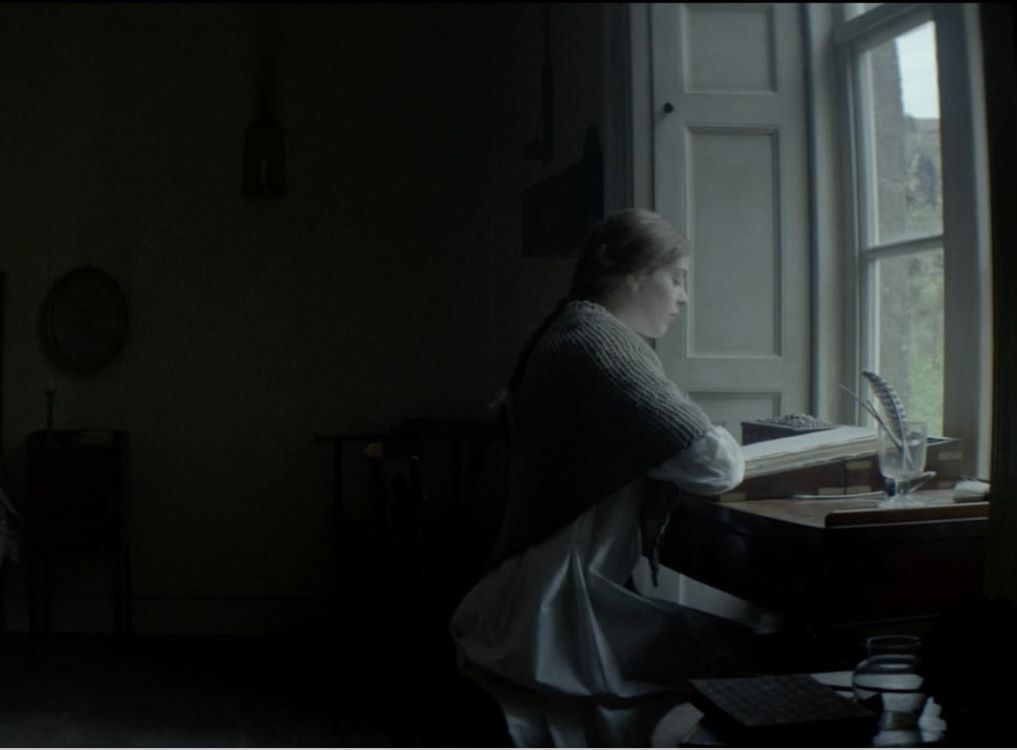
Still from 'Emily' (2022)
Sound in Frances O’Connor’s ‘Emily’ (2022) — The Art of Characterisation through Sound Design
During the Theatrical Season of 1968–69, Dan Dugan, then in his mid twenties, was working in the sound department of the American Conservatory Theatre (ACT) in San Diego. A few years earlier, Dugan had dropped out of the University of San Francisco to pursue a career in stagecraft and lighting design before moving to sound. Dugan was frustrated with the sound effects of the time, which consisted largely of occasional sound being played from a record player or tape deck to support the staging of the play.
At the 1968 Shakespeare festival at the ACT, in his first attempt at improving this, Dugan connected ten loudspeakers to three stereo tape decks, and wired them up to play a wide range of sounds on cue. These innovations led to his work being labelled ‘Sound Design’ — the very first time the term had been used — and this eventually gave birth to a new practice in theatre and filmmaking.1
Modern Sound Design encompasses a number of aspects, including scoring (selecting auditory elements or composing original music tailored for the context), soundtracking (selecting preexisting songs or music), and mixing (blending and adjusting these elements to achieve a balanced auditory experience).2 In filmmaking, the process of sound design begins directly on set, where sound is captured using long-arm microphones called boom mics. These microphones, equipped with pop filters, are strategically positioned above actors during scenes to record a clear audio. Alongside capturing the actors’ dialogue, boom mics also capture the ambient sounds of the environment, known as ‘room tone’.3 Room tone is interwoven with moments of silence between dialogue to preserve the spatial integrity of the scene.
Once filming is complete, the audio is typically edited using Dolby Atmos, a surround sound technology developed by Dolby Laboratories. Sound designers leverage this technology to position individual audio ‘objects’ within a three-dimensional space and dynamically move them in tandem with on-screen actions. This results in an immersive surround sound experience, enabling listeners to perceive sounds emanating from various directions and height levels.
Foley is another common practice in filmmaking which involves recreating everyday sounds in a controlled studio environment. This is usually necessary to enhance weak or otherwise unsuitable sound captured on set. Foley artists replicate sounds such as the rustling of a jacket, footsteps on a wooden floor, or the impact of a fist hitting an object using a variety of everyday items. From breaking a stick of celery to simulate a snapping sound to smashing plates, Foley artists reproduce the required sounds while closely observing a scene so that the audio can be later synchronised with the original sound in post-production.4
In combination, these techniques of sound design can have a profound impact on film or theatre. In the film Emily (2022), a semi-biographical account of the English novelist Emily Brontë, written and directed by Frances O’Connor, the sound was designed by the Israeli Niv Adiri. In the opening scenes, Emily, who is portrayed by Emma Mackey, relates a story of a war. As her narrative unfolds, the audience is transported into her imagination, hearing the sounds associated with the events she describes, from the bugle calls of soldiers to the clashing of swords and the neighing of horses. The noise of people shouting and stock audio of explosions form the backdrop to Emily’s voice, bringing home the brutality of the imaginary war to the audience. The striking depiction of these imagined events through sound also conveys the character of Emily, her vivid imagination and her gift for evocative storytelling.5
Later in the film, a new curate named William Weightman (Oliver Jackson-Cohen) arrives at the parish and during a sermon talks about the heavy rain he had encountered on the way. At the point where William begins to describe the rain, the unimpressed Emily shuts her eyes and as she does so the sound of his voice is gradually overtaken by the intensifying noise of the rain. In another poignant moment, following the blossoming romance between Emily and William, their first kiss is underscored by the surrounding wind which becomes louder whenever they draw close but dies out when they pull away. Here sound design brings out the emotional interiority of the characters and imbues these moments with an intensity that they would not otherwise have.
Sound design serves as a pivotal tool for immersing audiences deeply in a story. The judicious application of sound design unveils and magnifies the characters’ inner lives and emotional landscapes beyond the confines of dialogue alone. The performances are given additional depth and meaning by emphasising a specific line or moment; or even to suggest that a character’s outward speech may not align with how they feel. This window into a character’s interior life, without requiring additional dialogue, creates a deeper bond with the audience.6
When Dan Dugan began his early experiments with sound design in 1968, he paved the way for modern innovations in the field. Dugan’s ultimate aim was to draw audiences closer to the story unfolding on stage. The example of Emily shows that he has achieved his aim. In the final scene of Emily, Emily’s elder sister, Charlotte, is depicted alone in her bedroom during Emily’s illness. As Charlotte opens her bedroom window, the ambient sounds of nature flood in, echoing her introspective journey as she begins to write her own story. We see Charlotte opening herself up to her own creativity — the notion conveyed through no more than a silent performance and the accompanying sound.
References
- Kate Finan. "The History of Sound Design". Boomboxpost.com. 2023
- NFI. "Sound Design". NFI.edu. 2023
- Backstage. "What is Sound Design? An Intro to Sound in Film". Backstage.com. 2023
- Backstage. "What is Sound Design? An Intro to Sound in Film". Backstage.com. 2023
- Directors UK. "Emily: an interview with Frances O’Connor". Directors.UK.com. 2022
- Venus, Linda. Cut to the Chase: Writing Feature Films with the Pros at UCLA Extension Writers’ Program. New York: Penguin Publishing Group. 2013. P. 248

This is a film that spoke to me as a writer, but also as someone who just loves film. The story was one to which I could relate well, but it was the factors outside of the writing that sold it in the end. I was really taken up by how the sound design influenced my relationship with the film. It allowed me a window into the internal feelings of the main character.— Jamie Clarke