
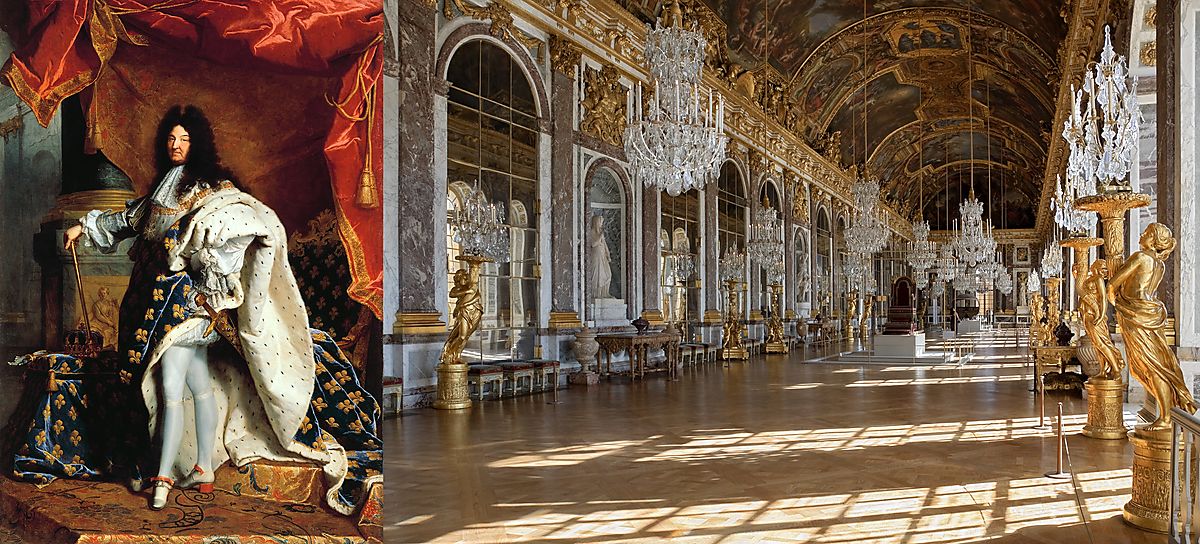
Louis XIV and Galerie des Glaces, Versailles
Social Control in 17th Century France: Life at Louis XIV’s Versailles
In 1682 in an unusual move, Louis XIV moved his entire royal court to Versailles. At the time of his ascension in 1643, he had inherited challenging conditions. France was composed of fragmented provinces ruled by noble elites, characterised by their strong local identities. They constituted rival spheres of political authority that threatened national unity and the stability of Louis XIV’s rule.1
By frequently requiring their presence in Versailles, Louis XIV ensured his nobles were geographically distant from their local power bases. He further consolidated power with a strict daily routine characterised by ceremony, which accorded importance to even the holding of the King’s candlestick.2 These rituals provided courtiers with critical access to the monarch, and thus became the mechanism through which courtiers could advance, sustain, or even lose their rank; their duties outside of Versailles became less important, almost irrelevant.
The petit lever (from lever ‘to get up’), an elaborate ritual in the King’s bedroom, began at 8:15am, when he would be dressed by his chosen courtiers. Participation in this ceremony was highly coveted because it provided the opportunity to influence the King or ask for favours.
This was followed by the grand lever at 8.30am, when the King would leave his bedroom and enter the galerie and proceed to mass. This ceremony was less exclusive and required the King to walk through the corridor amongst his court. Consequently, it was often overwhelmed by courtiers, with hundreds routinely queuing outside.
Louis XIV reportedly rejected requests from nobles who spent little time at Versailles with retorts such as ‘He is a man I never see!’3 — a testament to the King’s skill at social control.4
References
- Beik, W.. Louis XIV and Absolutism. Boston: Bedford /St Martins. 2000. p35
- Norton, L. Memoirs of the Duc De Saint-Simon: 1691-1709 v.1: 1691-1709 Vol 1 (Lost Treasures). 2nd ed.. London: Prion Publishers. 1999. p220-225
- Norton, L. Memoirs of the Duc De Saint-Simon: 1691-1709 v.1: 1691-1709 Vol 1 (Lost Treasures). 2nd ed.. London: Prion Publishers. 1999. p220
- Norton, L. Memoirs of the Duc De Saint-Simon: 1691-1709 v.1: 1691-1709 Vol 1 (Lost Treasures). 2nd ed.. London: Prion Publishers. 1999. p220-225

I was inspired by my postgraduate studies to write this article. After several visits to Versailles, I was struck by the varied history of the building. First conceived by a powerful young King, it served as a symbol of absolute monarchical power. In 1837, forty years after the French Revolution, it was transformed into a museum.— Holly Rowe