
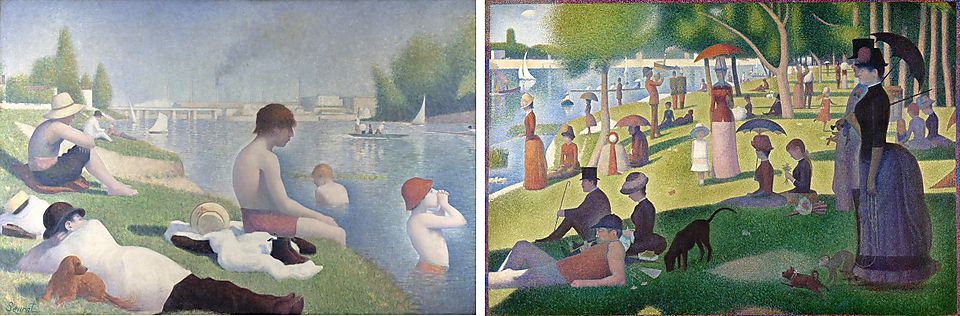
Seurat's Grande Jatte and Bathers as a social contrast
Seurat's Grande Jatte and Bathers as a Social Contrast

Viewing Georges Seurat's Sunday Afternoon on the Island of Grande Jatte, we can see the members of the Parisian middle-class enjoying their Sunday. But what is on the other shore of the Seine?
Recent studies have suggested that the middle-class members of the Grande Jatte are facing their class inferiors, the Bathers at Asnières. This view is also supported by the fact that both paintings were supposed to be of the exact same size, although the artist later enlarged the Grande Jatte.
These artworks constitute a social comment by the artist and when they are considered as a pair, it is obvious that Seurat chose a subject related to class contrast. Whereas the middle and upper-classes enjoy the sun and the spring as a Sunday habit, the working-class members of the Bathers were probably taking a break from work. The figures in the Grande Jatte seem to be stiff and even lonely, in comparison to the Bathers, who, freed from the long-sleeved clothes, look calm and at ease.
The leisure activities are the part of social life where the intermingling of the lower-middle class with the bourgeoisie is most obvious. Accordingly, Seurat shows the different classes of his society sharing the same activities, but at the same time opposite to each other.
This depiction has an even stronger social meaning if we consider that it is presented by an artist with well-known Marxist influences.
Recent studies have suggested that the middle-class members of the Grande Jatte are facing their class inferiors, the Bathers at Asnières. This view is also supported by the fact that both paintings were supposed to be of the exact same size, although the artist later enlarged the Grande Jatte.
These artworks constitute a social comment by the artist and when they are considered as a pair, it is obvious that Seurat chose a subject related to class contrast. Whereas the middle and upper-classes enjoy the sun and the spring as a Sunday habit, the working-class members of the Bathers were probably taking a break from work. The figures in the Grande Jatte seem to be stiff and even lonely, in comparison to the Bathers, who, freed from the long-sleeved clothes, look calm and at ease.
The leisure activities are the part of social life where the intermingling of the lower-middle class with the bourgeoisie is most obvious. Accordingly, Seurat shows the different classes of his society sharing the same activities, but at the same time opposite to each other.
This depiction has an even stronger social meaning if we consider that it is presented by an artist with well-known Marxist influences.
Do you want to learn to write like this?
References
- Smith, P. Seurat Re-viewed. The Pennsylvania State University Press, Pennsylvania. 2009
- Eisenman, F. S. Nineteenth Century Art, A Critical History. Thames & Hudson, London. 2011
- Clark., T. J.. The Painting of Modern Life, Paris in the Art of Manet and His Followers. Princeton University Press., New Jersey. 1984