
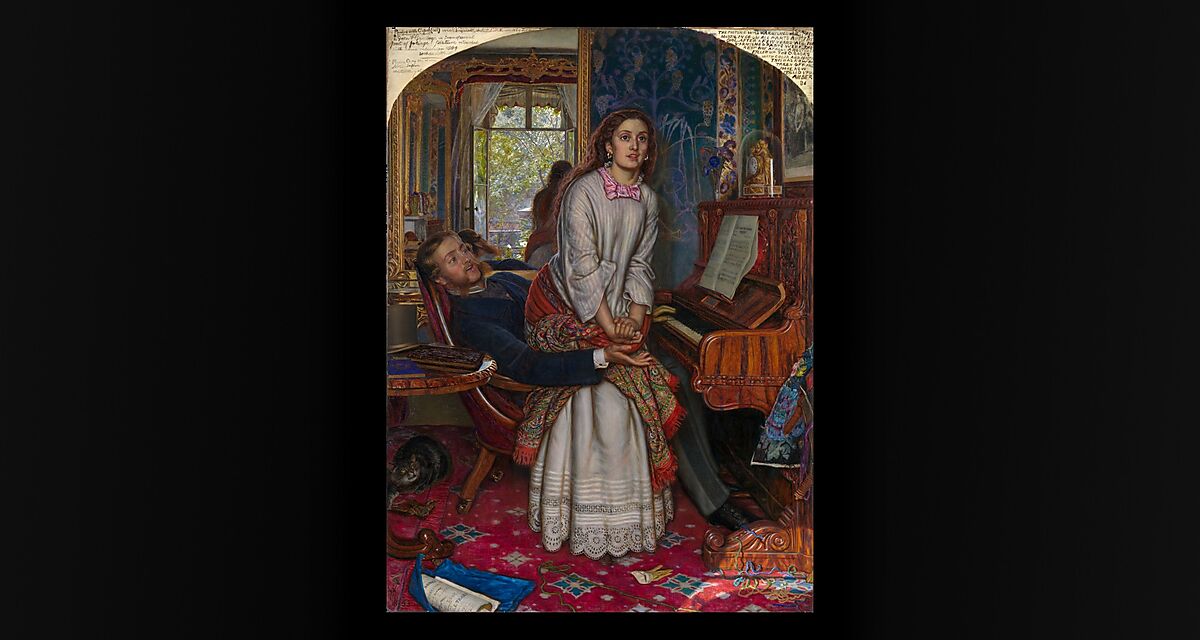
The Awakening Conscience
Self-renewal and Victorian Reality in William Holman Hunt’s ‘The Awakening Conscience’ (1853)
A woman with a prominently absent wedding ring, a visitor with his hat still on the table, a newly decorated apartment… William Hunt’s The Awakening Conscience (1853) tells the story of a kept woman.
The woman has been singing Thomas Moore’s ‘Oft, in the Stilly Night’ (1818) of ‘cheerful hearts now broken...’ at the piano. On the ground in a state of abandon lies Alfred Tennyson’s poem ‘Tears Idle Tears’ (1847), lamenting ‘So sad, so fresh, the days that are no more…’1. Both are works of nostalgia, referring to better times in the woman’s past. As for her present state, like the bird trapped under the table by a predatory cat, like the female figure in the glass-encased clock, she is prevented from escaping her disadvantaged state, perhaps through poverty, or a lack of opportunity.
The painting comes at a time in the Victorian Era where, despite its rigid conservatism, there was a growing awareness of the plight of disadvantaged women.2 In addition to these moral concerns, Hunt was also interested in the purity of medieval Christian motifs and wished to demonstrate the spiritual awakening of a closed mind (as a real-world counterpart to his The Light of the World (1853) painting, which shows Christ knocking on a closed door).
Hunt reveals his sympathy for the woman through the subtle interplay between the confines of the room and the outside world, which is directly visible to the woman through the open window, and indirectly to us in the mirror. The woman is shown rising from the man’s lap, as if struck by a sudden realisation, an expression of wonder on her face at something hidden from our view, her rising figure illustrating the moment of awakening conscience.
Hunt intended the moment of realisation to be triggered by the words of the song they have been singing. He once referred to a verse in the biblical Proverbs, which likens a man who ‘singeth songs to an heavy heart’ to someone who ‘taketh away a garment in cold weather’, as his inspiration for the painting. Their singing (‘Fond memory brings the light, Of other days around me’) reminds the woman of a happier past to which she now seeks to return.
The setting introduces a subtle satire of the wealthy man, as he is shown with his gloved left hand lingering on the piano keys: the woman’s realisation has been triggered by the man himself.3
Although Hunt bestows on the woman the right to atone for past mistakes, her escape to freedom would be a perilous one. John Ruskin, an art critic of the time, wrote to The Times newspaper in May 1854,4 explaining the meaning of the painting — to correct apparent public confusion over it. Ruskin pointed out the harsh realities awaiting a former mistress of the time, arguing that Hunt had painted the ‘pure whiteness’ of the woman’s dress only to starkly contrast the dust and soil it would gather as ‘her outcast feet’ stepped onto the street.
References
- Adam Roberts (ed.). Alfred Tennyson: A Critical Edition of the Major Works. New York: Oxford University Press. 2000. p.133, l.126-30
- Anderson, Amanda. Tainted Souls and Painted Faces: The Rhetoric of Fallenness in Victorian Culture. Ithaca: NY: Cornell University Press. 1993. pp.43-4
- George P. Landow. "The Awakening Conscience". Victorian Web. 2020
- John Ruskin. "The Pre-Raphaelites". Duquesne University. 1999

My first encounter with Hunt’s The Awakening Conscience (1853) in an art history class was an experience full of discovery. Despite the woman’s pleasant expression and the warm colours, the cat lurking under the table and the distant reflection of an open window somehow made me anxious. At first glance, I could not imagine the plethora of meaning hidden behind the symbolism that is so definitive of the Pre-Raphaelite movement.— Ugnė Civilyte