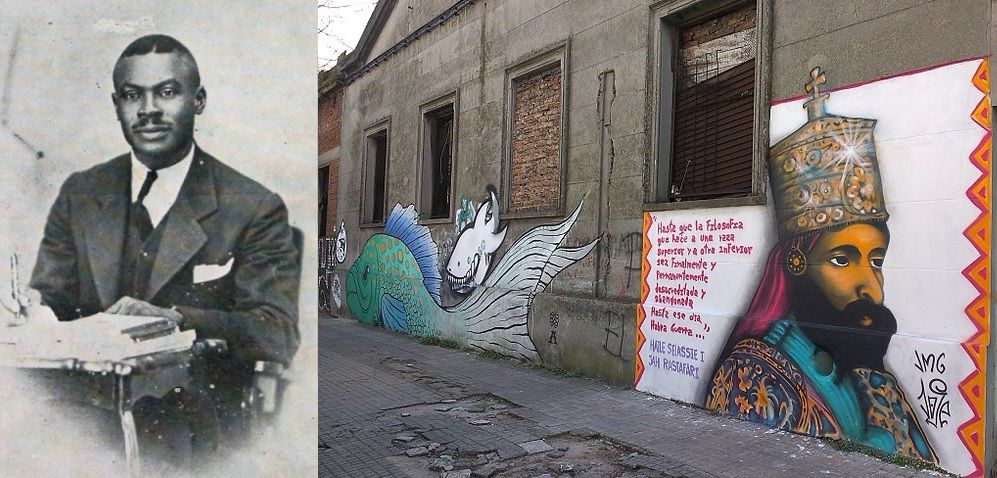
Leonard Howell came face-to-face with his blackness when he moved to Harlem, New York from colonial Jamaica in the 1920s. It was here that he joined forces with Marcus Garvey, another major figurehead in the Rastafari movement.
Howell’s first-hand experience of segregation in Harlem convinced him of the need to encourage the Black race to rise above the forces holding them back, including themselves.1 Howell allied himself with other Black leaders across the world, which was seen as threatening to the White administration in Jamaica.2
Marcus Garvey in his preachings had prophesied the crowning of a Black King in Africa, the Redeemer.3 Shortly afterwards Ras Tafari Makonen became emperor of Ethiopia taking the name Haile Selassie I. The idea of an imperial Black race, mirroring the empires of Europe, now seemed a reality.4
Returning to Jamaica in 1932, Howell advocated six principles which lay the foundation of the Rastafari movement.5 These include hatred and vengeance toward the White race, the superiority of the Black race, the return to Africa, and acknowledgment of the divinity of Haile Selassie I.6
In preaching this message, Howell was charged and imprisoned for two years for sedition in 1934. The Rastafari movement, however, had taken root and would continue to grow in the following decades, spreading outside of Jamaica and attracting non-Black (and paradoxically White) followers.
Although his message contained vengeance for an entire race of people, Howell’s motivation was arguably to reclaim the power of which he felt his race had been forcibly stripped.
Beckford, O. & Gayle. H. Caribbean Culture Notes: Unit 3: Religion in the Caribbean. University of the West Indies Mona Campus. 2016. 3
Ashly Cork
London
I wanted to highlight the importance of the Rastafari movement beyond the stereotype of smoking weed and growing dreadlocks. The movement has been instrumental in both Jamaican and African culture for decades and is important for those who identify themselves as Black and also those who identify with the struggles of being a part of a system that has been to their detriment for centuries.