
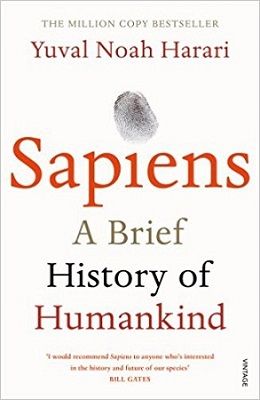
Sapiens Front Cover
Sapiens: a Brief History of Humankind

Sapiens (2011) by Yuval Noah Harari is a biography of humankind, detailing over 150,000 years of evolutionary history of biology and culture starting from the stone age.
Harari begins this journey through the ages with a section covering The Cognitive Revolution, in which Homo Sapiens developed cognitive traits that separated them from every other previously existing genus of Homo. During this period, Homo Sapiens began to think abstractly, solve problems, develop increased dexterity and strengthen language capability.
Harari then moves on to The Agricultural Revolution. This era sparked population growth and drove more humans to interact with one another on a larger scale, thereby creating societies with predefined roles for each individual. His thorough explanation of The Agricultural Revolution lays a solid foundation for the third major part of this book: The Unification of Humankind.
In this section, Harari explains how the creation of hunter-gatherer societies led to political, economic and religious institutions. He writes about the globalisation of these institutions sparked by Homo Sapiens’ advanced communication. This leads the reader to the Scientific Revolution, the final part of the book.
Harari finishes Sapiens with a thorough explication of our history from the end of the Renaissance to the present-day. He writes about the cause and effect of the Scientific Revolution, the history of human happiness and the implications of modern technology on humankind in the near future. More can be read of Harari’s take on what will become of Homo Sapiens in his sequel Homo Deus.
Harari begins this journey through the ages with a section covering The Cognitive Revolution, in which Homo Sapiens developed cognitive traits that separated them from every other previously existing genus of Homo. During this period, Homo Sapiens began to think abstractly, solve problems, develop increased dexterity and strengthen language capability.
Harari then moves on to The Agricultural Revolution. This era sparked population growth and drove more humans to interact with one another on a larger scale, thereby creating societies with predefined roles for each individual. His thorough explanation of The Agricultural Revolution lays a solid foundation for the third major part of this book: The Unification of Humankind.
In this section, Harari explains how the creation of hunter-gatherer societies led to political, economic and religious institutions. He writes about the globalisation of these institutions sparked by Homo Sapiens’ advanced communication. This leads the reader to the Scientific Revolution, the final part of the book.
Harari finishes Sapiens with a thorough explication of our history from the end of the Renaissance to the present-day. He writes about the cause and effect of the Scientific Revolution, the history of human happiness and the implications of modern technology on humankind in the near future. More can be read of Harari’s take on what will become of Homo Sapiens in his sequel Homo Deus.