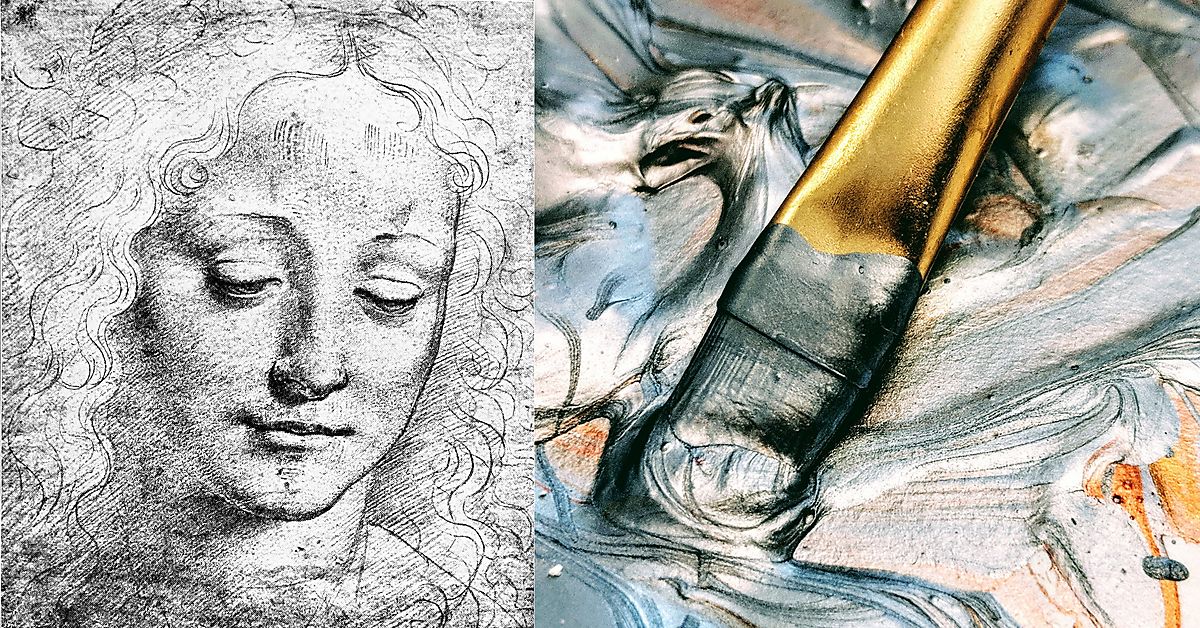
This work, ‘Disegno vs Colorito’, is a derivative of ‘Girl’s Head’, ‘Paintbrush’ used under CC BY. ‘Disegno vs Colorito’ is licensed under CC BY SA 4.0 by The Cultural Me
Ruining a Good Drawing with Colour just as Mankind was Ruined by Eve
During the Italian Renaissance (1340–1550), an interesting debate arose: of the two parts that make up every painting, namely the drawn outline (disegno) and the colour that is subsequently applied (colorito), which was more important?1
This sort of competitive evaluation, known as paragone (literally ‘comparison’), was common at the time. However, this particular paragone had existed even as far back as Aristotle (384–322 BCE) who declared his preference for drawing by stating ‘the most beautiful pigments… [on a canvas] will not give as much pleasure as a black-and-white outline.’2
The disegno vs colorito argument also surfaced the ambivalent attitude that men have historically held towards female ornamentation, in particular the wearing of make-up. The plainness and simplicity of a drawing and the subsequent lustre that the addition of colour brings gave rise to an easy metaphor: colour on a painting was no different to make-up on a woman, serving only to disguise the truth.3
Renaissance theorists such as Giorgio Vasari (1511–74) also drew upon gender to argue the case for drawing; while colour was associated with emotion, seduction and femininity, drawing was perceived as intellectual and masculine.4
A few centuries later, French art critic Charles Blanc (1813–82) continued the tradition in his The Grammar of Painting and Engraving (1867).5 However, perhaps reflecting the changing times, he admits that colour is necessary to engender (or create) a painting, just as ‘the union of man and woman engender humanity’6. Yet colour, like a woman, must be contained: ‘drawing must conserve it’s preponderance over colour. If it is otherwise, painting will run to ruin; it will be lost through colour as humanity was lost through Eve.’7
Alice Thaler. Von Ontologischen Dualismen des Bildes. Philosophische Ästhetik als Grundlage kunstwissenschaftlicher Hermeneutik. Schwabe Verlag Basel. 2012. 156
Aristotle. Poetics. translated by G. F. Else. Ann Arbor: University of Michigan Press. 1970. 26
Jacqueline Lichtenstein. Making Up Representation. The Risks of Femininity. Representations. Misogyny, Misandry, and Misanthropy No. 20. 1987. 77-87
Norma Broude, Mary D. Garrard. The Expanding Discourse. Feminism and Art History. Westview Press. 1992. 33
Jan de Heer. The Architectonic Colour: Polychromy in the Purist Architecture of Le Corbusier. 010 Publishers. 2009. 22-23
Charles Blanc. Grammaire des Arts du Dessin, Architecture, Sculpture, Peinture. Nabu Press. 2012. 23
Charles Blanc. Grammaire des Arts du Dessin, Architecture, Sculpture, Peinture. Nabu Press. 2012. 23
Judith Kuthy
Vienna
I wanted to introduce the reader to Charles Blanc and describe how the French writer linked colour and drawing to the sexes and what that implied.