
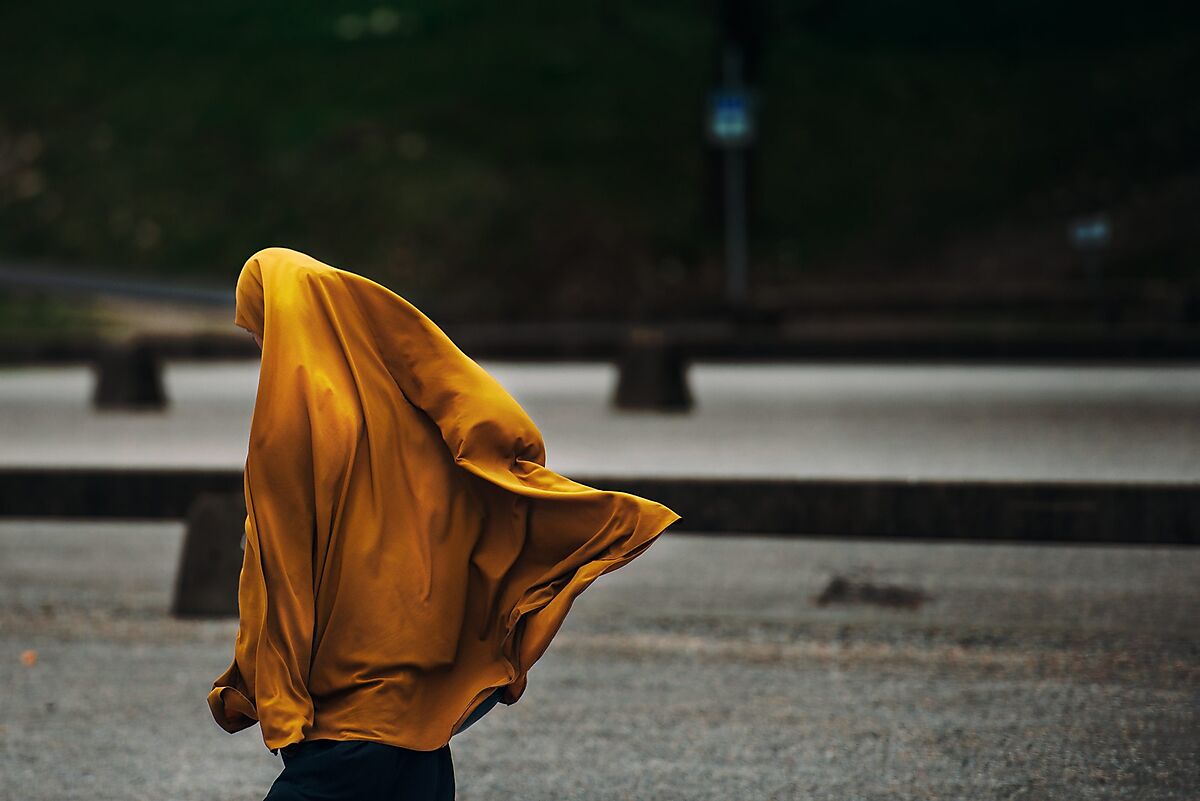
Muslim Woman in Yellow
Religious Symbolism, Islamic Head Coverings and Laïcité in France
On 3 October 1989, in the scenic French town of Creil, three Muslim students were expelled from school for refusing to remove their headscarves.1 The girls had been wearing the hijab.
In the Islamic sacred text the Qur’an, in surah An-Nur (the 24th chapter) verse 31, women are directed ‘not to reveal their hidden adornments’2 except to their husbands, and men and boys of the immediate family. This has been interpreted with varying degrees of stringency in Islamic traditions, leading to different forms of veils and coverings. The hijab covers the hair, neck and chest, but leaves the face exposed. The niqab is a head covering with an opening only for the eyes. The burqa is the most exacting in which the whole body is covered with (typically black) cloth with a veil also descending over the eyes.
At the time, the French supreme court (Conseil d’État) sided with Eugène Chenière, the headmaster, and the expulsion was upheld. Two months later, two of the girls, Leila and Fatima (of Moroccan origin), returned to school without their headscarves after the intervention of the King of Morocco. The third girl, Samira (of Tunisian origin), eventually returned to school, also without headscarf, on 26 January 1990.3
Over the following decade similar episodes unfolded across the country, of Muslim students defying the rule and then being expelled. Eventually, in 2004, legislation was put in place banning conspicuous religious symbols in state schools. This included the hijab as well as other religious symbols such as the crucifix. Further legislation followed in 2010 banning face coverings in public places. This affected the wearing of the niqab and burqa; Muslim women could no longer wear them whilst going about their daily activities such as using public transport or shopping.
The 2010 bill passed both the national assembly and the senate with one objection from Daniel Garrigue, an independent conservative, who stated that ‘in fighting extremist behaviour, we risk sliding towards a totalitarian society.’4 Jean Glavany from the Socialist Party also criticised the law for being too aggressive and believed it would stoke tensions within France.5 Others such as former prime minister François Fillon argued that the law would promote gender equality and increase public safety.6
In 2021, Marine Le Pen (a rightwing politician) proposed a ban on Muslim headscarves too in public spaces.7 Contemporary president Emmanuel Macron’s view was that if someone ‘wears a hijab in a public space it is not my business’, but if they chose to wear one in state institutions, then it would be his business, stating that ‘in public services we have a duty of neutrality’8.
Politicians, it would seem, reflect the will of the people. And sure enough prior to the 2010 law, a poll revealed that 82 percent of the French population approved of the burqa ban.9
Why would French society, generally seen as liberal and tolerant, support something that Amnesty International has called a violation of Article 10 of the Human Rights Act (the right to freedom of expression)?
Around the time of the 2010 law’s passage, France had endured several terrorist attacks, in the wake of which the idea that Islam threatened the French way of life had begun to take root. In 2000, three quarters of the population believed that Islam was incompatible with core French values,10 and by 2013 over 50 percent agreed with the idea that Islam posed a danger to the western world.11 The opposition to face coverings also drew strength from the desire for female equality. In the year prior to the 2010 ban, in his State of the Nation speech, president Nicolas Sarkozy (under whose administration the ban was enacted) said ‘France is a country where there is no place for the burqa, where there is no place for the subservience of women’.12 For Sarkozy the burqa was a symbol of oppression.
However, headmaster Eugène Chenière had something altogether different in mind when he expelled the students back in 1989, namely, the idea of laïcité.
Laïcité (which is related to the word ‘laity’, those that are not of the clergy) is loosely translated as secularism. Laïcité is different from anticlericalism (opposing the power of the clergy) in that it is seen to safeguard against both the influence of the clergy in state affairs as well as the influence of the state in religious matters.
This idea has historical roots dating back to the French Revolution and the correspondent decline in religious privileges against the rise of individual expression, and mirrors a general movement towards anticlericalism across Europe in the 19th century (directed at the Catholic Church). Laïcité became central to the French education system with the enacting of the Jules Ferry laws of 1881–82 which declared that education should be free, compulsory and secular. In 1905, secularism became law with the state being debarred from instituting and supporting an official religion, and simultaneously people being given the freedom to practise any religion (or none at all). In 1958, laïcité was enshrined in the first article of the French constitution, which reads ‘France shall be an indivisible, secular, democratic and social Republic. It shall ensure the equality of all citizens before the law, without distinction of origin, race or religion’13.
For Eugène Chenière, then, the issue of overt religious symbolism brought into question the government’s role in creating religiously neutral public services and spaces. For wider French society today, the fear that Islam is incompatible with the French way of life, the perception that face coverings are a symbol of female oppression, and the deep-rooted idea of laïcité now combine to drive the discourse on the hijab, niqab and burqa — a discourse that is in direct conflict with its adherents.
References
- Joan W. Scott. "Symptomatic Politics: The Banning of Islamic Head Scarves in French Public Schools". French Politics, Culture & Society. 23, no. 3. 2005. 106-127. p.106
- Muhammad Muhsin Khan and Taqī-ad-Dīn al- Hilālī. The Noble Quran In the English Language. London: Darussalam Publications. 1997. p.405
- Nicky Jones. "Beneath The Veil: Muslim Girls And The Islamic Headscarf In Secular France". Macquarie Law Journal. 9. 2009. 47-69. p.49-53
- Ryan Brown. "French Parliament OKs Burqa Ban". Salon. 2010
- Andrea Chandler. "The Politics Of Face Coverings And Masks In Russia, France, And Quebec". Canadian Journal Of European And Russian Studies. 09. 2015. 1-23. p.8
- Angelique Chrisafis. "Full-Face Veils Outlawed As France Spells Out Controversial Niqab Ban". The Guardian. 2011
- News Wires. "Riding High in the Polls, France's Le Pen Proposes Hijab Ban". France 24. 2021
- Connexion Journalist. "French President Says Muslim Hijab ‘Not My Business’". The Connexion. 2019
- Russell Heimlich. "French Support for Ban on Full Islamic Veil". Pew Research Center. 2010
- Engy Abdelkader. "A Comparative Analysis of European Islamophobia: France, UK, Germany, Netherlands, and Sweden". UCLA Journal of Islamic and Near Eastern Law. 16. 2017. 29-63. p.32
- Gert Pickel. Understanding Common Ground. Gütersloh: Bertelsmann Stiftung. 2013. p.30
- Angelique Chrisafis. "Nicolas Sarkozy Says Islamic Veils Are Not Welcome In France". The Guardian. 2009
- National Legislative Bodies. "Constitution of 4 October 1958". refworld. 2022

After visiting Paris in 2011 during protests against the law banning the niqab and burqa, I became interested in the subject. I wanted to know why the French government decided to outlaw certain types of clothing. I want the reader to understand what lacité means to the French and how it relates to Islamic head covering such as the hijab, niqab, and burqa.— Julius Kasobya