
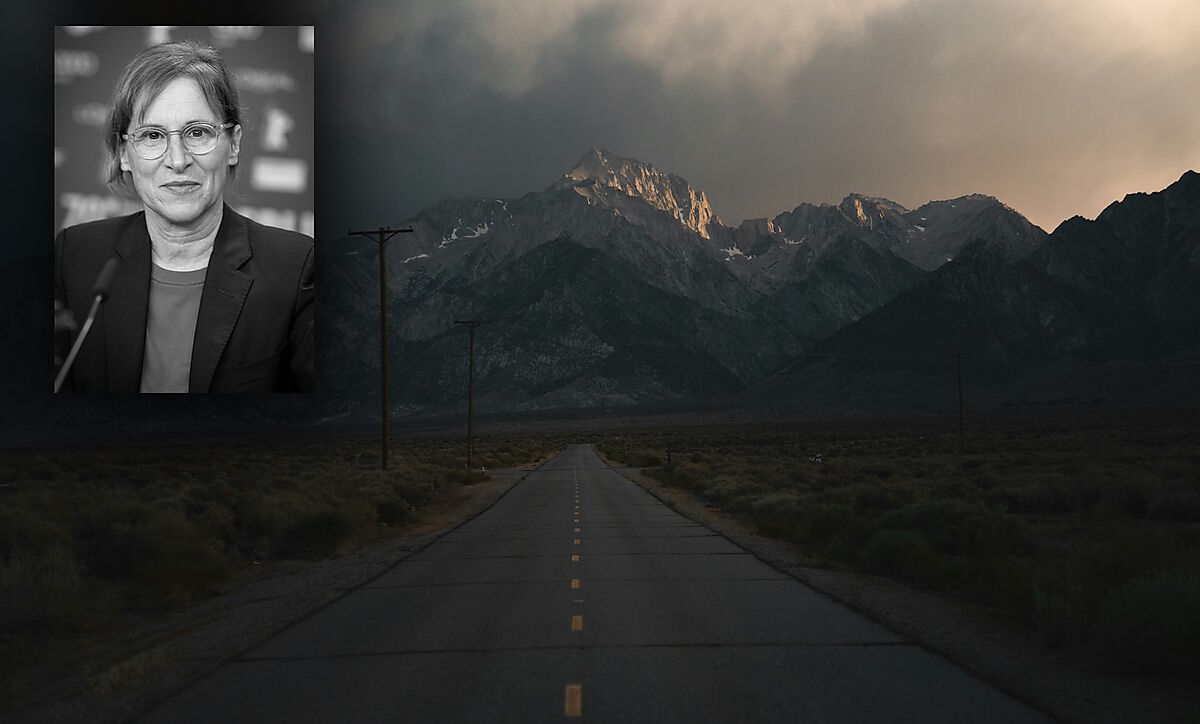
The Desolate and Kelly Reichardt (inset)
Reichardt’s ‘Certain Women’ (2016): On Slow Cinema and the Liminal Spaces of Everyday Female Experience
When American filmmaker Kelly Reichardt met Portland-based writer Jonathan Raymond through a mutual friend in the early 2000s, their collaboration marked the start of a series of acclaimed films. Reichardt, born and raised in Miami, Florida, made her directorial debut with River of Grass (1994) at age 30. Over the following decade, she found it increasingly difficult to secure funding for another full-length feature, remarking that ‘it had a lot to do with being a woman’1. Raymond’s stories, set in his home state of Oregon, offered Reichardt the landscapes she sought: the tranquil forests, endless deserts, and quiet small-town diners of the Pacific Northwest. Her first film after this long hiatus, Old Joy (2006), adapted one of Raymond’s short stories, and firmly established a key element of her aesthetic — the desolate. But her cinematic style would not be complete until she drew upon another, perhaps unexpected, influence: Italian Neorealism.
The Italian Neorealist movement (1943–52) pioneered a cinematic style defined by non-professional actors, location shooting, and low budgets; their subject: the political and economic realities of working-class life. Among its seminal works is Vittorio De Sica’s Bicycle Thieves (1948), a landmark portrayal of postwar hardship and toil among the poor.
A key element of neorealism was its treatment of cinematic time, an idea expounded most influentially by French film theorist André Bazin (1918–1958). Bazin argued that by extending time onscreen, filmmakers could draw audiences closer to the real lives they portrayed. His ideas are reflected in the neorealist commitment to capturing the slow, often uneventful rhythms of everyday life without recourse to spectacle.
In Wendy and Lucy (2008), Reichardt draws directly on the neorealist aesthetic of De Sica’s Umberto D. (1952), mirroring its portrayal of human struggle through the close bond between a human and a dog. Wendy and her dog Lucy drift through Oregon in search of work and a future in Alaska, echoing the postwar hardships depicted in De Sica’s film. Although made fifty years apart, both works remain timeless studies of labour and poverty. Reichardt’s adaptation of this tradition, however, introduces something new: a distinctly female perspective, which sets the tone for her later films.
In Reichardt’s 2016 triptych Certain Women, the lives of four Montana women intersect tenuously. Laura Wells (Laura Dern) is a frustrated lawyer whose difficult client refuses her advice, only to accept it when it is repeated by a male colleague. Reichardt’s filmmaking is immersed in a sense of place: the dreary landscapes represent not only a setting that works against its protagonists, they embody the weariness that defines their lives. Laura navigates these spaces by walking and driving across empty distances, with long silences opening up a space for contemplation.
In one scene, Laura speaks on the phone from her car, while the camera pans to her point of view: a desolate parking lot beyond the windscreen. As she remarks, ‘It’d be so lovely to think that if I were a man, I could explain the law and people would listen and say, ‘okay’,’ the stillness of the parking lot outside provides an ironic contrast to Laura’s sentiment of alienation — a visual representation of the world in which she is forced to live.
The motif of movement, set against empty spaces and long silences, continues to characterise other female experiences in Certain Women. Gina Lewis (Michelle Williams) searches for native sandstone for her family home, while her husband, who is having an affair with Laura, subtly undermines her at every turn. In an extended car sequence following a frustrating exchange, Gina confronts him, then falls silent, staring out the window at the bare Montana landscape beyond.
The composition of this sequence is fairly similar to Laura’s moment of contemplation in her own car, and Reichardt thus connects the two women through such intersecting experiences. The passing reflection of the landscape in the car’s window mirrors and doubles its emptiness, emphasising Gina’s exhaustion and isolating her within a life that continuously works against her.
Amidst a bleak backdrop of dead trees and the muted yellow-brown tones of the landscape, Gina walks along a riverbank. A close-up of her face shifts the focus from the desolate setting to her private interiority, while the slow, steady movement of the river suggests a symbolic medium of tranquillity — and the possibility of escape.
In Reichardt’s final story, silence itself becomes a shared experience, drawing together a rancher (Lily Gladstone) and a young lawyer (Kristen Stewart). Their tentative bond forms across nights at a local diner and long horseback rides, with Reichardt building intimacy not through dialogue but through empty spaces and silence. When they ride together, the rhythmic sound of hooves becomes a kind of music, carrying the weight of what remains unspoken. In this space, only the two women exist, united in their isolation.
Reichardt’s films craft narratives around everyday labour and ordinary situations, but her approach to cinematic time goes beyond social realism. Instead, she adopts an aesthetic known as Slow Cinema where the extended duration of scenes invites the viewer to look ‘longer than expected’ — an expectation as ‘controlled by society’2. While in ‘tethering value to time, labor to bodies’3 Slow Cinema draws upon the neorealist tradition, it differs crucially by focusing on the experience of time itself. This deliberate stretching of cinematic duration in Reichardt’s work disrupts how we typically consume films, forcing us, as viewers, to confront subtler realities: the liminal, internal spaces of the everyday experience that conventional storytelling might overlook.
Within Reichardt’s oeuvre, these liminal spaces subtly reveal the struggles and vulnerabilities inherent to the everyday female experience. Historically, cinema has prioritised stories of masculine heroism and conflict. Recent portrayals of women’s stories have often sought legitimacy by mirroring this paradigm. Reichardt’s approach differs intentionally. As she remarks, ‘It all just seems everything is getting faster. Faster, faster, faster — we all want things faster. I guess there is a part of me that likes the pull against that.’4
Within this celebration of femininity in contemporary cinema through visual indulgence (Sofia Coppola’s Marie Antoinette (2006)) or icons of female strength (Ripley in the Alien films), Reichardt appears to insist upon something else: the subtle, overlooked experiences of ordinary women. Her protagonists could be any woman you pass on the street, their lives unfolding in the margins, almost unnoticed.
Citations
References
- Sam Littman. "Reichardt, Kelly,". Senses of Cinema. 2014
- Karl Schoonover. "Wastrels of Time: Slow Cinema’s Laboring Body, the Political Spectator, and the Queer". Framework: The Journal of Cinema and Media. 53, no. 1. 2012. 65–78. p. 66
- Karl Schoonover. "Wastrels of Time: Slow Cinema’s Laboring Body, the Political Spectator, and the Queer". Framework: The Journal of Cinema and Media. 53, no. 1. 2012. 65–78. p. 68
- Nigel M Smith. "Kelly Reichardt: ‘Faster, faster, faster – we all want things faster". The Guardian. 2017

I was introduced to Kelly Reichardt’s filmmaking and the slow cinema movement in a film criticism module at university. Having studied Italian neorealism earlier, I was captivated by the shared slowness of both styles and a certain resignation which, in Reichardt’s case, allows for a more understated depiction of femininity in response to the pace of contemporary society. Through this article, I wanted to highlight Reichardt as an often-overlooked female auteur and examine her unique approach to writing women’s stories with subtlety and a focus on everyday emotional realities.— Mrinalini Mishra