
Qi Baishi and Xieyi Style
Qi Baishi, the Xieyi Style and the Aesthetic between Real and Imaginary

In 1902, at the age of 40 Qi Baishi leaves his home in Hunan Province, China, where he was born a peasant, to wander across the country. He studies the masters of calligraphy in Xi’An, discovers the beauty of the mountains of Guilin, encounters artists who show him traditional paintings… These experiences deeply inspire Qi Baishi to perpetuate traditional art — one that is far removed from the grandiloquent style of scholarly Chinese painters: Qi Baishi evokes the simple things in nature in a truly poetic and subjective way.
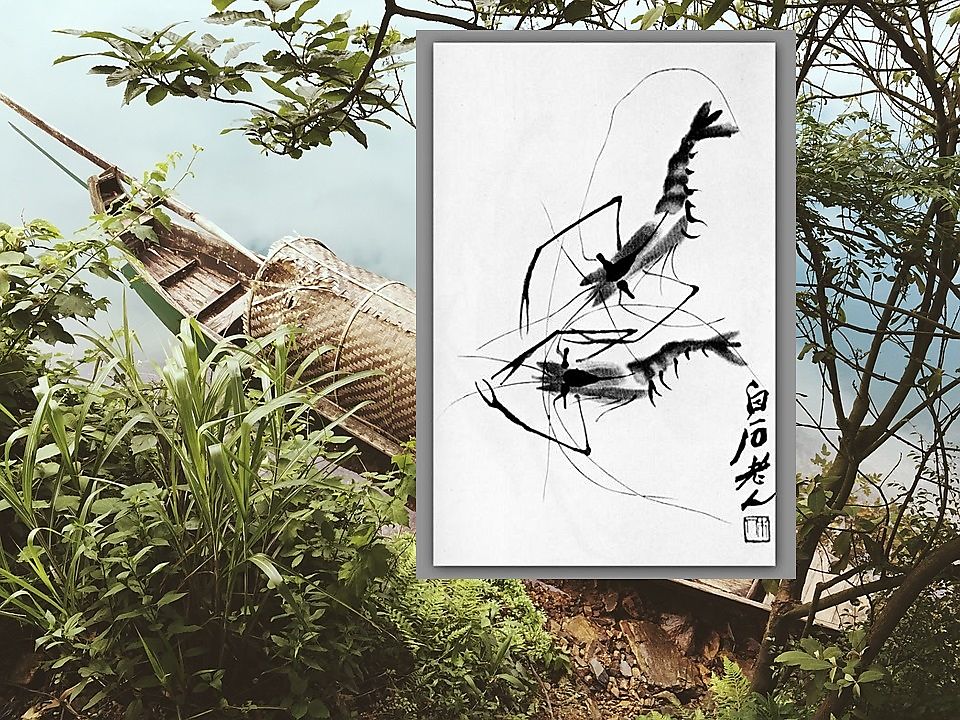
Qi Baishi quickly abandoned his technical training and strove instead for xieyi (‘sketching thoughts’), a new simplistic and expressive style where he found more freedom for his calligraphic approach to painting. Shrimp (1947) is an illustration of this subsequent transformation, reflecting his aesthetic between real and imaginary, precision and expressivity. Their translucent bodies and legs are brought to life through playful brush strokes. The crustaceans resemble Chinese characters, marked by the repetition of a conventionalised pattern.1 According to Qi Baishi, ‘The excellence of a painting lies in its being alike, yet unlike. Too much likeness flatters the vulgar taste; too much unlikeness deceives the world.’2
Qi Baishi’s xieyi style gives weight to empty space, allowing the
eye to extrapolate imaginatively. Although the execution is minimalist, the method requires deep knowledge of the subjects represented and exceptional calligraphy skills, which Qi Baishi mastered fully over his lifetime; the paintings created towards the end of his life are considered the most accomplished.