
Protestant Reformation
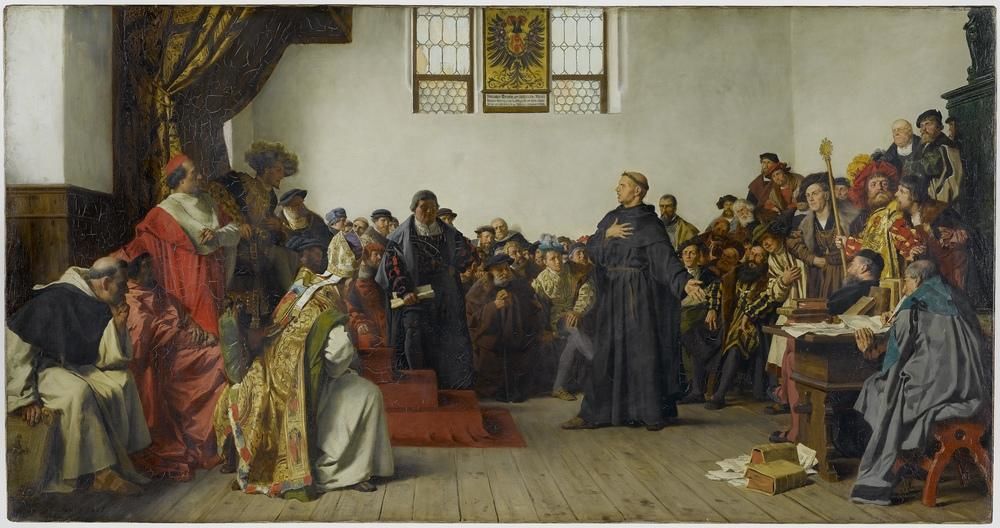
"Luther at the Diet of Worms"
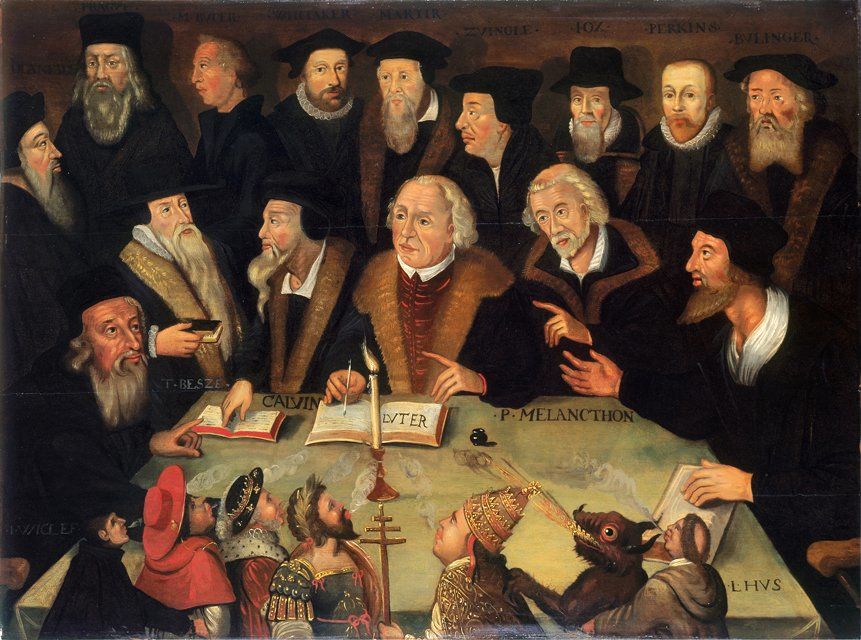
Martin Luther in the Circle of Reformers, German School, 1625-1650
The Reformation was a movement in Western Christianity in 16th-century Europe. Although the Reformation is usually considered to have started with the publication of the Ninety-five Theses by Martin Luther in 1517, there was no schism until 1521 when there was official condemnation of Luther and banning of citizens of the Holy Roman Empire from defending or propagating his ideas.
Luther began by criticising the sale of indulgences, insisting that the Pope had no authority over purgatory. The Reformation developed further to include a distinction between Law and Gospel, a complete reliance on Scripture as the only source of proper doctrine (sola scriptura) and the belief that faith in Jesus is the only way to receive God's pardon for sin (sola fide) rather than good works.
The initial movement in Germany diversified, and other reformers arose independently of Luther. The spread of Gutenberg's printing press provided the means for the rapid dissemination of religious materials in the vernacular. Leaders within the Roman Catholic Church responded with the Counter-Reformation, initiated by the Confutatio Augustana in 1530.
Northern Europe, with the exception of most of Ireland, came under the influence of Protestantism. Southern Europe remained predominantly Catholic. There were continued expulsions of Protestants in central Europe up to the 19th century.
Luther began by criticising the sale of indulgences, insisting that the Pope had no authority over purgatory. The Reformation developed further to include a distinction between Law and Gospel, a complete reliance on Scripture as the only source of proper doctrine (sola scriptura) and the belief that faith in Jesus is the only way to receive God's pardon for sin (sola fide) rather than good works.
The initial movement in Germany diversified, and other reformers arose independently of Luther. The spread of Gutenberg's printing press provided the means for the rapid dissemination of religious materials in the vernacular. Leaders within the Roman Catholic Church responded with the Counter-Reformation, initiated by the Confutatio Augustana in 1530.
Northern Europe, with the exception of most of Ireland, came under the influence of Protestantism. Southern Europe remained predominantly Catholic. There were continued expulsions of Protestants in central Europe up to the 19th century.
Reformation adapted from Wikipedia and licensed by The Cultural Me under CC BY SA 3.0