
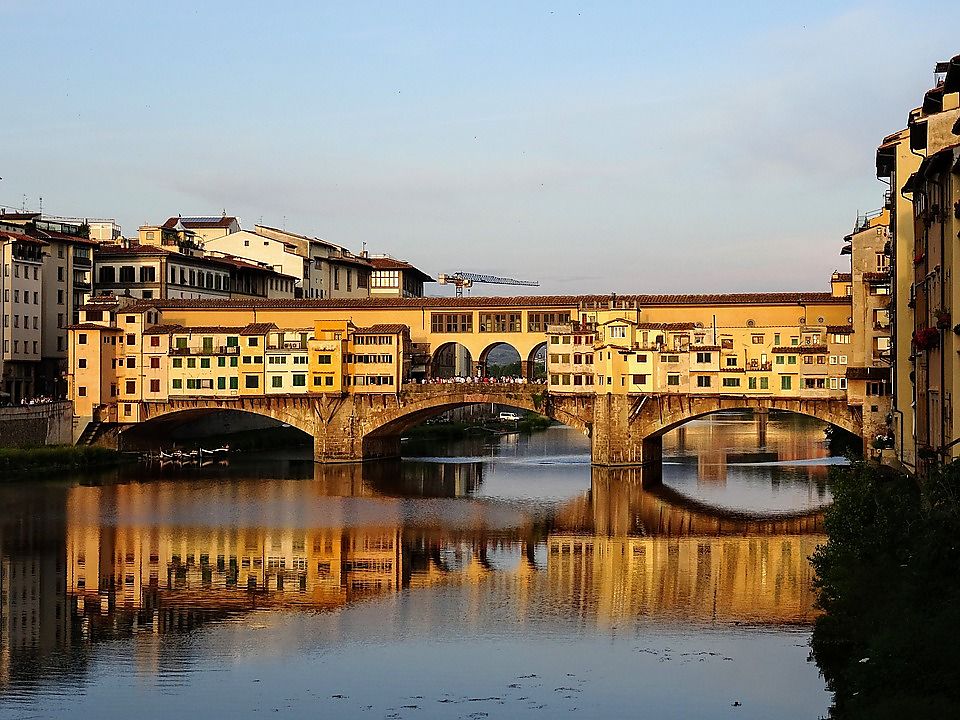
Florence Ponte Vecchio
Ponte Vecchio

The Ponte Vecchio crosses the Arno River at its narrowest point within the city walls of Florence. Since its creation 700 years ago, the bridge is a testament to the skilful craftsmanship of the middle ages. However, it has undergone some alterations along the way, including special adaptations for Adolf Hitler.
Completed in 1345 it was rebuilt following a major flood that wiped out its predecessor. Taddeo Gaddi is often credited with the design, yet there is a case to be made for Neri di Fioravanti or Fra Giovanni da Campi.
There is a lower and upper gallery, the upper known as the Vasari Corridor. This passage was used solely by the Medici Family so that they could avoid the bustling street that had sprung up below. In an attempt to recover construction costs, the government rented out 46 shops on the lower gallery.
The shops were later sold and, without strict governance, traders began to alter the structure, building upwards and backwards over the river. The appearance of the bridge was altered again in 1938 by Benito Mussolini, for Adolf Hitler. Mussolini wanted his guest to enjoy a good view of Florence during his visit; the central windows in the upper corridor were replaced with a large viewing gallery.
The Nazis occupied Florence for a year during WWII. During their retreat in 1944, they destroyed all of the bridges crossing the Arno River, except one: the Ponte Vecchio was the only one to survive.
Completed in 1345 it was rebuilt following a major flood that wiped out its predecessor. Taddeo Gaddi is often credited with the design, yet there is a case to be made for Neri di Fioravanti or Fra Giovanni da Campi.
There is a lower and upper gallery, the upper known as the Vasari Corridor. This passage was used solely by the Medici Family so that they could avoid the bustling street that had sprung up below. In an attempt to recover construction costs, the government rented out 46 shops on the lower gallery.
The shops were later sold and, without strict governance, traders began to alter the structure, building upwards and backwards over the river. The appearance of the bridge was altered again in 1938 by Benito Mussolini, for Adolf Hitler. Mussolini wanted his guest to enjoy a good view of Florence during his visit; the central windows in the upper corridor were replaced with a large viewing gallery.
The Nazis occupied Florence for a year during WWII. During their retreat in 1944, they destroyed all of the bridges crossing the Arno River, except one: the Ponte Vecchio was the only one to survive.