
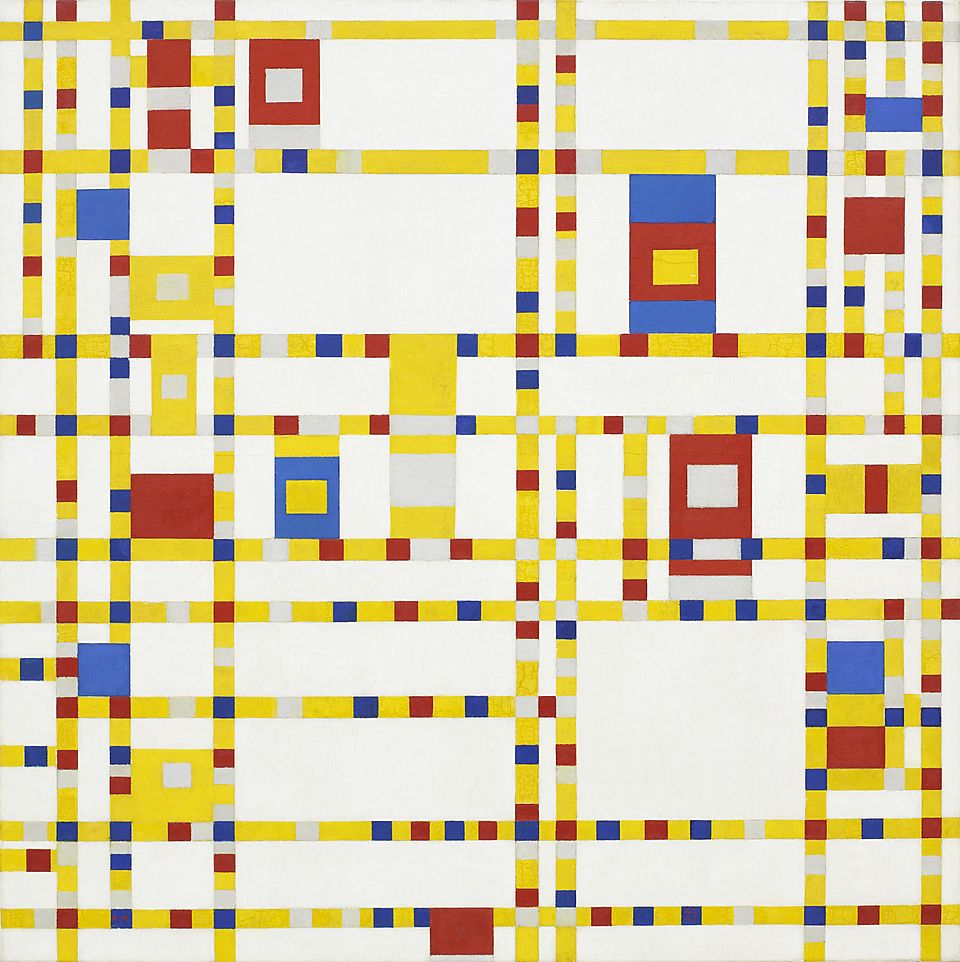
Broadway Boogie Woogie 1942
Piet Mondrian and the Colour of Dance

In 1938, at the age of 65, Piet Mondrian left his beloved Paris for London, fearful of developments in Nazi Germany. Two of Mondrian's paintings had been included in Hitler’s Degenerate Art (Entartete Kunst) exhibition of 1937: an attempt to ridicule and disempower modernist art, considered divisive by the Führer. It would have been a sad parting for Mondrian as Paris had served as his home and inspiration since 1919. He was enthralled by its popular culture; its dynamism and spirit. He loved to dance and was captivated by the energy of its contemporary jazz music and dance culture.
In 1940 Mondrian moved on from London to New York. He was once again entranced by his surroundings. The city’s vitality, its vibrancy and verve precipitated a step change in Mondrian’s work: the bold, straight black lines and interconnecting primary coloured rectangles on white and grey backgrounds, which had become his trademark during the Paris years, began to evolve.
Fascinated by the syncopated rhythms of the 1940s New York nightlife, Mondrian developed a lively, colourful, rhythmic style, exemplified by Broadway Boogie Woogie (1942-43), his last completed work before his death in 1944.
Mondrian valued the close parallels between the art forms embodied within dance and painting, seeking to capture not only the structured patterns and skilful balance of dance, but also the inherent aspect of free expression. Mondrian also valued his environment: in fleeing those who sought to obstruct his creativity, he found the inspiration for it to thrive.
In 1940 Mondrian moved on from London to New York. He was once again entranced by his surroundings. The city’s vitality, its vibrancy and verve precipitated a step change in Mondrian’s work: the bold, straight black lines and interconnecting primary coloured rectangles on white and grey backgrounds, which had become his trademark during the Paris years, began to evolve.
Fascinated by the syncopated rhythms of the 1940s New York nightlife, Mondrian developed a lively, colourful, rhythmic style, exemplified by Broadway Boogie Woogie (1942-43), his last completed work before his death in 1944.
Mondrian valued the close parallels between the art forms embodied within dance and painting, seeking to capture not only the structured patterns and skilful balance of dance, but also the inherent aspect of free expression. Mondrian also valued his environment: in fleeing those who sought to obstruct his creativity, he found the inspiration for it to thrive.