
Les Démolisseur
Paul Signac’s Anarchist Art: Les Demolisseurs

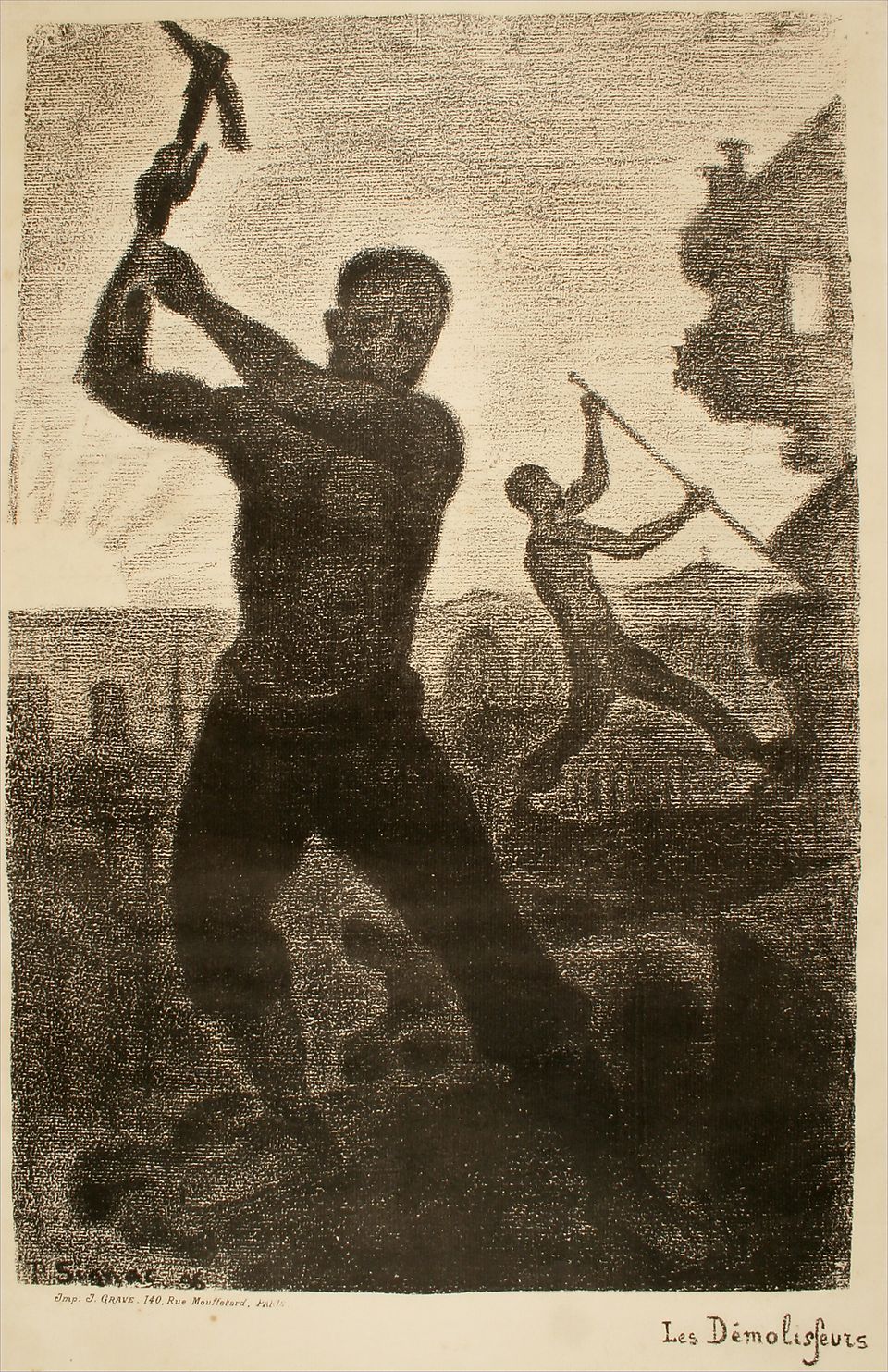
Paul Signac worked actively over his lifetime to spread his anarchist ideas. One of his illustrations for the anarchist cause, Les Demolisseurs, appeared in the journal Temps Nouveaux in October 1896. The painting shows two labourers knocking down a building using an axe and a crowbar. The demolition of a stone city building through the hard work of a working-class member indicated the virtuous victory of the proletariat over the bourgeoisie.
This iconographical tradition probably originated from Courbet and his painting The Stone Breakers (1849), which iconises the worker as a symbol of hard work, in contrast to the fat and indolent bourgeoisie who benefits from the former’s toil. As for the title of Signac’s artwork The Demolishers, there is the suggestion that the two protagonists are tearing the building apart, as if they were tearing apart the “old, useless structure of the State”1.
Other artists like Pissarro, Steinlen and Luce also produced radical anarchist pieces at the time, alongside other more modest artists like Seurat, who conveyed his message in more subtle ways.
However, Signac remained a leading figure of anarchist art, with many works that brought the awakening of the proletariat to the attention of Parisian society, within the spirit of hope for a better world.
This iconographical tradition probably originated from Courbet and his painting The Stone Breakers (1849), which iconises the worker as a symbol of hard work, in contrast to the fat and indolent bourgeoisie who benefits from the former’s toil. As for the title of Signac’s artwork The Demolishers, there is the suggestion that the two protagonists are tearing the building apart, as if they were tearing apart the “old, useless structure of the State”1.
Other artists like Pissarro, Steinlen and Luce also produced radical anarchist pieces at the time, alongside other more modest artists like Seurat, who conveyed his message in more subtle ways.
However, Signac remained a leading figure of anarchist art, with many works that brought the awakening of the proletariat to the attention of Parisian society, within the spirit of hope for a better world.