
Partition of Bengal (1905)
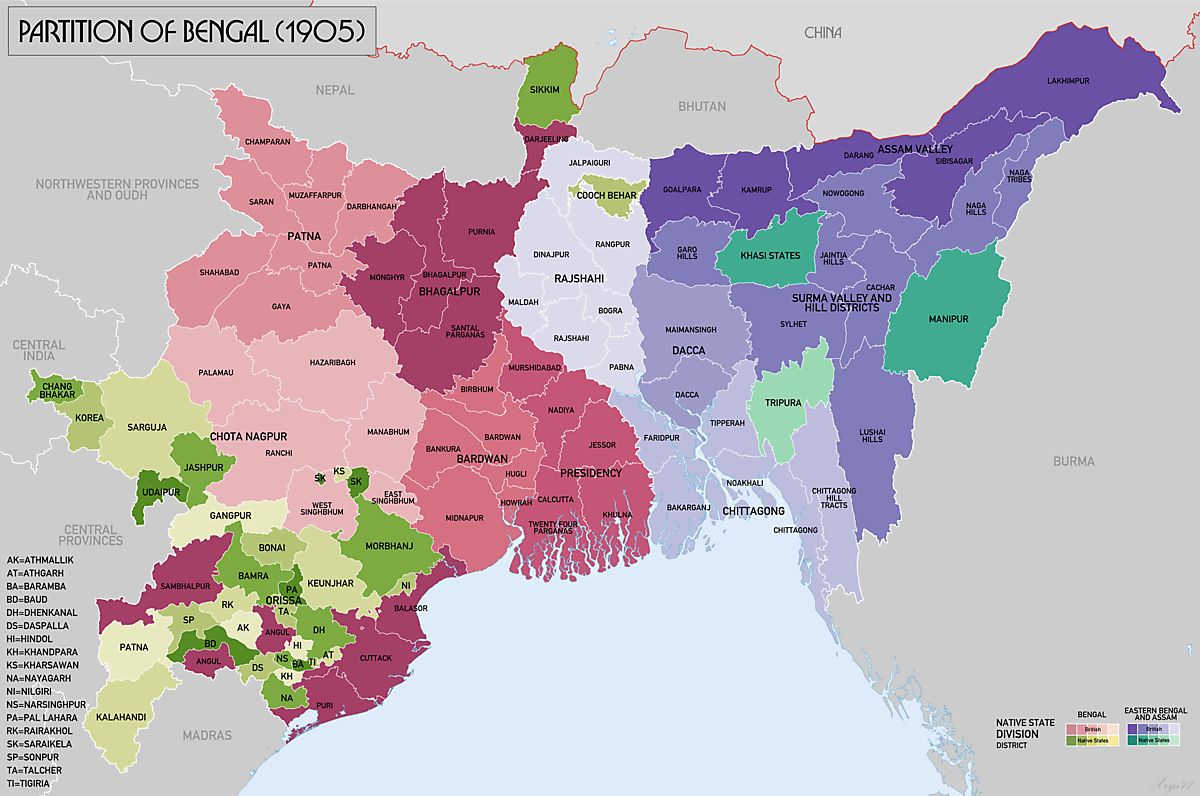
BengalPartition1905 Map
The decision to effect the Partition of Bengal was announced on 19 July 1905 by George Curzon, Viceroy of India (1899–1905). The partition took place on 16 October 1905 and separated the largely Muslim eastern areas from the largely Hindu western areas.
The Hindus of West Bengal, who dominated Bengal’s businesses, complained that the division would make them a minority in their own province. They were outraged at what they saw as a ‘divide and rule’ policy, even though Curzon stressed it would produce administrative efficiency.
The partition also animated the Muslims into forming their own national organisation along communal lines.
The partition gave rise to the Swadeshi movement. The movement brought economic pressure on the government, initially by boycotting British goods, then later through a policy of non-cooperation. The protests arose amidst a growing belief among Hindus that East Bengal would gain further independence with its own courts and policies.
Following the protests, Bengal was reunited in 1911 by Lord Hardinge (Viceroy 1910–1916).
In 1947, Bengal was partitioned for the second time, solely on religious grounds, as part of the Partition of India following the formation of the nations India and Pakistan. In 1955, East Bengal became East Pakistan, and in 1971 became the independent state of Bangladesh.
The Hindus of West Bengal, who dominated Bengal’s businesses, complained that the division would make them a minority in their own province. They were outraged at what they saw as a ‘divide and rule’ policy, even though Curzon stressed it would produce administrative efficiency.
The partition also animated the Muslims into forming their own national organisation along communal lines.
The partition gave rise to the Swadeshi movement. The movement brought economic pressure on the government, initially by boycotting British goods, then later through a policy of non-cooperation. The protests arose amidst a growing belief among Hindus that East Bengal would gain further independence with its own courts and policies.
Following the protests, Bengal was reunited in 1911 by Lord Hardinge (Viceroy 1910–1916).
In 1947, Bengal was partitioned for the second time, solely on religious grounds, as part of the Partition of India following the formation of the nations India and Pakistan. In 1955, East Bengal became East Pakistan, and in 1971 became the independent state of Bangladesh.
Partition of Bengal (1905) adapted from Wikipedia and licensed by The Cultural Me under CC BY SA 3.0