
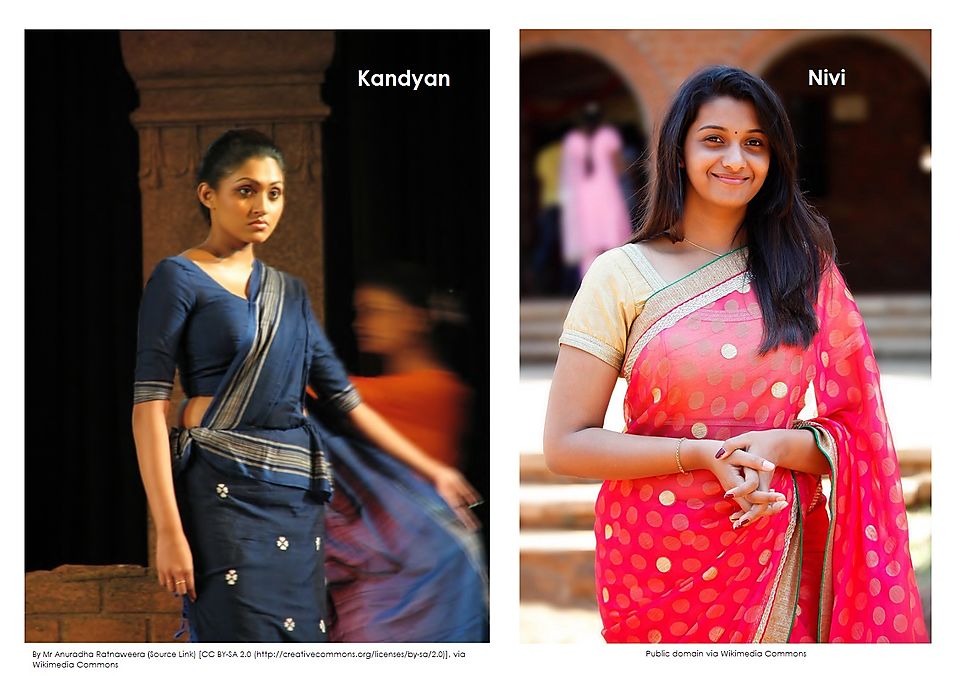
Contrasting the Kandyan and Nivi Saris
Osariya — The Kandyan Sari

Women of Sinhalese ethnicity (the majority ethnic group in Sri Lanka) drape their saris in a distinctive manner that sets them apart from the minority Tamil and Muslim groups. While this is common knowledge to Sri Lankans, it takes a trained eye to spot the difference.
The special sari is called osariya in Sinhalese or the ‘Kandyan’ by English speakers, as the style arises from Kandy, a traditionally conservative city located in the central hills.
The distinctive feature of the Kandyan sari is the frill along the midriff. In the more common Nivi style, shown on the right above, the loose-end of the sari (or pallu) is draped across the body thereby covering the midriff.
In addition, it is also common for the blouse worn with the Kandyan sari to have more elaborate puffed sleeves, as in the picture below.

Sinhalese women normally only wear the Kandyan to formal occasions, such as weddings, or to patriotic or religious festivities. However, Sinhalese women in certain traditional professions, such as teaching, and public facing roles, such as newscasting, may also wear the Kandyan to work; the Nivi is worn at all other times. Tamil and Muslim women also distinguish themselves through other means, for instance by wearing a headscarf or a pottu (bindi), but the sari in their case is always draped in the Nivi style.
As the Kandyan is only ever worn by the Sinhalese, it serves as a striking visible identity of their culture.
The special sari is called osariya in Sinhalese or the ‘Kandyan’ by English speakers, as the style arises from Kandy, a traditionally conservative city located in the central hills.
The distinctive feature of the Kandyan sari is the frill along the midriff. In the more common Nivi style, shown on the right above, the loose-end of the sari (or pallu) is draped across the body thereby covering the midriff.
In addition, it is also common for the blouse worn with the Kandyan sari to have more elaborate puffed sleeves, as in the picture below.
-2.jpg)
Sinhalese women normally only wear the Kandyan to formal occasions, such as weddings, or to patriotic or religious festivities. However, Sinhalese women in certain traditional professions, such as teaching, and public facing roles, such as newscasting, may also wear the Kandyan to work; the Nivi is worn at all other times. Tamil and Muslim women also distinguish themselves through other means, for instance by wearing a headscarf or a pottu (bindi), but the sari in their case is always draped in the Nivi style.
As the Kandyan is only ever worn by the Sinhalese, it serves as a striking visible identity of their culture.