
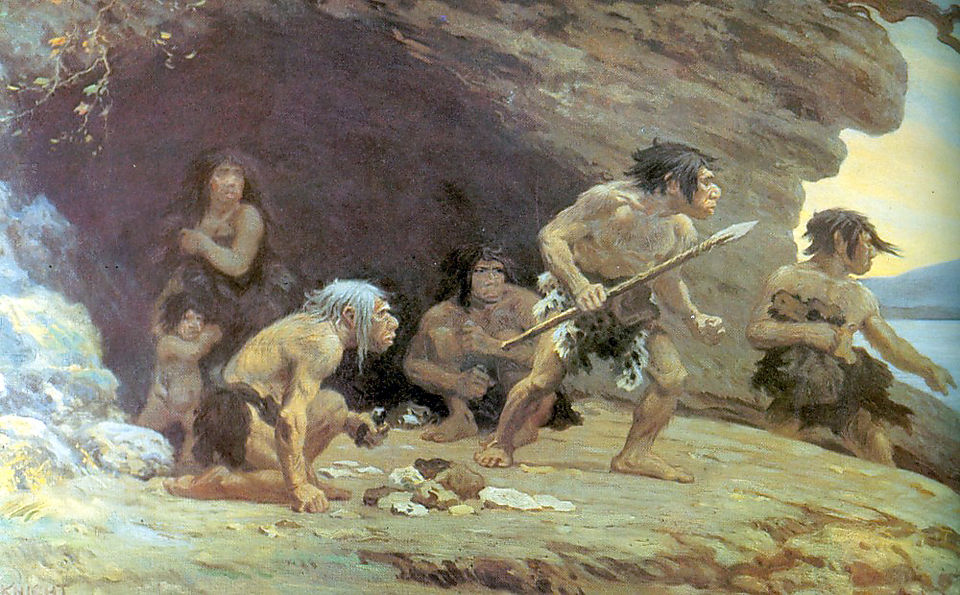
Le Moustier Neanderthals, AMNH
Neanderthals - the Unexpected Artists

The very word ‘Neanderthal’ has connotations of unintelligence – an association that could change in light of new research. Cave art recently discovered in Spain predates the arrival of modern humans in Europe by 20 thousand years.
Neanderthals were given credit for human symbolism through body adornment using mineral pigments, shell beads, eagle talons and feathers but not the more refined artistic expression of cave and rock art that is attributed to modern humans.
However, recent research paints Neanderthals in a new light1. New techniques in U-Th dating uses the outermost layer of the cave art to provide a minimum age. This method was used in three Spanish caves: La Pasiega, Maltravieso and Ardales, where animals, hand stencils, dots and geometric shapes are painted on the walls. For all three sites, the cave art was determined to be at least 64 thousand years old. Thus substantially predating the arrival of modern humans in Europe, who are estimated to have arrived between 45-40 thousand years ago.
The results are the first of their kind; as research continues it is expected that the gap between modern humans and Neanderthals will continue to narrow.
Neanderthals were given credit for human symbolism through body adornment using mineral pigments, shell beads, eagle talons and feathers but not the more refined artistic expression of cave and rock art that is attributed to modern humans.
However, recent research paints Neanderthals in a new light1. New techniques in U-Th dating uses the outermost layer of the cave art to provide a minimum age. This method was used in three Spanish caves: La Pasiega, Maltravieso and Ardales, where animals, hand stencils, dots and geometric shapes are painted on the walls. For all three sites, the cave art was determined to be at least 64 thousand years old. Thus substantially predating the arrival of modern humans in Europe, who are estimated to have arrived between 45-40 thousand years ago.
The results are the first of their kind; as research continues it is expected that the gap between modern humans and Neanderthals will continue to narrow.