
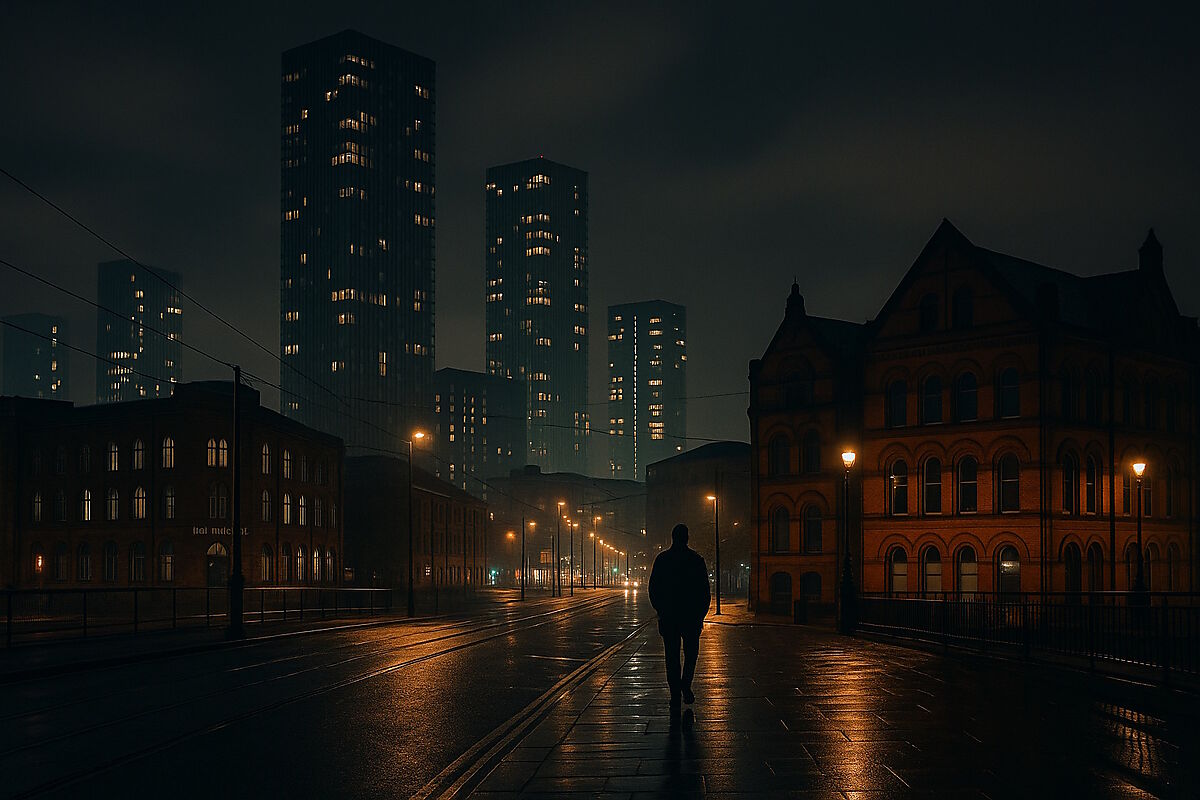
The Political City
Navigating the Political City: Psychogeography, Regeneration, and Urban Memory — A Case Study of Manchester
In his literary sketch Night Walks (1860), Charles Dickens writes about his nighttime wanderings through London, describing his encounters with drunkards, ‘the interminable tangle of streets’ and ‘the children who prowl’, vividly capturing the nocturnal atmosphere of Victorian England.1 Similarly, three years later, Charles Baudelaire in The Painter of Modern Life and Other Essays (1863) wrote about the flâneur — an urban wanderer, a man who acts as ‘passionate spectator and marvels at the eternal beauty and the amazing harmony of life in capital cities’.2 Dickens and Baudelaire’s urban writing are precursors to what is now known as psychogeography.
The term psychogeography emerged in the mid-20th century through groups such as the Lettrist International and the Situationist International — both collectives of radical left-wing intellectuals and artists. Guy Debord (1931–94), a French Marxist theorist and philosopher, defined the term as ‘the study of the precise laws and specific effects of the geographical environment, consciously organized or not, on the emotions and behaviour of individuals.’3 Thus, according to Debord, urban spaces are capable of producing distinct emotional and behavioural responses, depending on how they are organised.
One can certainly argue that rambling through an abandoned industrial quarter evokes feelings that are different to wandering through London’s Oxford Street on a Saturday afternoon. Similarly, meandering through the granite-tinted streets of Aberdeen colours your mood differently to ambling through Manchester’s Oxford Road during freshers week.
Manchester, a city in northern England, emerged in the 19th century as a global hub for cotton production, earning it the sobriquet ‘Cottonpolis’. At the time, large-scale migration into the city led to ‘haphazard’ urban expansion.4 Manchester's industrial dominance began to decline during the interwar years (1918–39), partly due to increasing international competition from countries such as India and Japan. At this critical juncture, the city shifted its economic focus towards the service sector. By the late 20th century, Manchester faced the challenges typical of many post-industrial urban centres: economic stagnation, underinvestment, and a decaying cityscape.
In a pivotal moment in 1996 an IRA bomb exploded in the city centre’s Corporation Street. The explosion ravaged through ‘over one million square feet of commercial and retail space’.5 The bombing, arguably, was the catalyst for the city’s rapid transformation into the 21st century. Between the 2011 and 2021 censuses, the population of Manchester increased by nearly 10%, reaching 551,900, and over the last thirty years it ‘has grown faster than other major English cities’.6 Glass-skinned skyscrapers glitter along the skyline, now home to offices, hotels, and high-rise apartments. These high-rise developments have been funded through a combination of private investment and public initiatives, including the £300m Greater Manchester Housing Investment Fund launched by Chancellor George Osborne in 2014 — an economic lever that helped unlock projects that might otherwise have stalled. The fashionably redeveloped city has gained a new memorable nickname: ‘Manchattan’.
The regeneration has also stretched out to the suburbs. In the former mill town of Stockport, there is a symbolic contrast between the Hat Museum (industrial-era mill and warehouse) and the new 15-storey block of apartments purpose-built for renting.
Urban regeneration, however, can lead to tensions. In 2024 a fundraiser was held at Platts Field Community Garden to raise funds to take Manchester City Council to court after it approved a block of luxury student accommodation in Hulme. Local Labour Councillor, David Meller recently raised concerns about the ‘pitfalls of gentrification,’7 specifically addressing the unaffordability of Stockport apartments. However, gentrification is enabled by political decisions — such as planning approvals and public-private investment strategies — that influence which kinds of development occur and where.
Urban regeneration also alters how pedestrians navigate and experience the city. At the street level, modifications to elements such as the location of pavements, zebra crossings, pelican lights, underpasses, bridges, signage, and anti-homeless devices, collaborate to subtly regulate public behaviour.
Urban space, therefore, is inherently political. Decisions made by public and private urban power structures with social, economic, and political interests shape topography and infrastructure. These power structures typically include city planners, architects, local councils, and government departments. Urban regeneration in post-industrial cities often causes the erasure of the city’s heritage. This has several socio-political implications: the erosion of community identity, the displacement effects of gentrification, and the spread of homogenised urban space.
Psychogeography offers a critical lens through which to examine urban space and the transformations it undergoes. Psychogeographers navigate the city on their own terms, prioritising getting lost, exploring, and drifting as key modes of engagement. Practitioners resist urban order through subtle acts of subversion: taking unofficial shortcuts, detouring from prescribed routes, and venturing into off-limits areas (legally). In cultural theory, these can be understood as ‘tactics’ — ‘victories of the ‘weak’’ and ‘clever tricks’ that seek to reverse the lopsided power dynamic between city authorities and the pedestrian.8
The psychogeographer, while navigating the city, perceives within it its remnants or hauntings — the traces of past lives and lost structures.9 Dickens laments ‘the good old times’, poetically capturing instances of temporal fluidity in his nocturnal journeys through the dark heart of London. In this sense, a post-industrial city such as Manchester can be understood as a kind of palimpsest (a surface on which new layers are inscribed without fully erasing what came before).10 These historical layers provide access to the emotional undercurrents of urban space — the memories embedded in its architecture, streets, and symbols.
On Corporation Street today, under the bridge that links the Arndale Centre to the Selfridges department store, stands an unremarkable post box. Closer inspection reveals a brass plaque beneath with an inscription that reads, ‘This postbox remained standing almost undamaged on June 15th 1996[…]’ That is the hidden truth of urban regeneration: look closely and the past still lingers.
References
- Dickens, Charles. Night Walks. 1860; repr. London: Penguin Classics. 2010. pp. 10, 16, 27
- Baudelaire, Charles. The Painter of Modern Life and Other Essays. c. 1863; repr. London: Da Capo Press. 1986. pp. 9, 11
- Guy Debord. "Introduction to a Critique of Urban Geography". bopsecrets.org</em><em>. 1955
- Hendrickson, K.E.. The Encyclopedia of the Industrial Revolution in World History. Lanham: Rowman & Littlefield. 2015. p. 589
- Reed, P., Groundswell:. Constructing the Contemporary Landscape. New York: Museum of Modern Art. 2005. p. 40
- Greater Manchester Combined Authority. "Census 2021 Briefing". Greater Manchester Combined Authority. 2023
- David Carey. "The booming Greater Manchester town where locals are being priced out". Manchester Evening News. 2024
- Certeau, Michel de, Luce Giard, and Pierre Mayol. The Practice of Everyday Life. Berkeley: CA: University of California Press. 2002. p. Xix
- Dickens, Charles. Night Walks. 1860; repr. London: Penguin Classics. 2010. pp. 10, 16, 27
- Jeffrey A. Kroessler. "The City as Palimpsest". CUNY Academic Works. 2015

I first heard about psychogeography in a crowded seminar room during my second year at university. Until then I had never thought that walking could be disruptive, radical or even a reflective act. In this article I combine walking with my interest in urban environments, particularly Manchester–a city with an important history and a changing landscape.— Sahil Gufar