
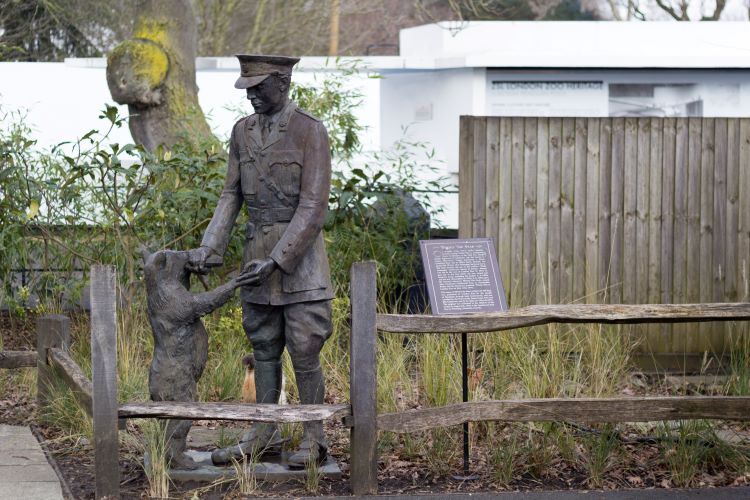
Harry Colebourn and Winnie the Bear Sculpture
National Winnie The Pooh Day 2024

January 18th 2024
Deep in the 100 Acre Wood, you can be sure Winnie the Pooh is celebrating his special day today with friends and an extra pot of honey.
He may be interested to learn about some very special cousins of his, and how marvelous bears just like him have inspired astronomers, kings, queens, poets, and billions of children all over the world…but then again, he might find it all too bothersome for a bear of little brain.
Ten Fascinating Facts About Bears
1. The animal adjective for bear is ‘ursine'...
2. ...which is where we derive the names of the two constellations in the northern sky: Ursa Major and Ursa Minor.
3. Britain was home to bears as far back as 7,000 years ago, and now they're back!
Bristol Zoo has reintroduced European brown bears, European grey wolves, Eurasian lynxes, and wolverines into 7.5 acres of ancient woodland creating an exciting glimpse into Britain's wild past.
Bristol Zoological Society is a conservation and education charity, which runs and operates Bristol Zoo Project.
bristolzoo.org.uk4. The original gang of Pooh and his other stuffed toy companions, Tigger, Kanga, Piglet, and Eeyore, are on display at the New York Public Library. Some say their bedraggled appearance can be attributed to the family dog!
Since 1987, Pooh and four of his best friends—Eeyore, Piglet, Kanga, and Tigger—have been living at The New York Public Library.
The New York Public Library5. ‘Bear Grease’ was thought to be a cure for male pattern baldness from around the 1600s up to the 20th century. It was made of the fat of the brown bear and it was developed with the reasoning that as bears are very hairy it should help human hair grow.
6. A grizzly bear by the name of Old Martin lived in the Tower of London after he was presented to King George III by the Canadian Hudson Bay Company in 1811. Old Martin lived in the Royal Menagerie alongside other exotic species such as lions, monkeys, an elephant, and a polar bear who fished in the River Thames.
7. in 1805, the eccentric poet, Lord Byron, was so cross to learn that cats and dogs were not permitted in Cambridge University colleges that he went straight out and bought a tame bear. As no rules existed forbidding bears as pets he was allowed to keep it.
8. On Christmas Eve in 1956, author Michael Bond felt sorry for a lonely bear in a shop at Paddington train station and bought it as a present for his wife. He wrote his first book in only ten days and the tag around Paddington's neck saying 'Please look after this bear' was inspired by the refugee children and evacuees he saw during WWII.
9. In 1902 a tiny black bear cub unwittingly started a cultural phenomenon when President Roosevelt refused to shoot it on a hunting trip, saying that he would never be able to look his children in the eyes if he did. Inspired by the story that was soon broadcast in the papers, a toy shop in New York created a stuffed bear and named it 'Teddy' after the president.
10. During WW1, Canadian Lieutenant Harry Colebourn, a trained veterinarian, rescued a bear cub whose mother had been shot. He paid $20 for the black bear and named her Winnipeg, after his hometown.
Shortly after, Lieutenant Colebourn brought ‘Winnie’ to the UK.
When the troops went to the front line in France Lieutenant Colebourn left Winnie temporarily in the care of London Zoo, visiting her whenever he was on leave however, the war lasted so long that he decided the zoo should become her forever home.
Winnie was so friendly the staff let children into her enclosure to play and ride on her back.
One day she met a boy called Christopher Robin who fell so in love he renamed his favourite stuffed bear Edward after her.

Winnie the Pooh was inspired by one of our most famous residents, a black bear called Winnie taken in when her mother was killed by a hunter and she has an enduring influence on pop culture today.
www.londonzoo.org