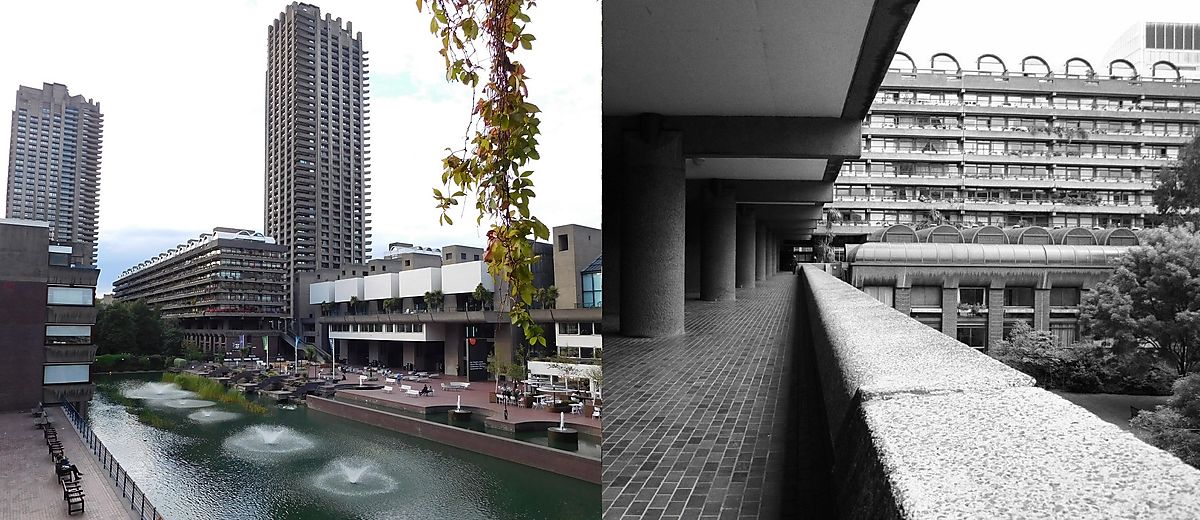
The Barbican Estate (1965-76) has been voted the least favourite building on London’s skyline.1 Constructed on a site left empty by WW2 bombing, the name Barbican itself pays homage to an earlier Roman fort found on the site.
The challenge was to provide attractive, high-quality residential accommodation in an otherwise commercial area. The modernist architects Chamberlin, Powell and Bon, who had completed an estate nearby, were awarded the contract. They were inspired by the work of Le Corbusier, especially his Brutalist housing project Unité d'Habitation (1952) in Marseilles. This influence is evident in the estate’s three high-rise towers, the raised pedestrian podium on which the building stands; and also through the incorporation of schools, restaurants and cultural venues, forming a vibrant and cohesive neighbourhood.
The Barbican follows the principles of modern architecture while at the same time acknowledging the past. The crenelated walls and arrow slits of medieval castles reference the early history of the site. Like a modern-day equivalent, the estate is screened from the outside world and enhanced with landscaped gardens and lakes. A network of bridges and walkways, inspired by the canals and car-free pathways of Venice, guide the resident or visitor through the estate.2
The attention to detail, from the distinctive tooled-concrete finish of the facades to the custom-designed plant boxes, sets the Barbican apart from the rest of London’s post-war housing estates. Of momentous size and scale, designed to reinvent modern city living, the Barbican estate stands as a monument to beautiful Brutalist architecture.
Most Brutalist buildings are considered “ugly”. If people knew more about the history of the buildings, the style and the architects, they would look at Brutalist buildings in a different light. I want the reader to learn more about one of London’s best examples of Brutalist architecture and to see that the Barbican is not brutal, but beautiful.