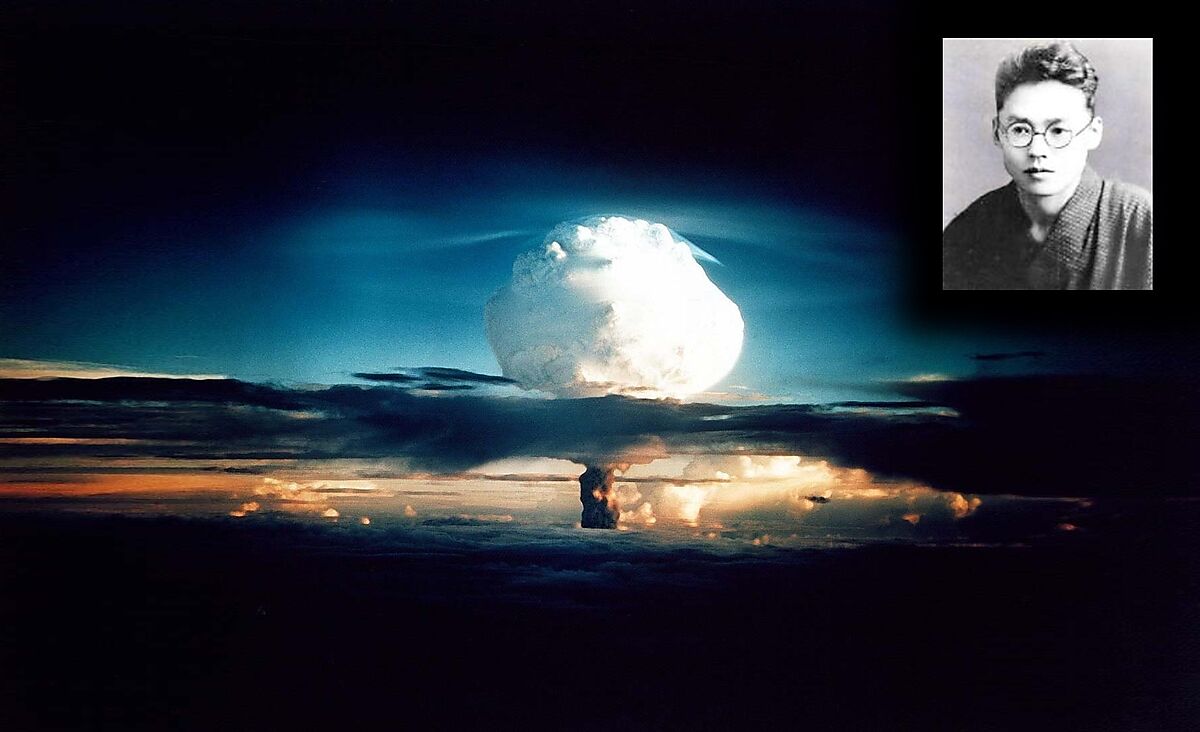
This work, ‘Hydrogen Bomb & Masuji Ibuse (inset)’, is a derivative of ‘Hydrogen Bomb’, ‘Masuji Ibuse’ used under CC BY. ‘Hydrogen Bomb & Masuji Ibuse (inset)’ is licensed under CC BY SA 4.0 by The Cultural Me
Masuji Ibuse’s ‘Black Rain’ (1965) and Atomic Bomb Trauma in Postwar Japan
On a clear morning in the summer of 1945, the young novelist Masuji Ibuse learnt that an atomic bomb had destroyed the capital of his home province, Hiroshima. Twenty years later, Ibuse published Kuroi Ame (Black Rain), a novel based on the journal entries of survivors.
In Black Rain, Shizuma Shigematsu and his wife seek to resolve a troubled marriage proposal for their niece Yasuko. All three are hibakusha (atomic bomb survivors); Yasuko is also suspected to be tainted by the soot-filled, radioactive ‘black rain’ that was said to fall in the days following the bombing. Shizuma attempts to piece together a journal of Yasuko’s whereabouts to prove her purity. However, he too suffers from flashbacks ‘There was a moment when the living room vanished and I saw a great, mushroom-shaped cloud rising into a blue sky. I saw it quite distinctly.’
Shizuma’s repressed trauma is a microcosm of wider experiences in postwar Japan. Although depression and suicide increased, the subsequent Allied occupation (1945–1952) prevented discussion.1 After liberation, Japan’s postwar state, with its focus on technologisation and economic growth, discouraged dwelling on the defeat.2
Black Rain helped Japanese society process ongoing trauma from the bombing.3 The novel became a mainstay of what became known as genbaku bungaku (atomic bomb literature), building upon earlier attempts by writers such as Yōko Ōta and Tamiki Hara.4
From the 1960s, because of Black Rain, there was also greater awareness of the plight of hibakusha, although many had already died in the previous decade, often isolated and ignored.
Ibuse received Japan’s most distinguished cultural awards, the Order of Cultural Merit and Noma Bungei Prize, for his contribution to literature.
Haruhiro Fukui. ‘Postwar Politics 1945-1973’, in The Cambridge History of Japan, Vol. 6.. Cambridge: Cambridge University Press. 2008. 154
John Dower. ‘Peace and Democracy in Two Systems’ in Andrew Gordon (ed.), Postwar Japan as History. Berkeley: University of California Press. 1993. 28
John Whittier Treat. Writing Ground Zero. Chicago: University of Chicago Press. 1995. 279
Reiko Tachibana. Narrative as Counter-Memory: A Half-Century of Postwar Writing in Germany and Japan. Albany: State University of New York Press. 1998. 164
Dido Gompertz
London, UK
I came across Masuji Ibuse’s novel when researching my dissertation on postwar Japanese film and literature. I was drawn to Kuroi Ame as a testament to the impact of generational trauma, which can affect the national psyche 20 years later or more. I am also interested in placing the work within a broader narrative, where previous attempts to bear witness by writers, including Yōko Ōta and Tamiki Hara, were overlooked.