
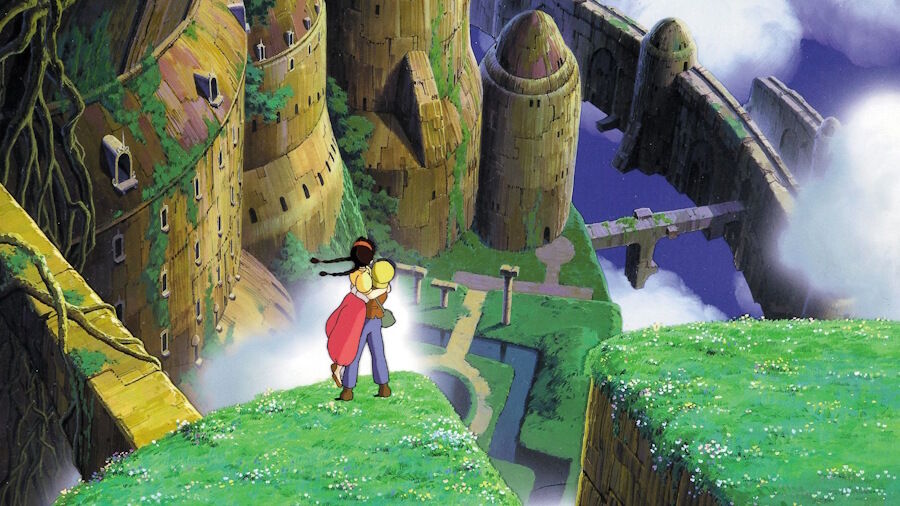
Still from Laputa: Castle in the Sky (1986)
Lieu de Mémoire: Miyazaki’s ‘Laputa: Castle in the Sky’ (1986) and the Welsh Miners’ Strike
Laputa: Castle in the Sky (1986) tells the story of an orphaned boy named Pazu, who works as a young mechanic in a mining town where the mines are beginning to run dry. One fateful night, he rescues a young girl called Sheeta who appears mysteriously floating down from the sky. She is fleeing from both sky pirates and government agents in pursuit of Sheeta’s crystal amulet, which is said to lead to the location of Laputa, a legendary castle floating in the sky.
Two years before the film’s release, director Hayao Miyazaki travelled to Wales in search of inspiration for Laputa. Miyazaki was working on the first production for Studio Ghibli, an animation studio he cofounded in June 1985. Having already directed two films and gained recognition for his environmental and anti-war themes, Miyazaki expressed a wish to return to a simpler form: an adventure fantasy for children.1
When Miyazaki arrived in Wales, the 1984–85 Miners’ Strike was at its height across the United Kingdom. This was a major confrontation between the industrial working classes and Margaret Thatcher’s Conservative government, which sought to close unprofitable collieries and curb the power of trade unions. In Wales, mining was the largest source of employment, and entire communities (particularly in places such as the Rhondda Valley and Merthyr Tydfil) had built their economic and cultural identity around the industry.
Miners across the country protested the closures, sometimes resorting to violent clashes with police, leading to arrests and imprisonment. The strikes ultimately failed, and most of the contentious mines were closed. In North and South Wales, between 22,000 and 25,000 people were left unemployed. Many families were forced to relocate, and as they left, local businesses folded. The result was economic decline and the erosion of entire communities.2
Under Miyazaki’s hand, the shadow of Wales seeps into Laputa’s world: the film’s mountainous landscapes and vast rolling hills, with their scatterings of ruins and small towns, evoke the untamed Welsh countryside. A filmmaker known for his reverence for nature and folklore, Miyazaki was ‘fascinated by the Celtic connection with nature’3 — the Welsh being a Celtic people, an indigenous people of Britain, who predate the arrival of the 5th-century Anglo-Saxons and whose identity emphasised a spiritual relationship with the natural world.4
Miyazaki also visited three notable Welsh castles: Caerphilly, Caernarfon, and Powis. These towering fortresses — their impenetrable walls and imposing forms standing high over their respective landscapes — find a counterpart in Laputa, both in the military complex where Sheeta is held and in the armoured shell of the floating castle itself. As enduring symbols of medieval ingenuity (their centuries-old structures are still largely intact) these castles offer a visible continuity with Wales’s cultural past.
Another key stop on Miyazaki’s Welsh journey was the collection of mining towns clustered around Rhondda Cynon Taff, a county borough in South Wales. These towns had once supported miners, their families, and a network of local businesses — communities that gradually fell apart as homes were vacated and shops closed. This world is reimagined in Laputa as Pazu’s hometown, with its smoky terraced houses and cobbled streets, inhabited by a supporting cast of miners who act as his co-workers and surrogate family.
In the film, Miyazaki’s portrayal of the Welsh miners (whose struggles he witnessed first-hand during the Miner’s Strike) is unambiguously positive. They are physically strong, industrious, and maintain a quietly resolute outlook despite their circumstances. They take in orphaned Pazu and, when Sheeta arrives, mysterious and unknown, their loyalty to Pazu alone is reason enough to protect her, even at their own risk.
Miyazaki made no secret of his admiration for the miners. In a 2005 interview with the Guardian, he described them as a ‘dying breed of fighting men’5, and noted that many in his generation saw them as a symbol of the working-class struggle for defending a way of life.6 There is a kind of romanticism in his description of their actions, which is reflected in how the Welsh themselves remember the strikes. However, his description of them as a ‘dying breed’ suggests a pessimistic belief that the miners’ ‘drive to fight — and carve their own way in life’7 is an important quality and work ethic lacking in newer generations.
In the same Guardian interview, Miyazaki shrugs and says, matter-of-factly, ‘Now they are gone’8. When interviewer Xan Brooks invites a comparison between their disappearance and the apparent decline of hand-drawn cell animation (Miyazaki’s preferred method until My Neighbour Totoro (1988), his last fully hand-drawn film), Miyazaki replies: ‘If it is a dying craft we can’t do anything about it. Civilisation moves on — the world is changing.’9
Despite Miyazaki’s apparent acceptance of such change, there is a certain fatalism: that something valuable is lost, even as change proceeds without pause.
It is to the deliberate act of seeking to preserve the memory of something lost that Laputa owes its very existence. Laputa, with its evocative landscapes and quiet towns, originates in Miyazaki’s desire that the miners’ way of life should not be forgotten. In this sense, Miyazaki renders Laputa as a lieu de mémoire (‘site of memory’), a term coined by French historian Pierre Nora to describe places where memory crystallises and secretes itself in the face of potential erosion (through progress and modernity). As such, sites of memory are constructed vessels of remembrance — deliberate responses to the disappearance of lived memory. Laputa becomes such a repository of remembrance, where the spirit of resilience, solidarity, and dignity of the Welsh mining community facing erasure is preserved — through Miyazaki’s art.
As Laputa approaches its 40th anniversary, the Miners’ Strike remains a defining episode in Britain’s industrial and political memory. And, despite Miyazaki’s fatalism, the spirit of those hardworking communities at the heart of those strikes lives on in Laputa — just as it once lived in Miyazaki’s own memory.
References
- Hayao Miyazaki. Starting Point: 1979-1996. United States: Viz Media LLC. 2014. p. 252
- Professor Robert Gildea FBA. "10-Minute Talks: The miners’ strike of 1984–85". The British Academy. 2021
- Susan Napier. Miyazakiworld: A Life in Art. United States: Yale University Press. 2018. p. 90
- Susan Napier. Miyazakiworld: A Life in Art. United States: Yale University Press. 2018. p. 90
- Xan Brooks. "A god among animators". The Guardian. 2005
- Xan Brooks. "A god among animators". The Guardian. 2005
- Hayao Miyazaki. Starting Point: 1979-1996. United States: Viz Media LLC. 2014. p. 253
- Xan Brooks. "A god among animators". The Guardian. 2005
- Xan Brooks. "A god among animators". The Guardian. 2005

Ever since I first discovered the works of Studio Ghibli as a child, I’ve gained an immense admiration for the power of storytelling through animation. Laputa: Castle in the Sky, like many of the other works in Studio Ghibli’s collection, contains such visual beauty and emotional depth. I always feel compelled to share my love of these films with others.— Abigail Richardson