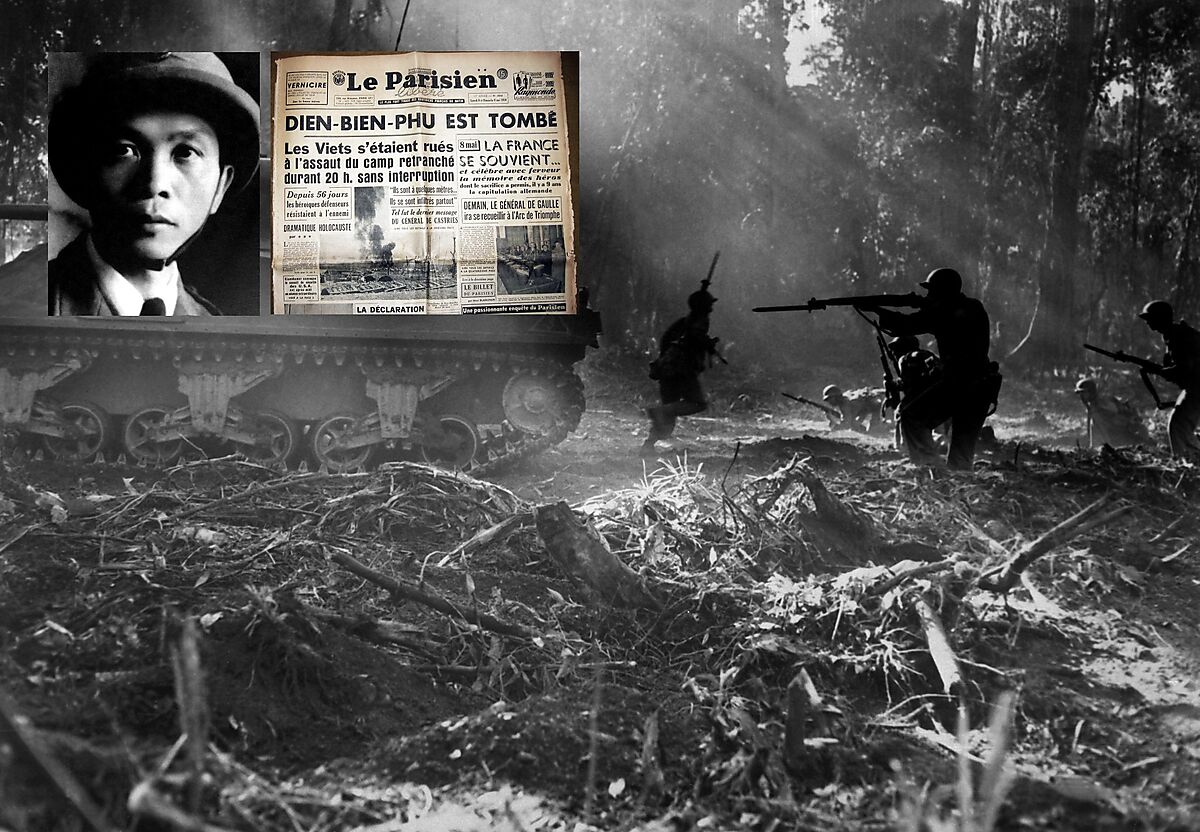
Among the mountains of north-western Vietnam, within the cuvette (basin), lies the remote military outpost of Dien Bien Phu. The base, a 14,000-man French garrison, was strategically positioned to cut off the supply route into Laos for the nationalist Viet Minh. The French referred to the occupied lands of Vietnam, Laos and Cambodia as Indochina, and by 1954 war had been raging in the region for eight years.
Surrounded by elevated, rocky terrain, backing into dense jungle, French forces were confident of their superiority at Dien Bien Phu. Deep in the communist breadbasket of the north, however, General Võ Nguyên Giáp and over 40,000 Viet Minh began an almighty offensive on the garrison on 13 March 1954. Many of the combatants were peasants1, armed with Chinese munitions, desperation and a certain romanticism over a climactic struggle to be rid of French imperialism.
The battle lasted 57 days; on the first day of Giáp’s attack, the north-western station was taken, soon followed by the airfield, limiting the French to airdropping supplies. Stationed in the caves and mountains surrounding the cuvette, which by April was a thick, muddy pit, Viet Minh combatants — young and old — unleashed continuous bombardments, chipping away at French morale and lines of defence day and night.
The French defence was finally broken on 7 May, and victory was declared formally at the Geneva Accords in July that year.
The battle marked the climax of what became known as the First Indochina War; the same Vietnamese forces would go on to combat American intervention less than ten years later in the Second Indochina War — better known as the Vietnam War.
Nguyên Giáp Võ. Dien Bien Phu. The Gioi Publishers. 1999. 147
Nick Vant
London, UK
This article stems from my interest in the Vietnam War. I spent some time travelling in Vietnam after academic studies. The article provides a way to contextualise events that led on to more familiar areas of history that we know.