
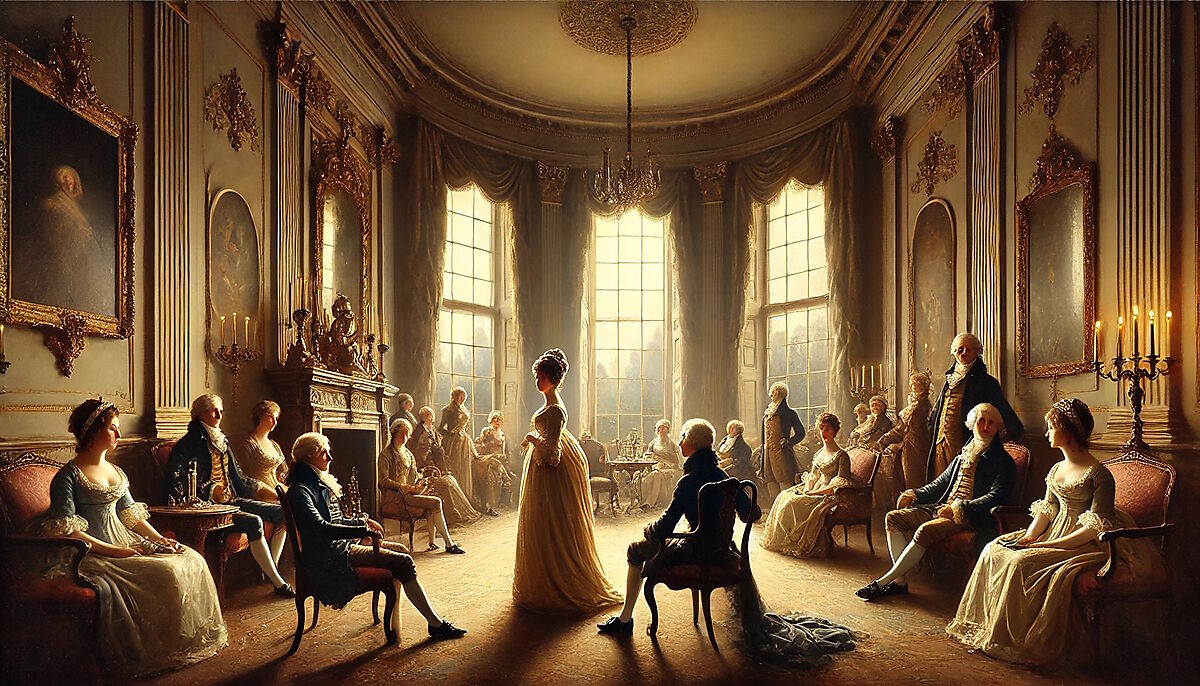
A Regency Setting
‘Lady Susan’ (1794): An Early Insight into Jane Austen’s Views on Marriage and Morality
In Jane Austen’s Lady Susan (1794), the protagonist Lady Susan’s relative financial stability does little to curb her desire for ever greater wealth. Austen herself, on a trip to a fabric shop in April 1811, on being ‘tempted by a pretty-coloured muslin’, later confessed in a letter to her sister Cassandra, ‘I am sorry to tell you that I am getting very extravagant, and spending all my money’1 — seemingly well aware of the materialistic impulse.
Austen, who was born in 1775, was writing at a time when women in Britain faced severe restrictions on their financial autonomy. Two legal practices — primogeniture and the common law doctrine of coverture2 — were key to these limitations. The former was ‘often enacted’3 to ensure that the entire estate of a person without a will passed to the eldest son; while the latter ensured that the property of a married woman was ‘consolidated into that of her husband’s’, thus effectively rendering women unable to function as ‘independent economic actors’.4 This lack of autonomy engendered a climate of ‘female financial anxiety’5, incentivising women to rely on marriage as their primary means towards financial security.
Austen’s Lady Susan is an epistolary novella (presented as a series of letters), in which the recently widowed Lady Susan Vernon, an ‘excessively pretty’ woman with a ‘happy command of language’6, is securely upper class and ‘not at present in want of money’7.
She attempts to marry her daughter Frederica to Sir James Martin, a ‘man of fortune’8 but also a ‘very weak young man’9, despite knowing that Frederica is ‘violently against the match’10. Lady Susan initially seduces Sir James with her coquetry and beauty, before directing his affection towards Frederica. When her scheme falls through she contemplates marrying Sir James herself, despite having once described him as ‘contemptibly weak’11. Sir James’s considerable wealth is clearly sufficient for Lady Susan to consider embarking on a marriage devoid of affection.
The theme continues as Lady Susan and her close friend Mrs Johnson plot the indirect ‘murder’ of the handsome and wealthy Mr Mainwaring’s wife so that she may seduce him. She urges Mrs Johnson to deliberately exacerbate Mrs Mainwaring’s anxieties to send her to an early grave.
Despite its frivolous nature, Austen’s early novel could be read as a study in female financial anxiety. One could trace Lady Susan’s single-minded ambitions for marriage to the doctrine of coverture and the inability of women of the time to function with financial autonomy. Her absurd and elaborate attempts at marriage are ultimately rooted in the desire for financial security — at the expense of emotional fulfilment.
Austen deepens the exploration by examining the moral consequences of this simmering anxiety in women of the time, how it could subject them to morally compromising situations. Lady Susan, in her relentless pursuit of financial advancement, is both an agent and victim of this materialistic drive, navigating through society without any sense of moral accountability or ‘consciousness of guilt’12 over her wrongdoings.
In her later novels, Austen celebrates moral growth and the attainment of virtue through her better-known protagonists such as Elizabeth Bennet in Pride and Prejudice (1813). Lady Susan, however, stands at odds with these later figures, marked by her selfishness and moral vacuity. Yet this extreme characterisation, when read as satire, unifies Lady Susan with Austen’s broader critique of the societal constraints on women of the Regency Era — a theme that Austen would continue to develop and sharpen in her most celebrated novels.
Lady Susan would remain unpublished during Austen’s lifetime, only to be discovered by her nephew James Edward Austen-Leigh, who found the manuscript among her papers after her death. He included a summary of the novella in his 1869 biography, A Memoir of Jane Austen. The full text was later published for the first time in 1871 as an appendix to a new edition of the memoir.13
References
- Sarah Chauncey Woolsey (ed.). Letters of Jane Austen: Selected from the Compilation of Her Great Nephew, Edward, Lord Brabourne. Little: Brown and co.. 1898. pp. 157-158
- Alexander Wakelam. "Coverture and the Debtors' Prison in the Long Eighteenth Century". Journal for Eighteenth-Century Studies. 44, no. 4. 2021. 343–360. p. 344
- Rita J. Dashwood and Karen Lipsedge. "Women and Property in the Long Eighteenth Century". Journal for Eighteenth-Century Studies. 44, no. 4. 2021. 335–341. p.335
- Alexander Wakelam. "Coverture and the Debtors' Prison in the Long Eighteenth Century". Journal for Eighteenth-Century Studies. 44, no. 4. 2021. 343–360. p. 344
- Helena Kelly. Jane Austen, the Secret Radical. Icon Books: Limited. 2016. p. 98
- Jane Austen. Lady Susan. New York: HarperCollins Publishers. 2012. p. 25
- Jane Austen. Lady Susan. New York: HarperCollins Publishers. 2012. p. 38
- Jane Austen. Lady Susan. New York: HarperCollins Publishers. 2012. p. 49
- Jane Austen. Lady Susan. New York: HarperCollins Publishers. 2012. p. 67
- Jane Austen. Lady Susan. New York: HarperCollins Publishers. 2012. p. 15
- Jane Austen. Lady Susan. New York: HarperCollins Publishers. 2012. p. 15
- Jane Austen. Lady Susan. New York: HarperCollins Publishers. 2012. p. 128
- The Morgan Library & Museum. "Jane Austen's Lady Susan". The Morgan Library & Museum. 2009

I was motivated to write this piece by my interest in exploring how a minority in a certain era and place is marginalised in the context of the wider cultural background. Having grown up in Hong Kong and lived in Japan, where gender equality is not as advanced as it is in Western nations, it was particularly intriguing to explore literary works that examine and criticise a self-perpetuating societal structure that relegates women to a disadvantageous position.— Benjamin Lam