
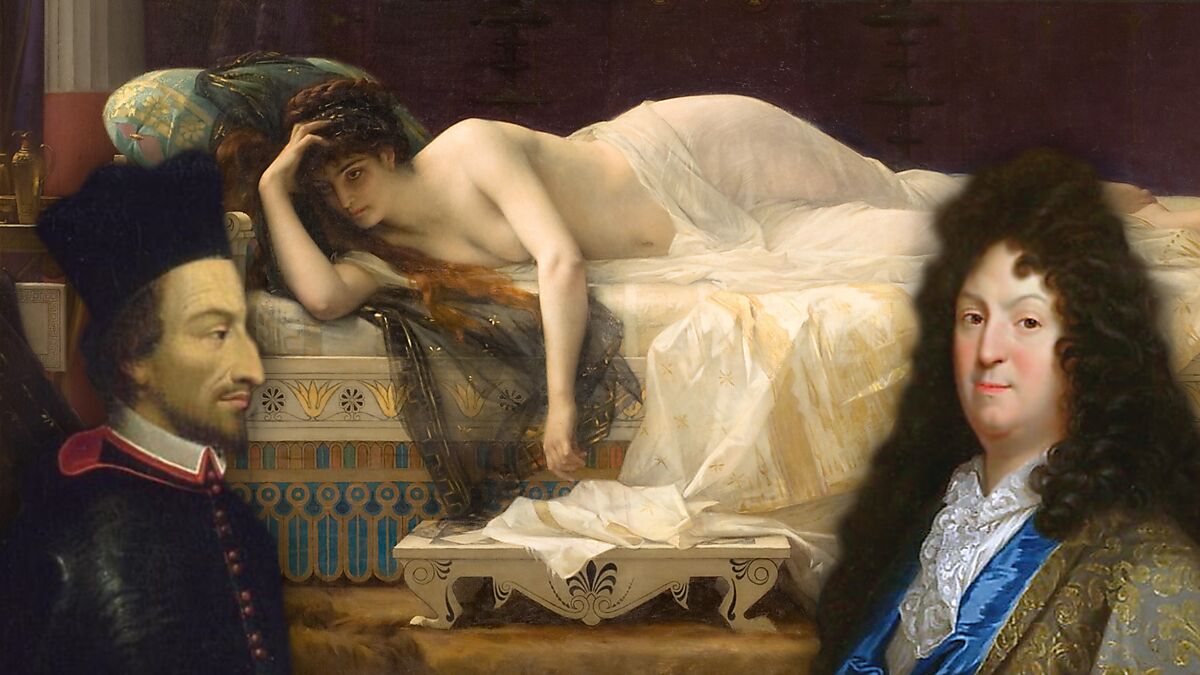
Phèdre by Alexandre Cabanel (1880), Cornelius Jansen and Jean Racine (inset)
La Bonne Femme and la Mauvaise Femme: Women in Racine’s ‘Phèdre’ (1677)
In around 1646–49, the orphan Jean Racine aged ten entered Port-Royal, a convent of followers of Jansenism, not far from Paris. There Racine gained knowledge of the classics of Greek and Roman literature (among other subjects), from which he would draw upon in his later career as a playwright.
Racine was also influenced by the teachings of Cornelius Jansen (1585–1638) bishop of Ypres on whose principles the school was founded. In Christian theology, the first humans, Adam and Eve, are expelled from paradise for consuming the forbidden fruit, an act referred to as the original sin. Jansen subscribed to an early Christian belief, rooted in the teaching of St Augustine of Hippo, according to which original sin is passed from one generation to another through concupiscence, the very sexual urges that produce children. As a result, a baby is born tainted with this sin and grows with it intact. Salvation is only possible through divine grace, the arbitrary will of God. Jansenism was a particularly pessimistic form of Christianity, which advocated a life of suffering and penance in anticipation of divine grace.
In 1677, Racine, then aged 38, wrote Phèdre, his 10th play, a tragedy in five acts. In the play, Phèdre, Queen of Athens, lusts after her stepson and brings about his death at the hands of the god Neptune. We are offered a pure alternative to Phèdre, the mauvaise (bad) femme, in the form of Aricie, the bonne (good) femme, her stepson’s true love, whose actions resemble quiet devotion over destructive obsession.1
Racine’s characters and story are taken from Greek mythology. As schooling at the time was primarily a classical education, many in Racine’s audiences would have been aware of Phèdre’s genealogy. According to the myth her mother, Pasiphae, develops lust for a white bull, with which she mates to produce an offspring. Racine weaves the thread of Jansenist concupiscence into the play through this hereditary link.2 Whilst not all humans give in to the temptation of concupiscence, those who do so condemn their descendants to a life-long struggle against unwanted desire.
Racine’s depiction of Phèdre as the mauvaise femme also deprives her of her own identity.3 She merely fulfils her role as a distorted mirror image of Aricie, whose unphysical and passive love only serves to highlight the Queen’s own depravity.
Racine layers Jansenist moralising on an ancient tale to relate to a contemporary audience. As for Phèdre, governed by her ancestry and deprived of her own identity, her end is inevitable. At the play’s denouement she drinks poison and falls dead.
References
- Véronique Desnain. "Les Faux Miroirs: The Good Woman/Bad Woman Dichotomy in Racine's Tragedies". The Modern Language Review. 96, no. 1. 2001. 38-46. p. 40
- Véronique Desnain. "Fille de Jézabel". in Philip Tomlinson (ed.). French classical theatre today: teaching, research, performance. Amsterdam: Rodopi. 2001. pp. 191-203. p. 194
- Veronique Desnain. "Fille de Jézabel: female genealogies in Racine". in Philip Tomlinson (ed.). French classical theatre today: teaching, research, performance. Amsterdam: Rodopi. 2001. 191-203. p. 202

In the spring of 2020, I took a class on 17th century French theatre and the literary theory surrounding it. As the global pandemic closed my university down and my flatmates went home, I was left with a lot of spare time. Bored of Netflix, I sat through hours of Racine's tragedies and was left fascinated by the dramatist’s deeply-rooted pessimism and black-and-white morality.— Amelia Gavin