
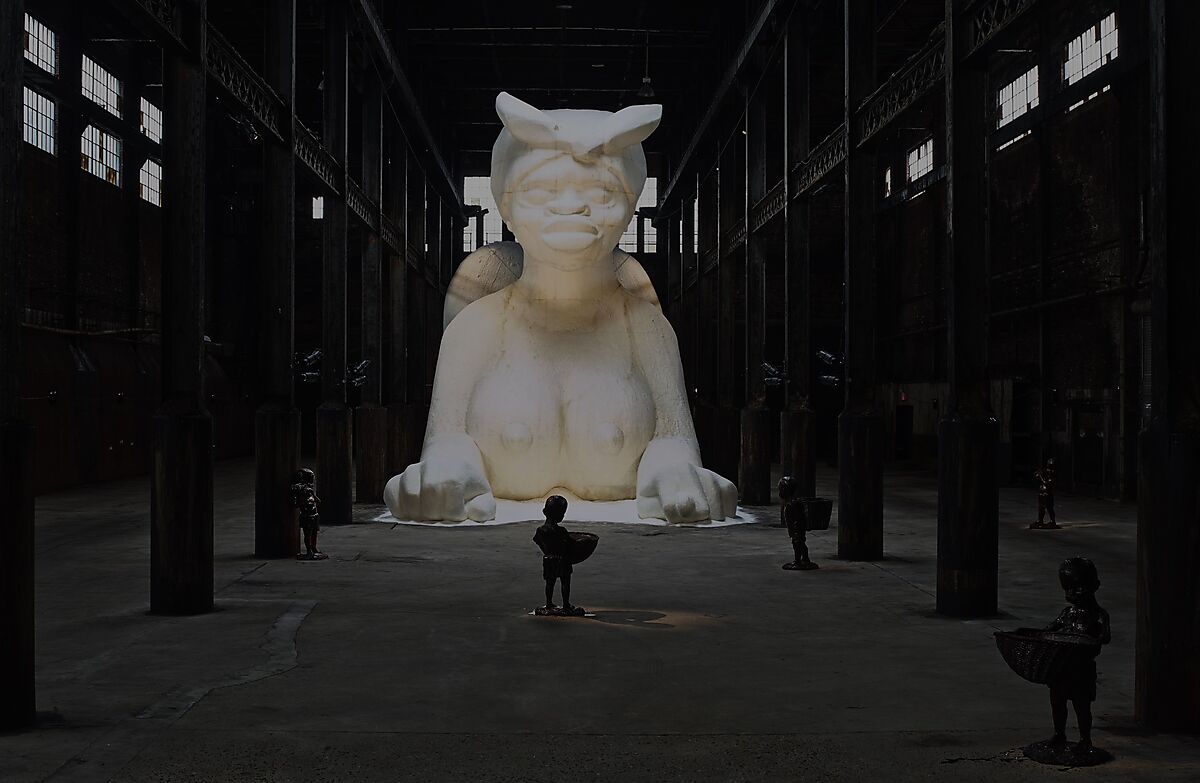
Kara Walker, A Subtlety, 2014
Kara Walker’s ‘A Subtlety’ (2014) — The Plantation Legacy in Contemporary America
In the summer of 2014, just a few weeks before the Domino Sugar Factory in Brooklyn, New York was to be torn down, a large queue of people waited outside in the heat for a glimpse of Kara Walker’s work ‘A Subtlety’. (A ‘subtlety’ being a small sugar figurine consumed during mealtimes in European aristocratic households during the Middle Ages.) As you enter, an overwhelming sweet smell within the decaying factory combines with the rusting ironwork and the stench of urine to confront the viewer with an acrid and nauseous air. The temporary, free public art exhibition sought, among other things, to challenge the viewer with their relationship to plantation narratives, sugar, and the black women who have long been associated with its production.
In the middle of the factory floor, Walker had constructed a gigantic figure out of white sugar of a black woman in the shape of a sphinx. The figure is that of the ‘mammy’ character that is now considered a racist stereotype. This depicts a smiling black woman, often shown wearing a kerchief and apron, happy with her servile state in American life. She is understood to be a domestic servant, reinforcing the stereotype that black women were only suitable for such work, which helped to rationalise economic discrimination.
The sphinx was surrounded by fifteen five-foot sculptures, also of sugar, of adolescent black boys holding baskets or carrying bunches of bananas. On the sugar plantations, while manual slave labour was mostly undertaken by males, women endured a uniquely exploitative experience as not only were they expected to support the labour in the fields, but they were also the means of ‘reproductive labour’, helping to sustain the workforce with their offspring. The role of the mother here, contrary to nature, was to bring into being and then commit her offspring to a life of hard manual labour.
To create the sculptures of the children, Walker poured dark molasses (a thick and viscous syrup that is a by-product of the sugar refining process) into moulds, and once released from these moulds the sculptures, on being subjected to the summer heat, begin to melt, buckling under their own weight, reducing them partly to sickly smelling puddles. These dark figures surround the looming presence of the giant (10.6m) sphinx-like statue created using 36,000kg of pure white refined sugar applied to a polystyrene base, creating a stark contrast. The children become victims of sugar, mirroring their real-life counterparts in American history. The sphinx looks upon this neglect of the molasses children unable to help, but to remain in her role as the stoic mother figure according to her design.
Walker’s use of sugar, a perishable product, reflects her view on the degradable nature of the human forms that she depicts. The black woman and her children are less than, or not as human, as others. Walker attempts to show through literal degradation what slavery did to many black women: metaphorically reducing them to a commodity that they aided in producing.
Slavery was legally abolished in 1865 in the United States with the ratification of the 13th Amendment to the Constitution. Almost 150 years later, Walker brings into view how plantation exploitation has continued to dominate the American consciousness. She makes clear that the issue of slavery is not a historical one, but rather that present-day America lives in a reactionary state to slavery, that the social contracts that maintained it for so long remain dominant and aggressive within current American culture.
A popular representation of the mammy caricature in America is Aunt Jemima, a brand for breakfast foods. (The brand was discontinued in June 2020 by parent company Quaker Oats in their progression towards racial equality.1) While it may seem that Walker is unwittingly propagating a negative stereotype, the nature of and the environment in which her sculpture is displayed allows for a different interpretation. On the label of a syrup bottle, the mammy figure is owned by the purchaser. On the mammoth scale in the Domino Factory, while the figure can be temporarily consumed by the viewer, they must leave empty handed.
Walker’s work was only temporary: it was dismantled on 6 July 2014, two months after its opening date of 10 May. However, through its sheer scale the figure attempts to loom large over America’s national consciousness, providing an outlet for conversations to develop on America’s national trauma of slavery, the plantations and black womanhood.
References

I was first introduced to Walker’s artwork during my time at university. Her sculpture instantly held the interest of everyone in the room — it was impossible to tear your eyes away — and evidently it has stayed with me ever since. Walker’s work connects to my long-standing interest in reframing trauma, while also bringing into full view things that simmer under the surface of daily life.— Rosie Robinson