In medieval Europe, every child was believed to be born with the biblical sin of Adam and Eve — rendering them worthy of eternal damnation.1 It was a time when childhood itself was not considered worthy of celebration.2 Children were rushed through their formative years, in a bid to suppress their inherent evil, and often presented as miniature adults.3
During the enlightenment, the Englishman John Locke (1632–1704), argued that a person’s education determined nine-tenths of whether they were ‘good or evil, useful or not,’4. Locke placed the utmost importance on environment and experience; he believed that children should be exposed to situations that nurtured their good character traits.5 Locke also urged the importance of recreation, that children ‘must play, and have playthings.’6 However, while Locke thought a child could be shaped for the benefit of society,7 Jean-Jacques Rousseau, an 18th century Swiss-born philosopher, argued that children should be set free from adult supervision and shielded from the corruption of civilisation8. He believed a child of nature would display its innate goodness9 10.
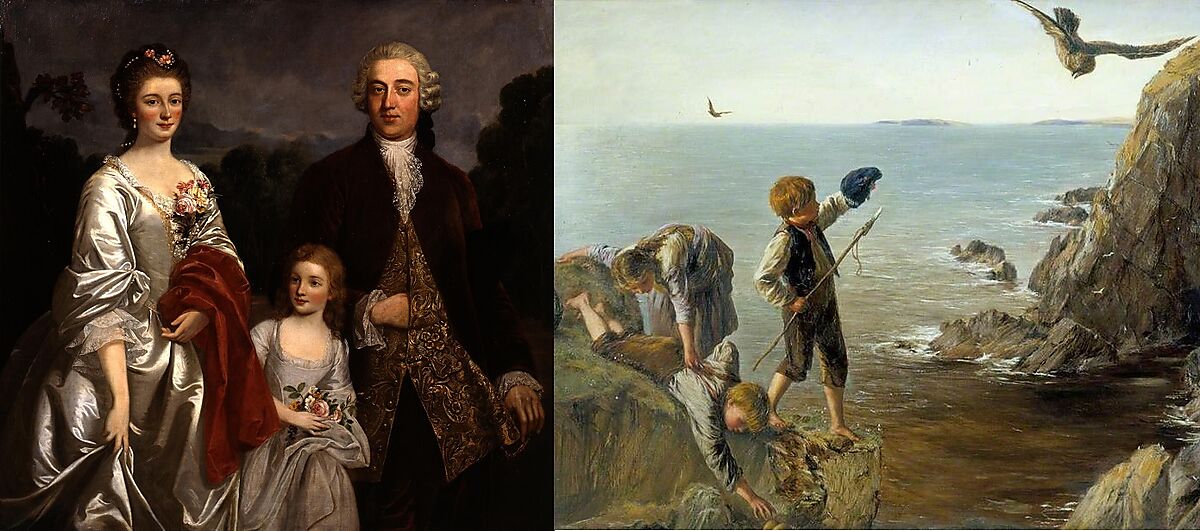
The work of Locke and Rousseau caused a change in European attitudes to children, a phenomenon clearly visible in the art of the period. Previously, depictions of children focused on their future role in society, often showing them as extensions of their parents,11 as in William Hoare’s Family Group (1770), where the little girl is merely the mirror image of her mother. A century later, however, the realisation that children should be allowed to develop naturally is visible in James Clarke Hook’s The Bonxie, Shetland (1873), where the children are painted at play, showing a clearer separation between the worlds of adulthood and childhood.
Beatrice, Pier Franco. The Transmission of Sin: Augustine and the Pre-Augustinian Sources. New York (printed in): Oxford University Press. 2013. 6
Smith, Robert N. God’s Plan of Creation: Written for All God’s Children Who Want to Know and Are Not Afraid to Think. Bloomington: AuthorHouse. 2014. 116
Aries, Phillippe. Centuries of Childhood. Penguin (reprint). 1962. 250
Locke, John. Some Thoughts Concerning Education: (Including of the Conduct of the Understanding). New York: Dover Publications, INC.. 2013. 25
Archard, David. Children: Rights and Childhood. Oxon: Routledge. 2004. 6
Locke, John. Some Thoughts Concerning Education: (Including of the Conduct of the Understanding). New York: Dover Publications, INC.. 2013. 31
Faulkner, Joanne. The Importance of Being Innocent: Why We Worry About Children. Cambridge: Cambridge University Press. 2010. 69
Durkheim, Emile. Durkheim's Philosophy Lectures: Notes from the Lycée de Sens Course, 1883–1884. Cambridge: Cambridge University Press. 2004. 256
Rousseau, Jean-Jacques. Emile: Or, On Education. New Zealand: The Floating Press. 2009
Salkind, Neil. Encyclopedia of Human Development, Volume 1. London: SAGE. 2009. 909
While working at the Royal Albert Memorial Museum, Exeter, I was fascinated by visitor reactions to a Victorian children exhibition. The children were from affluent families and dressed like adults, and there was a general consensus that they would have enjoyed a nice life. I don’t necessarily disagree — especially since poorer children were often sent out to work — and yet I couldn’t help thinking that none of the children looked particularly happy.