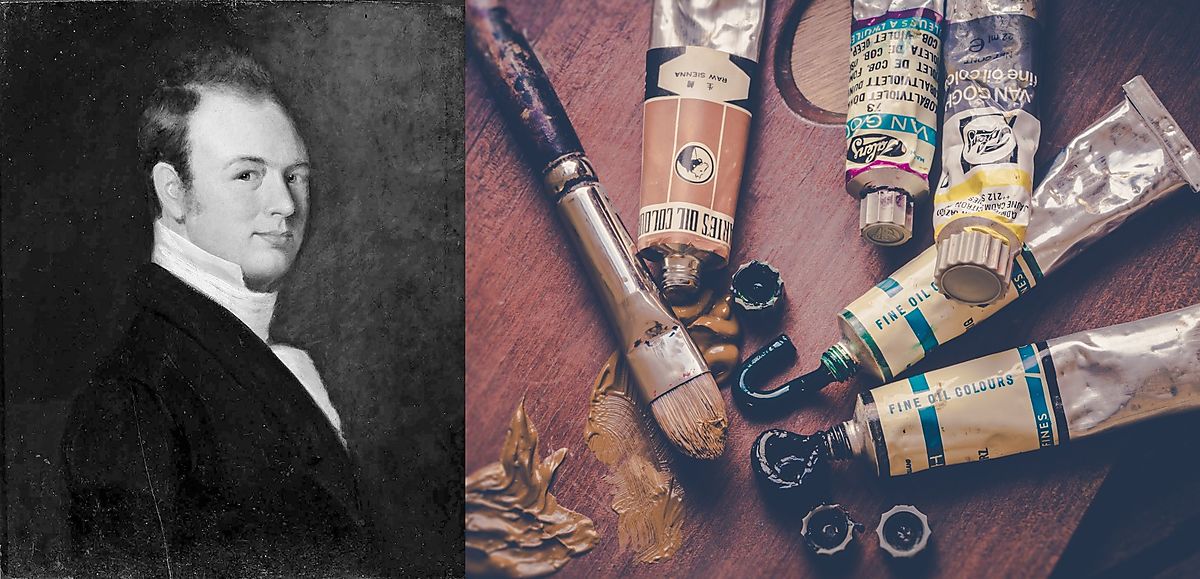
In 1841, a little-known American portraitist living in London invented a small, artists’ aid that would have a significant impact on art. While Monet, Renoir and Degas are commonly linked to impressionism, John Goffe Rand’s collapsible paint tube influenced the making of art at the time by providing a convenient way to store paint.1
Before 1841, the artist would prepare the paint by buying ground pigment from a merchant and mixing it with oil.2 The colours were then typically stored in pigs’ bladders, which the artist would later pierce to squeeze out the required amount. This method of storage was far from ideal, as the bladders tended to burst easily, were permeable, and once pierced could only be resealed with a puncture repair kit.3
The paint tube, made with inert tin so as not to react with the paint4, proved more convenient; more artists left their studios to work closer to their subjects. This change in setting enabled artists to capture the nuances of their environment in different light and weather, characteristic of the momentary paintings of the impressionists.5 The invention also enabled merchants to readily distribute the variety of new colours that were then available (thanks to the advancement of chemistry in the early 1800s), greatly enhancing the impressionist palette.6
Rand’s seemingly insignificant invention was critical in helping the impressionists execute their paintings with greater precision. Renoir’s son quotes his father as saying
Paints in tubes, being easy to carry , allowed us to work from nature, and nature alone. Without colors in tubes, there would be no Cézanne, no Monet, no Pissaro, and no Impressionism.”7
Cory MacPherson. Inventions in the Visual Arts: From Cave Paintings to CAD. Cavendish Square. 2017. 43
Robert Katz, Dars Celestine, Celestine Dars. The Impressionists Handbook: The Great Works and the World That Inspired Them. Metro Books. 2000. 305
Anthea Callen. The Art of Impressionists: Painting Technique & the Making of Modernity. Yale University Press. 2000. 106-108
Robert Katz, Dars Celestine, Celestine Dars. The Impressionists Handbook: The Great Works and the World That Inspired Them. Metro Books. 2000. 305
Anthea Callen. The Art of Impressionists: Painting Technique & the Making of Modernity. Yale University Press. 2000. 106-108
Robert Katz, Dars Celestine, Celestine Dars. The Impressionists Handbook: The Great Works and the World That Inspired Them. Metro Books. 2000. 305
Jean Renoir. Renoir: My Father. Mercury House. 1988. 734
Judith Kuthy
Vienna
The dynamic yet calm depiction of subjects in impressionism has always fascinated me. The impact the invention of the paint tube had on the stylistic aspects of impressionist paintings is a great example of how art movements cannot be described solely through the paintings of the period; the available technology and the environment in which the artists work is also important.