
Ionic Order
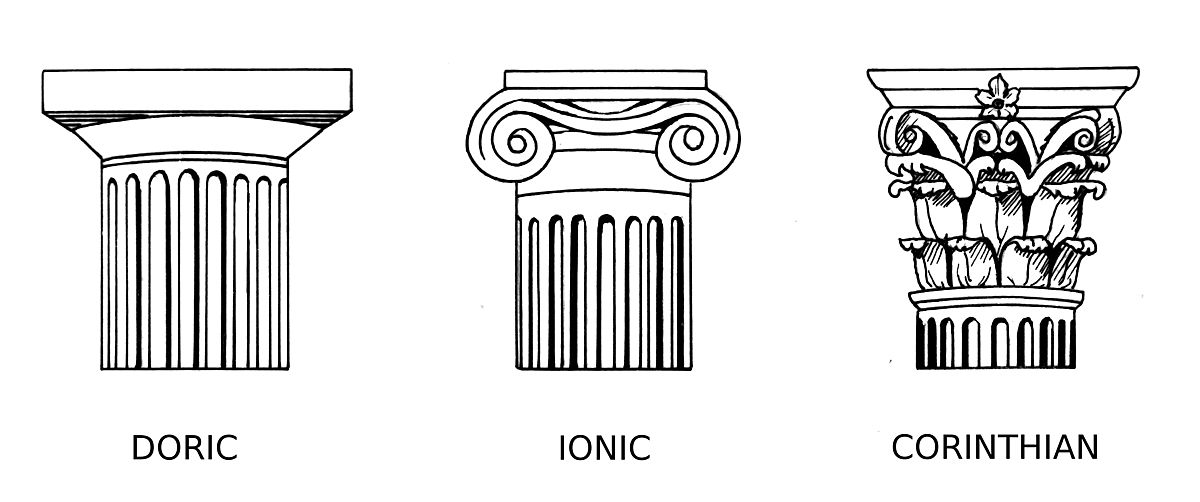
Line art drawing of Greek orders of building design.
The Ionic order came from eastern Greece.
It is distinguished by slender, fluted pillars with a large base and two opposed volutes (also called scrolls) in the echinus of the capital. The echinus itself is decorated with an egg-and-dart motif.
The Ionic shaft comes with four more flutes than the Doric counterpart (totalling 24). The Ionic base has two convex moldings called tori which are separated by a scotia.
A column of the ionic order is nine times its lower diameter. The shaft itself is eight diameters high. The architrave of the entablature commonly consists of three stepped bands (fasciae).
It is distinguished by slender, fluted pillars with a large base and two opposed volutes (also called scrolls) in the echinus of the capital. The echinus itself is decorated with an egg-and-dart motif.
The Ionic shaft comes with four more flutes than the Doric counterpart (totalling 24). The Ionic base has two convex moldings called tori which are separated by a scotia.
A column of the ionic order is nine times its lower diameter. The shaft itself is eight diameters high. The architrave of the entablature commonly consists of three stepped bands (fasciae).
Classical Order adapted from Wikipedia and licensed by The Cultural Me under CC BY SA 3.0