
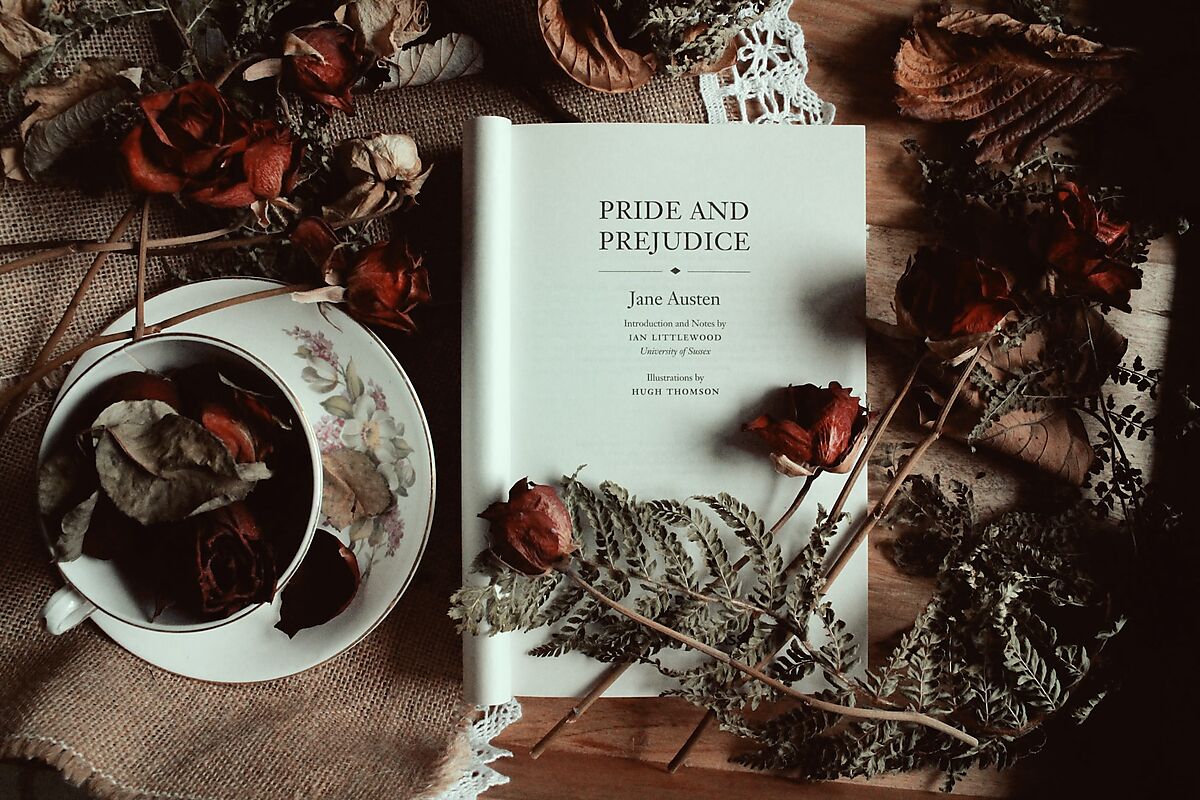
Jane Austen’s ‘Pride and Prejudice’
Independent Women and the Business of Marriage in Jane Austen’s ‘Pride and Prejudice’ (1813)
In 1813 Jane Austen, then in her late thirties, published her second novel, Pride and Prejudice. The story centres on the Bennet family, whose matriarch makes it ‘the business of her life’1 to see her five daughters — Jane, Elizabeth, Mary, Kitty and Lydia — ‘equally well married’.2 For women of the landed classes of the time, marriage was often a matter of securing their place in society. Unmarried women were referred to as ‘spinsters’ — originally a legal term, but one that had come to embody a lonely, miserable older woman.3
In Pride and Prejudice, Mr Bennet’s Longbourn, the fictional estate in Hertfordshire, ‘unfortunately for his daughters, was entailed in default of heirs male, on a distant relation’.4 In 19th-century England, a family’s land and property typically passed exclusively to the eldest son, a convention known as patrilineal primogeniture. This was commonly secured through a legal document called an entail, which specified who would inherit an estate.5 As Mr Bennet’s children are exclusively female, his closest male relative, his cousin Mr Collins, stands to inherit the family home.
Austen depicts Mr Collins, a clergyman, as ‘absurd’6 — pompous and prone to long, inane speeches. He is obsessed with status and prestige, taking great pride in the patronage bestowed upon him by the wealthy aristocrat Lady Catherine de Bourgh.
Despite her daughters finding Mr Collins unlikable, Mrs Bennet is anxious to secure a marriage between him and her second eldest daughter, Elizabeth. As for the eldest, she had already gone to great lengths to encourage a proposal from the wealthy Mr Bingley.
When Elizabeth refuses Mr Collins, Mrs Bennet is furious at this lost opportunity to escape becoming ‘destitute enough’7 in the event of Mr Bennet’s death. Mr Collins then turns his attentions on Elizabeth’s friend Charlotte Lucas who considers his proposal ‘solely from the pure and disinterested desire of an establishment.’8 At the age of 27, Charlotte is considered to be on the cusp of spinsterhood, facing the then familiar prospect of marrying within her class or else ‘dying an old maid’.9
The businesslike way in which Mrs Bennet goes about negotiating marriage is often a source of comedy in Pride and Prejudice. But her conduct reflected the realities of 19-century England,10 where marriage was indeed a business transaction in some respects. Austen, however, offers a novel perspective for the time — the idea of marrying for love. Aside from Charlotte Lucas, all other marriages that occur in the novel are the product of love. We gain an insight into Austen’s personal views on the matter in her 1808 letter to Cassandra, her only sister with whom she was very close, in which, while discussing the second marriage of a mutual acquaintance, she writes ‘I consider everybody as having a right to marry once in their lives for love, if they can’.11
To delve deeper into the intellectual environment in which Austen was writing we find that a couple of decades before Pride and Prejudice the writer Mary Wollstonecraft had published her book A Vindication of the Rights of Woman. Wollstonecraft calls for viewing women and men as intellectual equals. Marriage being ‘the only way women can rise in the world’12 was, she argues, to the detriment of their becoming well-rounded human beings. Changing social mores so that women could achieve their intellectual potential would, in Wollstonecraft’s view, not only be for the betterment of society, but would also enable a woman to become a better mother and wife — a capable companion, rather than a ‘humble dependent’.13
Seen in this light, the moulding of Elizabeth’s character into a woman who can think for herself could also be viewed as Austen aligning Pride and Prejudice with Wollstonecraft’s ideas on female emancipation.14
Austen’s final novel, Persuasion, was published shortly after her death in 1817. Persuasion follows the trials of the compassionate, level-headed Anne Elliot and again presents love as an elevated motivation for marriage.
Austen herself never married, choosing instead to live independently, relying on the income she earned from her writing. She declined her only marriage proposal from a wealthy Harris Bigg-Wither. Although her reasoning is unknown, in an 1814 letter giving relationship advice to her niece Caroline Jane Knight we read that ‘anything is to be preferred or endured rather than marrying without affection’.15
References
- James Kingsley, 3rd edn (ed.). Pride and Prejudice. Oxford: Oxford University Press. 2019. p.5
- James Kingsley, 3rd edn (ed.). Pride and Prejudice. Oxford: Oxford University Press. 2019. p.7
- Philippa Levine. "“So Few Prizes and So Many Blanks”: Marriage and Feminism in Later Nineteenth-Century England". Journal of British Studies. 28, no. 2. 1989. pp. 150-174. p. 150
- James Kingsley, 3rd edn (ed.). Pride and Prejudice. Oxford: Oxford University Press. 2019. p.21
- Robert Markley. "The Economic Context". in Janet Todd (ed.). The Cambridge Companion to Pride and Prejudice. Cambridge: Cambridge University Press. 2013. pp. 79-96. p. 84
- James Kingsley, 3rd edn (ed.). Pride and Prejudice. Oxford: Oxford University Press. 2019. p. 51
- James Kingsley, 3rd edn (ed.). Pride and Prejudice. Oxford: Oxford University Press. 2019. p. 49
- James Kingsley, 3rd edn (ed.). Pride and Prejudice. Oxford: Oxford University Press. 2019. p. 93
- James Kingsley, 3rd edn (ed.). Pride and Prejudice. Oxford: Oxford University Press. 2019. p. 93
- Ruth Perry. "Family Matters". in Claudia L Johnson and Clara Tuite, Blackwell Companions to Literature and Culture, 2nd edn (ed.). A Companion to Jane Austen. Chichester: Wiley-Blackwell. 2009. pp.323-331. p.323
- Emily Prince. "For Love or Money? Marriage in the Time of Jane Austen". Jane Austen Literacy Foundation. 2018
- Mary Wollstonecraft. A Vindication of the Rights of Woman. a Feminist Literature Classic) (n.p: e-artnow. 2013. p.20
- Mary Wollstonecraft. A Vindication of the Rights of Woman. a Feminist Literature Classic) (n.p: e-artnow. 2013. p.49
- Deborah Aschkenes. "Historical Context for Pride and Prejudice by Jane Austen". Columbia College. 2022
- Caroline Jane Knight. "Why Jane Austen Never Married". Austen Heritage. 2017

I decided to write this article after developing an interest in 19th-century female writers whilst at university. Jane Austen’s Pride and Prejudice was a natural choice, and I wanted to delve deeper into this world of colourful characters. Since its publication, readers have been fascinated with Mr Darcy and Elizabeth Bennet but after studying the novel, and watching multiple on screen adaptations, I feel it is often sold short as just a love story and therefore, through this article, I wanted to shine a light on Austen’s insightful social commentary.— Emma Smith BA (Hons)