
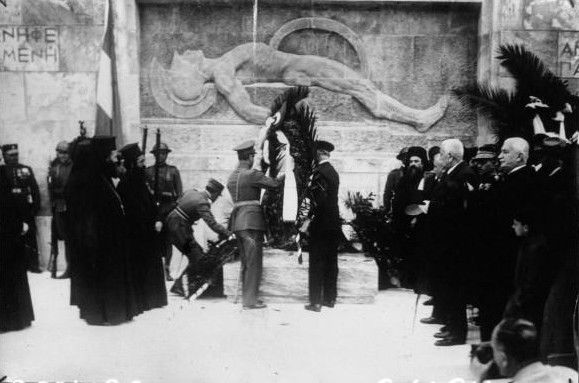
Inauguration of the Unknown Soldier, Athens 1932
Honouring the Unsung Heroes: the Example of Athens

German soldier-poet Theodor Körner wrote “happiness lies only in sacrificial death” as he prepared for battle in the Napoleonic War. After the First World War, there emerged a need to pay tribute to the unsung heroes of the war and to memorialise their sacrifice.
The Arc de Triomphe in Paris, Westminster Abbey in London, and the Monument of the Unknown Soldier in Athens are a testament to this need.
These monuments are an invocation of the past. Their value is acknowledged across nations, having as a greater goal the honouring of the fallen without political motives.
The Monument of the Unknown Soldier was erected in the 1930s and, like all monuments of this type, it is a cenotaph in tribute of war heroes. Similar to the French monument, it was decided that the best location was directly in front of the Greek Parliament.
The sculptural art is symbolic of the postwar period, reinforcing the prospect and hope of peace. The idea of honouring the dead is an abstract one and this was directly served by the abstract nature of the construction. The memory of the fallen was used as a symbol that embodies the trials and sacrifices of an entire nation. Heroes of war are honoured with every formality in every state.
Whether the citizens of a nation continue to associate such monuments as the embodiment of past heroic action will depend on their collective memory.
The Arc de Triomphe in Paris, Westminster Abbey in London, and the Monument of the Unknown Soldier in Athens are a testament to this need.
These monuments are an invocation of the past. Their value is acknowledged across nations, having as a greater goal the honouring of the fallen without political motives.
The Monument of the Unknown Soldier was erected in the 1930s and, like all monuments of this type, it is a cenotaph in tribute of war heroes. Similar to the French monument, it was decided that the best location was directly in front of the Greek Parliament.
The sculptural art is symbolic of the postwar period, reinforcing the prospect and hope of peace. The idea of honouring the dead is an abstract one and this was directly served by the abstract nature of the construction. The memory of the fallen was used as a symbol that embodies the trials and sacrifices of an entire nation. Heroes of war are honoured with every formality in every state.
Whether the citizens of a nation continue to associate such monuments as the embodiment of past heroic action will depend on their collective memory.
Do you want to learn to write like this?
References
- A. Teneketzis. The transformations of memory: the public sculpture in the Europe of the interwar period. Journal: History of Art. 2013
- G. L. Mosse. Fallen Soldiers, Reshaping the Memory of the World Wars. Oxford University Press. 1990