Hilma af Klint attended her first spiritual seance in 1879, aged 17.1 Spiritualism had taken root in Europe since the mid-19th Century, instilling the belief that it was possible to contact the dead.2 Childhood summers spent on her family’s estate on the idyllic island of Adelso and the premature death of her younger sibling, Hermina, further set the course for af Klint’s exploration of the occult.
Like many avant-garde artists around the turn of the century, af Klint subscribed to the esoteric belief system known as Theosophy, which shaped her worldview. The followers of Theosophy sought to revive spiritual wisdom said to be safeguarded by an ancient Eastern brotherhood. In 1896, af Klint formed the group “The Five” to explore the unseen realm that she believed existed. Attaining a trance-like state during seances, they created automatic drawings and cadavre exquis, dictated by messages from the other side.3
Almost 30 years later André Breton in his 1924 manifesto would appropriate automatism for the Surrealists when he defined surrealism itself as “Psychic automatism... the dictation of thought in the absence of all control exercised by reason and outside all moral or aesthetic concern.”4
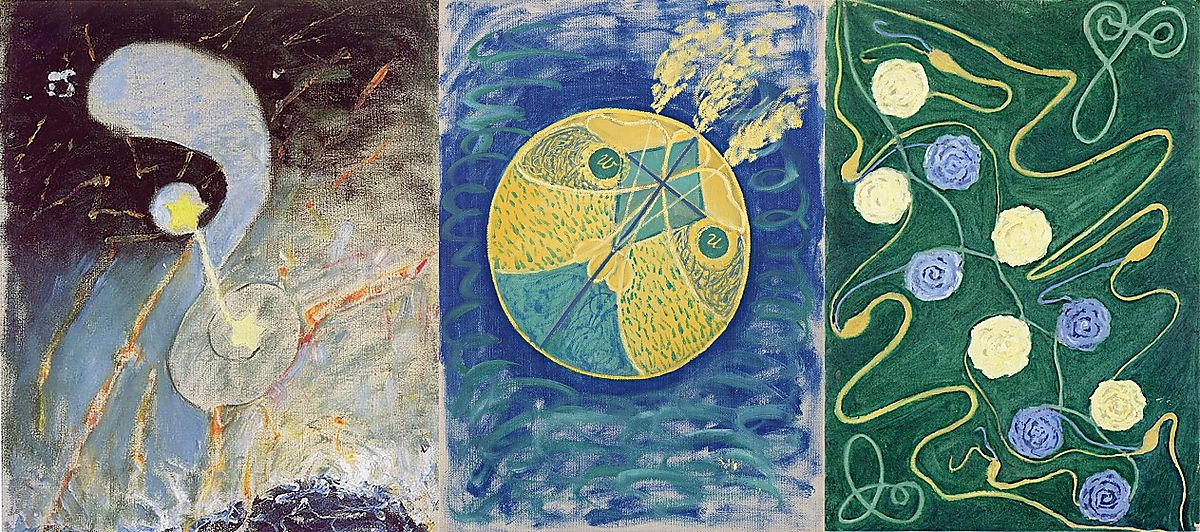
Meanwhile, The Five meticulously documented their seances for almost ten years up until 1905, when af Klint received a “commission” from an entity named Amaliel to create the series The Paintings for the Temple (1906-15). Drawing on transcriptions collected over this period and using a new visual language steeped in symbolism, af Klint created her first abstract subseries, Primordial Chaos in 1906 — a whole five years before Kandinsky’s first known abstract painting.
In light of the 2019 retrospective at the Guggenheim, I wanted to write about the modernist Swedish artist Hilma af Klint. She painted her first series of abstract paintings in 1906 using a method of trance-like meditation, later readopted by the Surrealists as “automated” drawing. I like to highlight little-known female artists whose work has been overlooked.