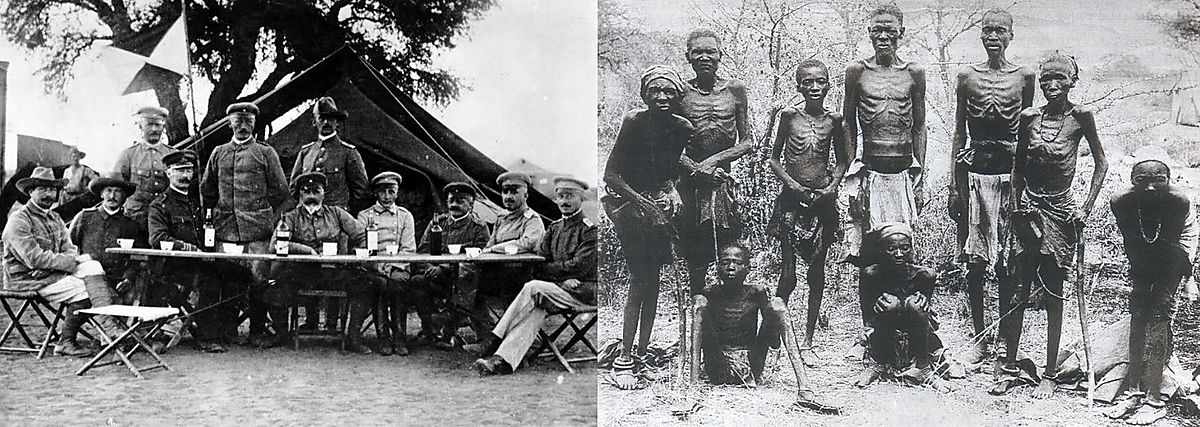
‘I will annihilate the rebelling African tribes with rivers of blood and rivers of gold’ — General von Trotha1
‘The result will not be the Bolshevisation of the earth…but the annihilation of the Jewish race in Europe’ — Adolf Hitler2
The first genocide of the 20th Century is largely a forgotten one. The Herero and Nama Genocide (1904-08) occurred in German South West Africa (Namibia) some 40 years before the WW2 Holocaust.
Following clashes with German occupying forces, the Herero were gunned down at the Battle of Waterberg (1904) or forced into the desert to die of thirst and starvation. The Nama suffered a similar fate, with the conflict eventually resulting in the deaths of 80% of the Herero and 50% of the Nama.3
The Herero who surrendered were branded with the letters GH (Gefangene (or captive) Herero)4—a more brutal version of the Nazi-enforced Star of David. Also, in an uncanny precursor of Nazi death camps, survivors were held in concentration camps, including Shark Island, where conditions could ‘in no way sustain life’5.
These similarities could suggest that, by providing the Nazis with both ideology and method, the Herero and Nama genocide was in some way the genesis for the Holocaust.
However, viewing the two genocides through this lens alone oversimplifies them: it ignores their contexts. The African genocide occurred during conflict over colonial territory, but there was no ‘objective conflict’6 between Nazi Germany and the Jews of Europe.
Perhaps most importantly, it reduces the Herero and Nama genocide to merely a rehearsal for the Holocaust, whilst ignoring the crucial factor that led to the murder of six million Jews—namely, a rife and pre-existing antisemitism.
Benjamin Madley. From Africa to Auschwitz: How German South West Africa Incubated Ideas and Methods Adopted and Developed by the Nazis in Eastern Europe. European History Quarterly 35, No. 3, SAGE Publications. 2005. 430
Hannes Heer and Klaus Naumann. War of Extermination: The German Military in World War II, 1941-1944. New York: Berghahn Books. 2009. 56
Barry Turner, ed.. The Statesman’s Yearbook. Hampshire: Palgrave Macmillan. 2008. 897
Ian F. W. Beckett. Modern Insurgencies and Counter-Insurgencies: Guerrillas and Their Opponents Since 1750. London: Routledge. 2001. 43
Elizabeth R. Baer. The Genocidal Gaze: From German Southwest Africa to The Third Reich. Detroit: Wayne State University Press. 2017. 12
It was only in my final year at university that I came across the Herero genocide, and I was amazed that not only had I never heard about it outside of academia, but that it had taken three years as a German student to come across such an important and tragic event. In writing this article, I also wanted the reader to understand the connection, if any, between the Herero Genocide and the Holocaust.