
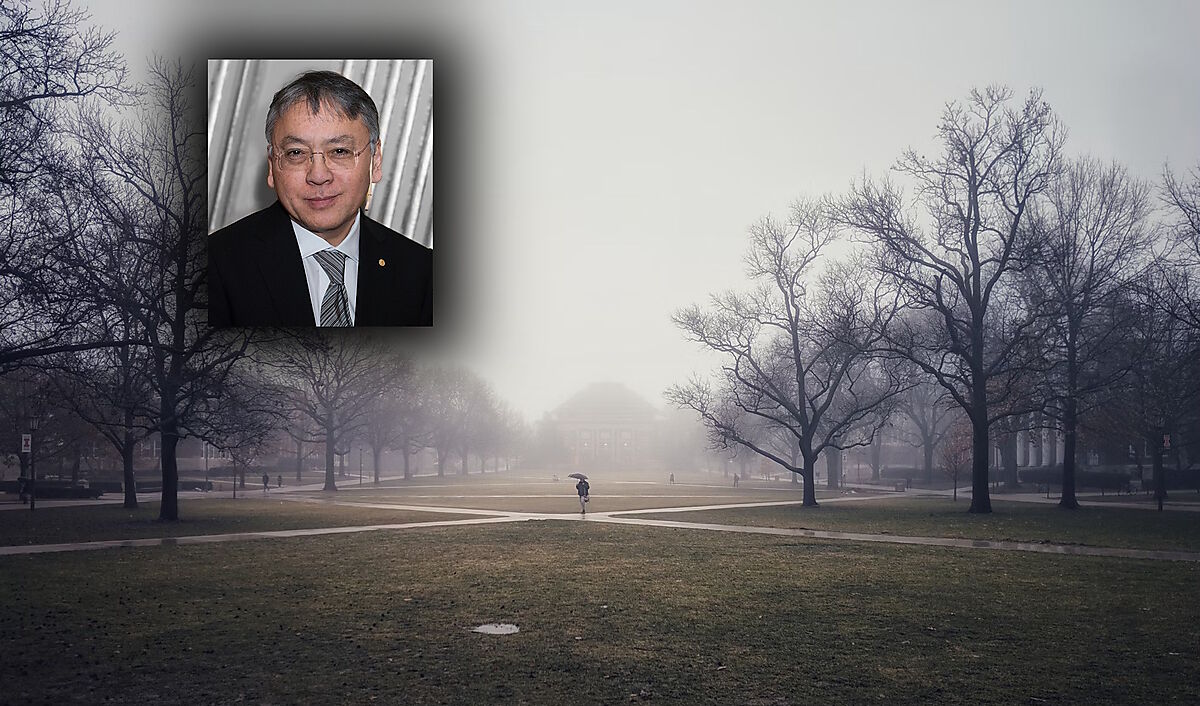
Haunted by Memory; Kazuo Ishiguro (Inset)
Haunted by Memory: Neo-Gothic Anxieties in Kazuo Ishiguro’s ‘Never Let Me Go’ (2005)
Kazuo Ishiguro’s Never Let Me Go (2005) is set in a world that is at once familiar and unsettling.1 Kathy, the narrator, reflects on her time at Hailsham, a seemingly idyllic boarding school where children, who are clones, are raised under careful supervision. Her memories initially offer comfort, lending stability to an uncertain present. Yet these recollections gradually deepen her awareness of a disturbing truth…
In the decade leading up to Never Let Me Go rapid technological advances, particularly in biotechnology, transformed society’s perceptions of life. The launch of the Human Genome Project and the successful cloning of Dolly the sheep in 1996 fuelled ethical debates about genetic manipulation and humanity’s increasing control over life. At the same time, society wrestled with both the promise and unease of emerging technologies, particularly the rise of the World Wide Web in 1991, which revolutionised access to information and transformed how people communicate. Ishiguro wrote against the backdrop of these anxieties and fascination, creating a novel that reflects the disquieting possibilities of a future transformed — not necessarily for the better — by scientific intervention.
Kathy herself is a product of these very interventions — a clone. For her, Hailsham is more than a school: it becomes a source of identity and memory, continually revisited in her mind. As an adult, she finds herself ‘seeking out … people from the past, and whenever [she] can, people from Hailsham’2. Her desire to reconnect with former classmates highlights how deeply the past remains entwined with her present. In the novel, memories, rather than fading, resurface insistently, blurring distinctions between past and present until time appears cyclical rather than linear.
Now working as a carer, Kathy drives across the country, often distracted by seemingly trivial details, fleeting glimpses of the landscape — a ‘corner of a misty field’ or ‘part of a large house in the distance’3 — evoke the spectral quality of her memories, representing something almost out of sight, just like her memories. These visions blur the boundary between past and present, suggesting that the past continues to haunt her, even as she tries to move forward. As she meets other clones, Kathy begins to realise that she fared better than most: ‘That was when I first understood how lucky I’d been to have attended Hailsham,’4 granting an insight into her growing awareness. Hailsham represents both a refuge and a reminder of her fate: a place of childhood innocence that conceals the grim reality awaiting her and her peers.
Later, Madame (Marie-Claude), a Hailsham benefactor who visits periodically to collect the students’ artwork, reflects on societal unease with the clones, how they ‘reminded people of a fear they’d always had’.5. Society’s discomfort arises from confronting beings created solely for utilitarian purposes, figures who appear human yet are disturbingly different — an unsettling embodiment of the ‘other’. Madame’s questions: ‘A generation of created children who’d take their place in society? Children demonstrably superior to the rest of us?’6 shifts the focus from Kathy’s personal struggles to broader societal anxieties, exposing how the very existence of the clones unsettles the foundations of human identity. Ishiguro uses Madame’s reflection to highlight society’s fear of what it cannot control; we also learn how the clones are excluded from a world that refuses to acknowledge them as equals. As the novel reaches its bleak conclusion, there is no hopeful resolution, only a lingering sense of unease.
Never Let Me Go is often classified as science fiction. However, closer examination shows that it is a novel squarely in the Neo-Gothic tradition, using memory, repetition, and unsettling familiarity to express contemporary anxieties about scientific progress and human identity. Ishiguro deftly blends Gothic motifs into a modern context to foreground society’s fears about the ethical and psychological implications of scientific advancements.
Neo-Gothic literature reinterprets traditional Gothic themes — monstrosity, psychological disturbance, and otherness7 — to reflect anxieties unique to the modern age. Hailsham itself, reminiscent of classic Gothic settings, becomes a space haunted by the ethical implications of scientific progress, where the past continually intrudes upon the present, disrupting the characters’ sense of autonomy and identity. Through the novel’s portrayal of the clones as othered beings, Ishiguro explores profound anxieties surrounding biotechnology and society’s fear of losing control.
In the Neo-Gothic tradition, the past is never fully relegated to history; it resurfaces persistently, disrupting the present and shaping lived reality.8 Kathy’s memories of Hailsham illustrate this recurrence, as her recollections blur the boundaries between past and present, preventing her from ever fully escaping the fate that has been predetermined for her.
In the novel’s closing pages, Kathy stands before a barbed-wire fence, gazing across a deserted field. The image is at once ordinary and deeply evocative. Beyond the fence lies a landscape that is familiar but unreachable — a metaphor for the life she will never have. This moment captures the essence of Never Let Me Go: a narrative shaped by longing, where the promise of a different future remains perpetually out of grasp. The field stretches out endlessly, but there is no way across.
References
- Kazuo Ishiguro. Never Let Me Go. London: Faber and Faber. 2005. pp. 1-304
- Kazuo Ishiguro. Never Let Me Go. London: Faber and Faber. 2005. p. 4
- Kazuo Ishiguro. Never Let Me Go. London: Faber and Faber. 2005. p. 6
- Kazuo Ishiguro. Never Let Me Go. London: Faber and Faber. 2005. p. 6
- Kazuo Ishiguro. Never Let Me Go. London: Faber and Faber. 2005. p. 259
- Kazuo Ishiguro. Never Let Me Go. London: Faber and Faber. 2005. p. 259
- Andrew Smith. Gothic Literature. Edinburgh: Edinburgh University Press. 2007. p.4
- Sarah E., Maier and Brenda Ayres, eds.. Neo-Gothic Narratives: Illusory Allusions from the Past. London: Anthem Press. 2020. p. 3

I chose to write this article after discovering my fascination with elements of the Gothic genre and my personal affinity for the themes in Ishiguro’s novels, particularly how their genre is classified in scholarly debate. I thoroughly enjoyed exploring the intersection between Ishiguro’s portrayal of human fragility and the darkness of the Gothic genre, and how these two elements come together to inspire reflection on our ever-changing world.— Mia Gazza