
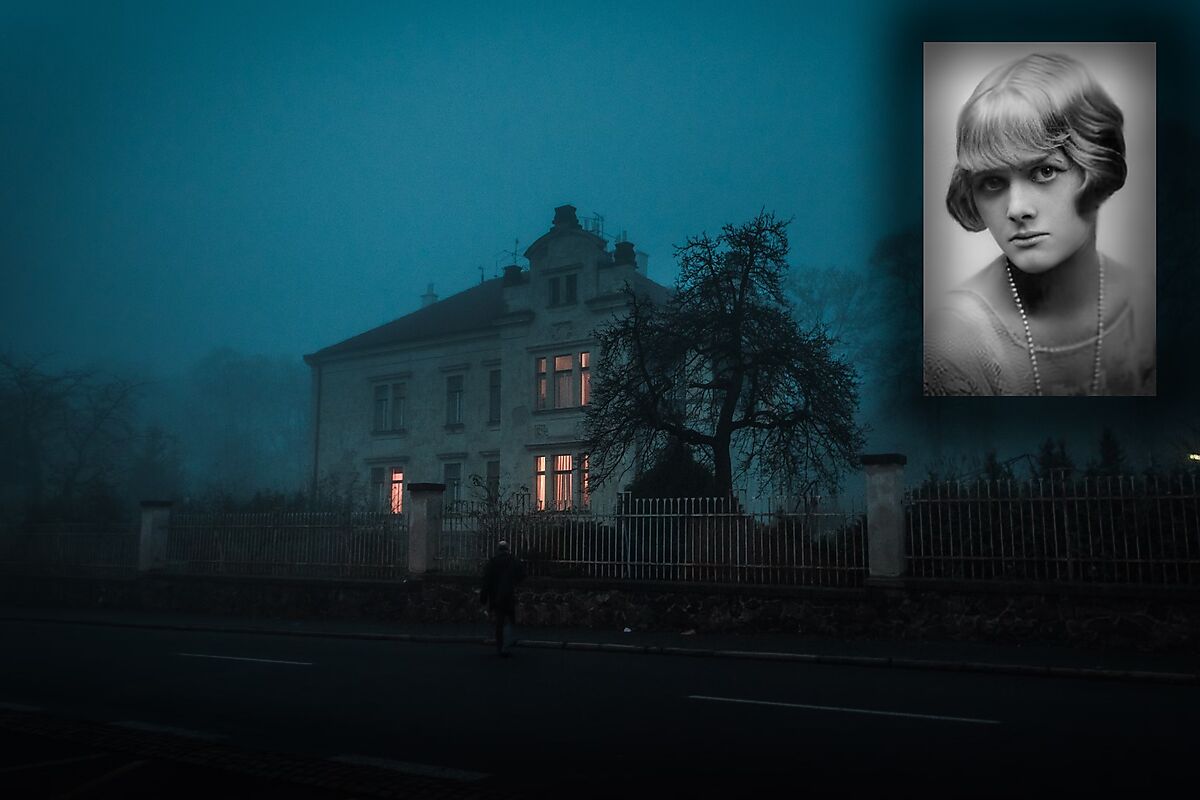
Gothic Realism and Daphne du Maurier (Inset)
Gothic Realism in Daphne du Maurier’s ‘Rebecca’ (1938)
Daphne du Maurier’s novel Rebecca (1938) is set in 1930s England, and tells the story of a young woman who falls in love with a tortured, enigmatic man — Maximilian de Winter. After marrying him, she moves to his imposing estate, Manderley; ‘Maxim’ is marrying for the second time following the death of his first wife, Rebecca.
As the story unfolds, the young heroine’s character is revealed to us, paradoxically, through that of Rebecca. Her insecurities are unveiled through the use of litotes, a rhetorical device where a point is emphasised by negating its opposite. Here the point being emphasised is the narrator’s own inferiority, and this is done by upholding the perfection that is Rebecca. When she investigates Rebecca’s old room she observes handwritten letters on her desk, and notes how ‘at the end of each of her personal letters she put her signature, “Rebecca”, that tall sloping R dwarfing its fellows.’1 Later, she sadly notes that her own handwriting is ‘without individuality; without style’2; she bemoans the ‘things I lack, confidence, grace, beauty, intelligence, wit — Oh, all the qualities that mean most in a woman — she possessed.’3
The young woman, the new Mrs de Winter, whose first name is never revealed, quickly comes to realise that Rebecca’s legacy is tightly woven into the fabric of Manderley. Rebecca’s ghostly presence is evoked in the shadows of Manderley and also via the unsettling devotion of Mrs Danvers, the housekeeper, leaving her to confront the unknown past as it intrudes into her life. The novel’s gradual incorporation of the spectral into the narrative is effected through the consciousness of the heroine. On the first afternoon at tea we learn of the ambiance, ‘an old quiet smell about the room, as though the air in it was little changed [...] I leant back in my chair, trying to instil into myself some measure of confidence, some realisation that I was here, at Manderley, the house of the picture-postcard’4.
In another episode, we discover that a ‘hurrying cloud hid the sun for a moment as I watched, and the sea changed colour instantly, becoming black, and the white crests with them very pitiless suddenly, and cruel, not the gay sparkling sea I had looked on first.’5 The sea’s personification as ‘cruel’ and ‘pitiless’ abruptly transforms the inviting seaside vista — also quietly connoting luxury — into something hostile.
When the heroine enters Rebecca’s bedroom, a ‘satin dressing-gown lay on a chair, and a pair of bedroom slippers beneath. [...] In a minute Rebecca herself would come back into the room, sit down before the looking-glass at her dressing-table, humming a tune, reach for her comb and run it through her hair’6. When Mrs Danvers pulls down the shutters the sinister descends: ‘The daylight had gone. The room looked unreal again in the false yellow light. Unreal and ghastly’.7
In Rebecca, through the lens of the heroine’s disconcerted perception, the familiar domestic environment metamorphoses into something achingly sinister and hostile. As a contemporary Sunday Times reviewer remarked, ‘Du Maurier mix[es] the grossest fantasy with the most admirable transcription of little scenes’8.
This overlaying of ‘little scenes’ of domesticity with the supernatural is a hallmark of Gothic Realism of which Rebecca is a prime example. Here the word ‘Gothic’ draws upon a rich literary heritage perhaps originating in Horace Walpole’s The Castle of Otranto (1764), and continuing through works such as Mary Shelley’s Frankenstein (1818), and Bram Stoker's Dracula (1897). Gothic literature is characterised by mystery and horror, and often features gloomy settings such as haunted castles or decaying mansions.
The ‘little scenes’ of the novel, the accurate and detailed depiction of life, contribute to the realistic aspects. When brought together we have ‘the horrors of quotidian reality in the home’9 or Gothic Realism.
Gothic realism uses the everyday (the home, in particular) to explore the psychological complexities inherent in the mundane. It is at its most effective when it portrays the familiar and the domestic as alien. Rebecca’s Gothic Realistic motif ultimately sets an unbalanced tone for the story. The heroine’s perception of herself — and her domestic surroundings — fluctuates throughout the novel, creating a persistent sense of unease in the reader.
Upon its publication, The Times dismissed the novel, saying ‘the material is of the humblest [...] nothing in this is beyond the novelette’.10 Du Maurier herself felt that the story was ‘grim’11 and ‘a bit on the gloomy side’.12 However, the novel remains popular, continuing to sell approximately 4,000 copies per month.13 In May 2023, The Independent included Rebecca in its ‘40 Best Books to Read Before You Die’ and praised its ‘atmospheric, psychological horror’.14 Clearly, Du Maurier’s subversion of domesticity has resonated with readers over the years, drawn to its melancholic and ambiguous, yet beautiful prose.
References
- Daphne du Maurier. Rebecca. London: Virago. 2018. p.25
- Daphne du Maurier. Rebecca. London: Virago. 2018. p.26
- Daphne du Maurier. Rebecca. London: Virago. 2018. p.108
- Daphne du Maurier. Rebecca. London: Virago. 2018. p.54
- Daphne du Maurier. Rebecca. London: Virago. 2018. p.73
- Daphne du Maurier. Rebecca. London: Virago. 2018. p.135
- Daphne du Maurier. Rebecca. London: Virago. 2018. p.136
- Margaret Forster. Rebecca. [n.p.]: Arrow. 1994. p.139
- Monika Elbert and Wendy Ryan (ed.). Haunting Realities: Naturalist Gothic and American realism. Tuscaloosa: University of Alabama Press. 2022. pp.1-304
- The novelry. "Rebecca, Daphne du Maurier: Analysis and Inception". The novelry. 2024
- Olivia Laing. "Sex, jealousy and gender: Daphne du Maurier’s Rebecca 80 years on". Guardian</em>, 2018<em>,
- Olivia Laing. "Sex, jealousy and gender: Daphne du Maurier’s Rebecca 80 years on". Guardian</em>, 2018<em>,
- Ceri Radford and Chris Harvey. "40 best books to read before you die, from Wolf Hall to Wuthering Heights". Independent. 2023
- Ceri Radford and Chris Harvey. "40 best books to read before you die, from Wolf Hall to Wuthering Heights". Independent. 2023

My relatives have always recommended Daphne du Maurier, but they could not have guessed the impact she had on me as a teenager. Reading Rebecca brought many common symptoms of adolescence to life: adoration, envy, melancholy, and fear. Du Maurier’s writing style is simple and unshowy but devastatingly effective at conveying these emotions, which appeals to me as a writer and a reader.— Miranda Hartley