
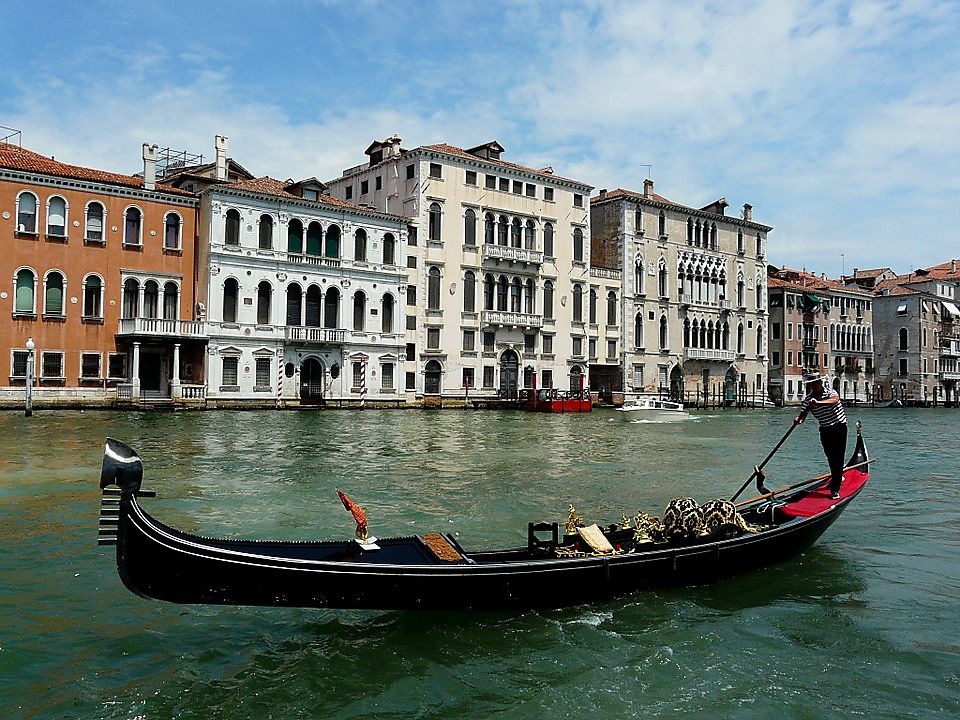
Gondola Grand Canal
Gondola

Gondolas were once used regularly by venetians: two hundred years ago there were around 10,000. However, today only 400 remain, mostly to ferry tourists along the canals. The first recorded mention of a gondola was in 1094 by a Venetian Republic official; by 1500 the gondola had become commonplace enough for artists Bellini and Carpaccio to depict them in their works.
Gondolas are flat-bottomed in order to navigate over shifting sandbars. They work today in the same way they always have; a single oar is used to propel and steer. The boat is asymmetrical, curved on one side so that a single oar can be used to direct the boat in a straight line. They are always painted in six coats of black; a result of 17th century law imposed to eradicate competition between the upper classes for the most impressive boat; however each gondola has unique upholstery.
Gondoliers have been exclusively male for almost a millennium. The prestigious role had been passed down from father to son, until 2010 when the first female was officially recognised as a gondolier3.
Gondolas are flat-bottomed in order to navigate over shifting sandbars. They work today in the same way they always have; a single oar is used to propel and steer. The boat is asymmetrical, curved on one side so that a single oar can be used to direct the boat in a straight line. They are always painted in six coats of black; a result of 17th century law imposed to eradicate competition between the upper classes for the most impressive boat; however each gondola has unique upholstery.
Gondoliers have been exclusively male for almost a millennium. The prestigious role had been passed down from father to son, until 2010 when the first female was officially recognised as a gondolier3.