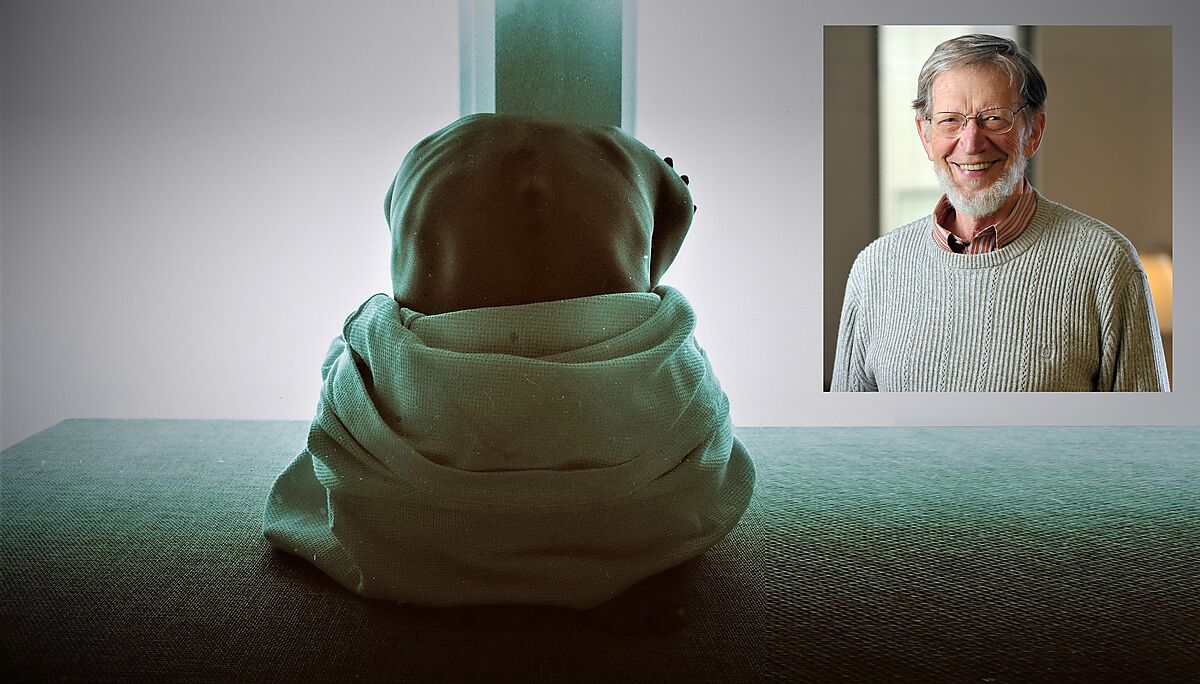
This work, ‘Depiction of Suffering & Alvin Plantinga (inset)’, is a derivative of ‘Woman Suffering’, ‘Alvin Plantinga’ used under CC BY. ‘Depiction of Suffering & Alvin Plantinga (inset)’ is licensed under CC BY SA 4.0 by The Cultural Me
God and the Existence of Evil — Alvin Plantinga’s Free-Will Defence
In Leo Tolstoy’s The Death of Ivan Illyich (1886), the high-court judge Ivan is struck down by illness in the prime of his life and dies an agonising death, with cries that could be heard ‘three rooms off’1.
The world is full of unnecessary suffering and evil — serial murder, war and genocide. In such a world, where is God?
Theists believe in the existence of an almighty and perfectly good God. However, the undeniable existence of evil produces a logical contradiction — two or more statements that cannot all be true — sometimes called the Epicurean paradox. Accordingly, if God exists, He could eliminate evil because He is almighty; and would want to because He is perfectly good. And yet He does not, which implies that He is either powerless or not perfectly good.
In God, Freedom, and Evil (1974)2 American Christian philosopher Alvin Plantinga showed how the contradiction could be resolved. God is almighty, but even He cannot do the logically impossible; He cannot create free humans and simultaneously prevent them, without suppressing their free will, from committing evil. Therefore, according to the free-will defence, evil occurs when humans misuse their freedom.
But what of the gratuitously painful death of Ivan Illyich? According to Plantinga, such apparently ‘natural’ evils are caused by the fallen angel Satan misusing his God-given freedom. While viewed in isolation this may indeed seem far-fetched, crucially, the idea of Satan transforms natural evil into moral evil, one committed through free will.
This allows Plantinga to show that the existence of evil does not make the existence of God impossible — that they can coexist — thereby resolving the Epicurean paradox.