
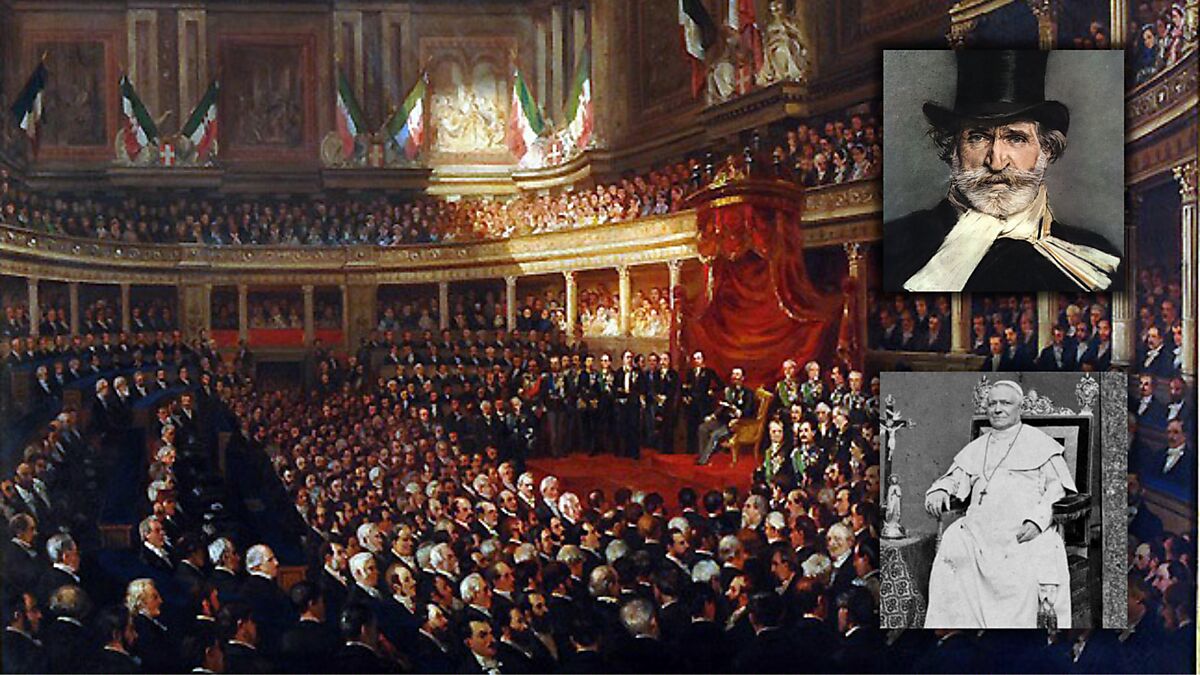
Verdi and the Unification of Italy
Giuseppe Verdi’s ‘Don Carlos’ (1867), Pope Pius IX, and Italian Unification
In 1867, Giuseppe Verdi completed his Don Carlos, which he would revise multiple times in the next 20 years for performances across Europe. The opera is set in 1560s Spain and France, during the reign of Philip II of Spain. Philip’s son and heir, Don Carlos, has travelled secretly to France to meet his soon-to-be-wife Elisabeth, daughter of the French king. She has never seen him, but they soon fall in love upon meeting. However, tragedy strikes when they learn that as part of a peace treaty between their two countries Elisabeth has been promised in marriage to Carlos’s father, Philip.
Six years earlier, in 1861, Verdi had become a Deputy to the newly formed Italian government.1 In the preceding decades, Verdi had supported the Italian wars for independence of 1848 and 1859, which had led to the establishment of the Italian Kingdom. This was, however, only the first phase of the Risorgimento (Italian Unification). Territories in the North remained under the control of the Habsburg Empire, and whilst he was preparing Don Carlos for its Paris premiere, a new armed struggle to bring the remaining foreign-ruled territories into the Italian Kingdom had begun.
Verdi’s opera is largely based on the German playwright Friedrich Schiller’s 1787 play Don Karlos. Schiller, influenced by the American Revolutionary Wars (1775–1783) which had just concluded,2 invented the character Roderick, the Marquis of Posa: a champion for political freedom in the Spanish Netherlands. In Verdi’s opera, we meet the Roderick equivalent, Rodrigue, a friend of Carlos, at the beginning of Act Two. Rodrigue urges his heartbroken friend to channel his suffering into achieving religious freedom for Protestants in Flanders (northern Belgium). As with Schiller’s Roderick, Rodrigue dies for the liberation cause at the hands of the Spanish Inquisition. In Schiller's play, this sacrifice is a dedication to liberty, from which a better society could emerge.3 Verdi, however, was trying to highlight a different problem.
Rome at the time was the seat of the Papal States, a large swathe of territories across central Italy presided over by the Pope. In the wake of the wars for Italian independence, Pope Pius IX condemned the nationalists in his ‘Syllabus of Errors’ (1864), a document outlining ‘the most important errors of our time’.4 However, within a few years Catholic theocracy (ie rule by the Church) began to unravel. On 20 September 1870, Rome fell to the nationalists and became the capital of the new Italian Kingdom. Although the Church had lost its territories, the Pope, confined to the Vatican, remained an influential figure. Verdi was opposed to the Pope’s power, writing to his friend Clarina Maffei that he could not reconcile Italy’s new-found freedoms such as the ‘liberty of the press’ with the Church’s past authoritarianism, in particular its involvement in the Inquisition.5
In Act Three of Don Carlos, we encounter a spectacle, which was a convention of Paris Opera at the time. Verdi, at the instigation of his librettists (the writers of the opera’s text), transforms a scene mentioned only nominally in Schiller’s play into a centrepiece where heretics are burned at the stake. At this point a mysterious voice emerges from off-stage, guiding the dying souls to heaven. Verdi specified this voice should be transmitted in a way to be heard only by the audience, and not by the perpetrators of the Inquisition on stage.6 This momentary break of the ‘fourth wall’ (the separation of the performers from the audience) allows the audience to hear from the perspective of the condemned, whilst simultaneously depicting the metaphorical deafness of Catholic fanaticism.
In Don Karlos, Schiller celebrated freedom in America, whereas in Don Carlos Verdi sought to eliminate the vestiges of Catholic theocracy.
References
- Mary Jane Phillips-Matz. "Verdi’s Life: a Thematic Biography". in Scott L. Balthazar (ed.). The Cambridge Companion to Verdi. Cambridge: Cambridge University Press. 2004. pp. 3-14. p.12
- Jeffrey L. High. "From Hypertext to Hypertext and (Hyper-)Space Opera: Schiller’s <em>Don Karlos</em>, Verdi’s <em>Don Carlo</em>, and George Lucas". Star Wars</em>’, <em>The Germanic Review: Literature, Culture, Theory. 95. 2020. pp.5-20. p.12-13
- Jeffrey L. High. "From Hypertext to Hypertext and (Hyper-)Space Opera: Schiller’s <em>Don Karlos</em>, Verdi’s <em>Don Carlo</em>, and George Lucas". Star Wars</em>’, <em>The Germanic Review: Literature, Culture, Theory. 95. 2020. pp.5-20. p.11
- Helena Rosenblatt. The Lost History of Liberalism from Ancient Rome to the Twenty-First Century. Princeton and Oxford: Princeton University Press. 2018. p.166
- and (ed.). Verdi’s Aida: The History of an Opera in Letters and Documents. Minneapolis: University of Minnesota Press. 1978. pp.72-3
- Gundula Kreuzer. "Voices from Beyond: Verdi’s <em>Don Carlos</em> and the Modern Stage". Cambridge Opera Journal. 18. 2006. pp.151-179. p.163

In the process of studying Verdi’s operas as a student, I became particularly interested in Don Carlos because it is as much about finding a place in the world as it is about ideological radicalism. I find the questions Don Carlos leaves unresolved as relevant today as they were a century and a half ago. The music is also hauntingly beautiful!— Belinda Robinson DPhil