
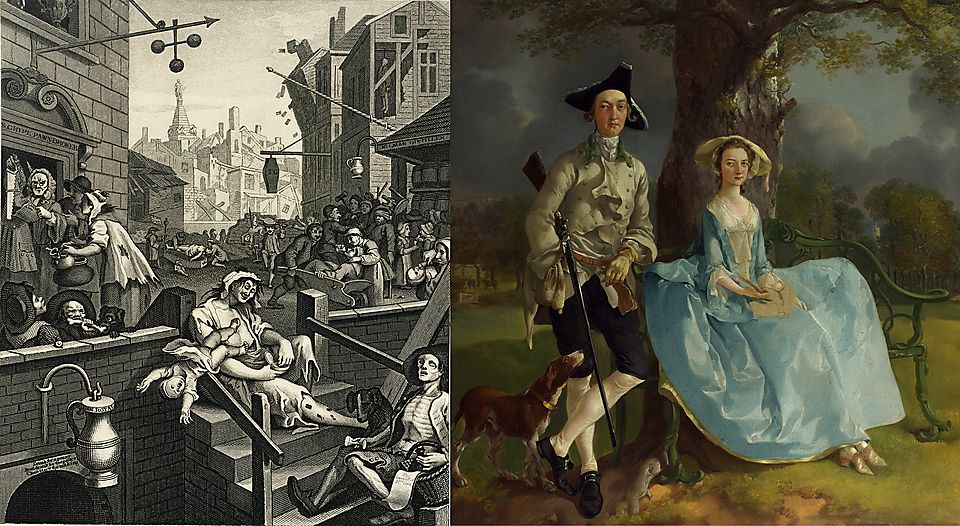
Juxtaposition of Gin Lane and Mr and Mrs Andrews
Gin Lane - Georgian Society According to Hogarth

A woman sits slumped on a set of filthy steps. She grins foolishly, blissfully unaware that her beloved child has slipped from her drunken grip and is hurtling towards an almost certain death. Behind her sits a man, who had probably seen better days, judging by his hat, gnawing on a bone long picked clean, almost indistinguishable from the dog sitting beside him, with whom he shares this gruesome delicacy. Welcome to London of the eighteenth century.
To call William Hogarth a breath of fresh air is somewhat ironic. In a world which sought to mask its darker side through idyllic pastoral paintings and displays of quintessentially English landscape, Hogarth was a startling antithesis. A talented painter and engraver, he sought out the bawdy, the boozy and the bleak: the downtrodden underbelly of a drunken and desolate England in the eighteenth century, and dragged it kicking and screaming into the public eye.
Most artists of the period aspired to depict England as a paradise; a vision of rolling fields, fluffy sheep and delicate ladies bedecked in dainty parasols fills the canvases of Gainsborough and his contemporaries. The woman presented in Gin Lane (1751) is quite the opposite, a symbol of a much more raw and realistic situation, and an unambiguous statement from the artist on the darker side of the narrative: one which was an inconvenience to the ideals of the elite.
To call William Hogarth a breath of fresh air is somewhat ironic. In a world which sought to mask its darker side through idyllic pastoral paintings and displays of quintessentially English landscape, Hogarth was a startling antithesis. A talented painter and engraver, he sought out the bawdy, the boozy and the bleak: the downtrodden underbelly of a drunken and desolate England in the eighteenth century, and dragged it kicking and screaming into the public eye.
Most artists of the period aspired to depict England as a paradise; a vision of rolling fields, fluffy sheep and delicate ladies bedecked in dainty parasols fills the canvases of Gainsborough and his contemporaries. The woman presented in Gin Lane (1751) is quite the opposite, a symbol of a much more raw and realistic situation, and an unambiguous statement from the artist on the darker side of the narrative: one which was an inconvenience to the ideals of the elite.