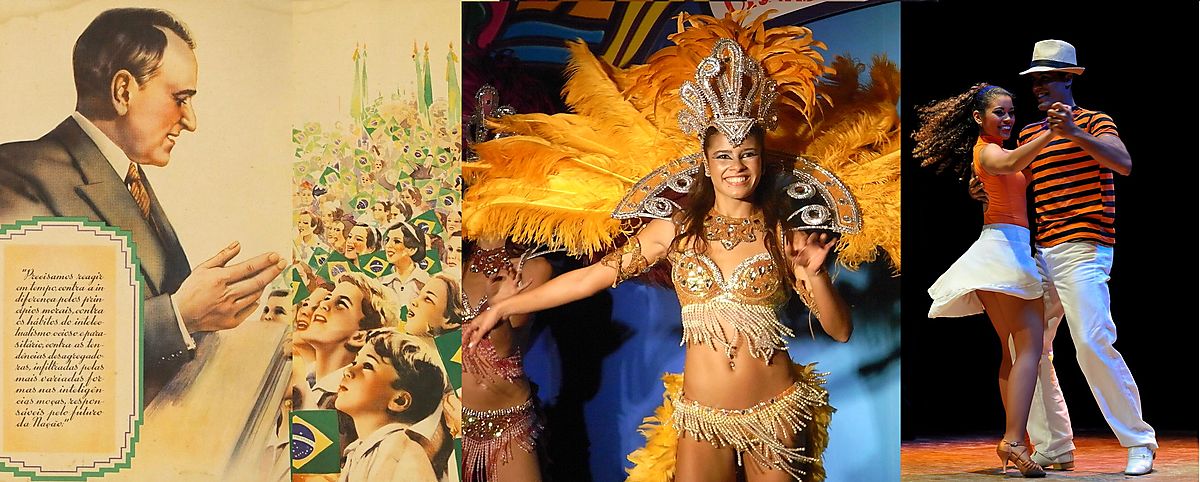
During the 1920s, in Brazil’s class-dominated society, a new form of music and dance was emerging in the favelas of Rio de Janeiro: Samba. The music was distinctive for its fast rhythm, the dance form for its rolling hips, differentiating it from the serious Argentine Tango and the sensual Cuban Rumba.
The favelas were historically the abode of the plantation slaves, forced out of the city into the hills,1 and consequently samba was stigmatised as the culture of the uneducated.2 This was soon to change.
In 1930, Getúlio Vargas, Brazil’s former finance minister, established a new government. Amidst the ensuing political instability, Vargas sought to unify the nation and the concept of brasilidade (roughly ‘Brazilian identity’) was born.
Vargas recognised the importance of popular culture in developing brasilidade. Music, with its ability to transcend class and geographical barriers, even reaching the illiterate through patriotically themed lyrics, became a key tool. Samba rose to prominence, promoted by the state, which sanctioned samba schools (escolas de samba) and even organised carnivals.3 Simultaneously, the number of radios increased significantly under Vargas, reaching an even wider audience through speakers in public squares. Whilst radio content was censored to align with the regime’s ideology, samba enjoyed a free rein, even garnering prizes for songs advocating brasilidade4.
The ensuing discovery of samba by the nation diminished its image as the music of the slums.5 Samba would also sell internationally through artists like Carmen Miranda, who exported this image of Brazil on her move to North America in 1939.
Today Samba has become synonymous with the very essence of Brazil—perhaps best demonstrated by its dominance at the 2016 Olympic ceremonies.
Vivian Schelling. Popular Culture in Latin America from the Cambridge Companion to Modern Latin American Culture, edited by John King. Cambridge University Press. 2004. 191
Lisa Shaw. The social history of the Brazilian samba. Ashgate. 1999. 1
Vivian Schelling. Popular Culture in Latin America from the Cambridge Companion to Modern Latin American Culture, edited by John King. Cambridge University Press. 2004. 192
Lisa Shaw. The social history of the Brazilian samba. Ashgate. 1999. 37
Lisa Shaw. The social history of the Brazilian samba. Ashgate. 1999. 11
Catriona Hosie
London, UK
I spent time in Rio de Janeiro in 2016, whilst volunteering at the Olympics as a timekeeper at the Sailing event, and again last summer as a tourist when the pull to return was too strong to resist. The energy that the Samba evokes in the streets and bars of Rio is intense and it's a secret I want to share with others.