
German Reunification
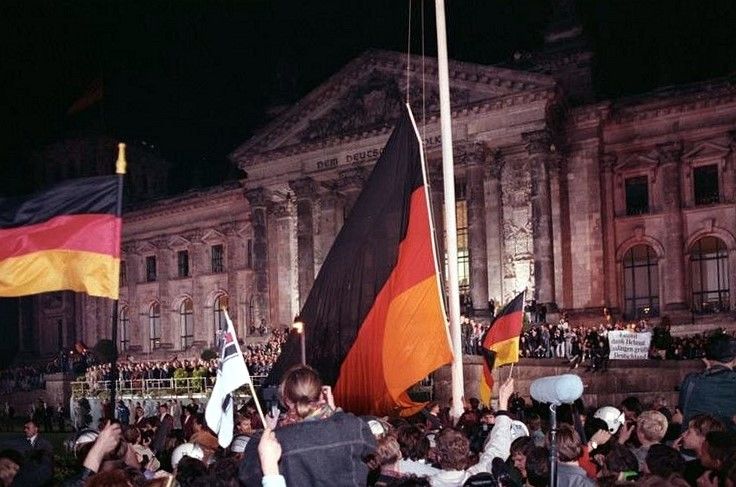
Berlin, deutsche Vereinigung, vor dem Reichstag
The German reunification was the process in 1990 in which East Germany became part of West Germany to form the reunited nation of Germany, and when Berlin reunited into a single city becoming the capital. The end of the unification process is officially referred to as German unity, celebrated on 3 October.
The East German government started to falter in May 1989, when the removal of Hungary's border fence with Austria opened a hole in the Iron Curtain. It caused an exodus of thousands of East Germans fleeing to West Germany and Austria via Hungary.
The Peaceful Revolution, a series of protests by citizens, led to East Germany's first free elections on 18 March 1990, and to the negotiations between East and West Germany that culminated in a Unification Treaty.
The united Germany is not a successor state, but an enlarged continuation of the former West Germany. As such, the enlarged Germany retained the West German seats in international organizations including the European Union and NATO, while relinquishing membership in the Warsaw Pact and other international organizations to which only East Germany belonged.
The East German government started to falter in May 1989, when the removal of Hungary's border fence with Austria opened a hole in the Iron Curtain. It caused an exodus of thousands of East Germans fleeing to West Germany and Austria via Hungary.
The Peaceful Revolution, a series of protests by citizens, led to East Germany's first free elections on 18 March 1990, and to the negotiations between East and West Germany that culminated in a Unification Treaty.
The united Germany is not a successor state, but an enlarged continuation of the former West Germany. As such, the enlarged Germany retained the West German seats in international organizations including the European Union and NATO, while relinquishing membership in the Warsaw Pact and other international organizations to which only East Germany belonged.
German Reunification adapted from Wikipedia and licensed by The Cultural Me under CC BY SA 3.0