
German Expressionism

German Expressionism
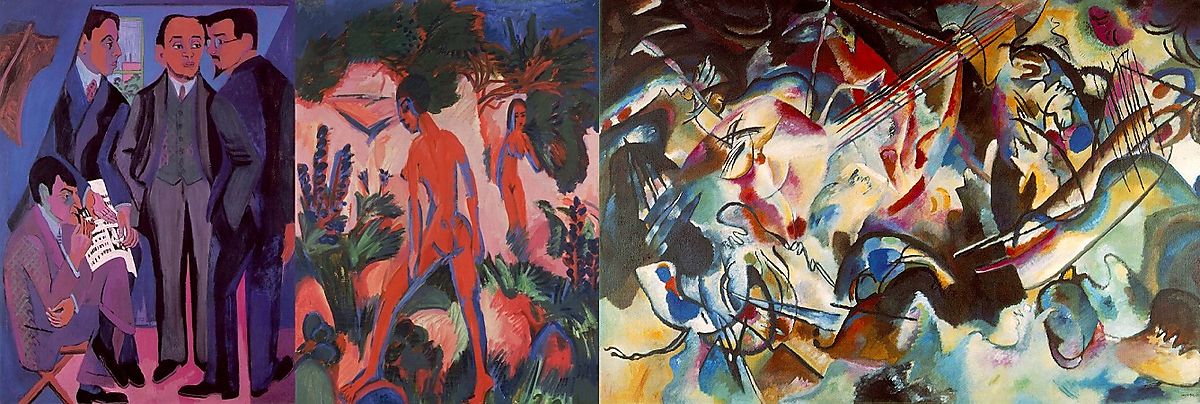
German expressionist painting emerged in 1905 in Dresden with the founding of Die Brücke (The Bridge), an artists’ association. The group was formed by four architectural students in rebellion against the social conservatism, and the bourgeois and materialistic values which dominated the country at that time.
These values upheld the traditional art of the European academies, with their emphasis on technical and aesthetic rules in the depiction of naturalist subjects. The expressionists also distanced themselves from the prevailing impressionist-post-impressionist styles and their preoccupation with depicting atmospheric effects. The key innovation of the expressionists was to enhance naturalism by incorporating emotion, eroticism and sensuality, essentially liberating themselves to express their innermost feelings.
The group installed a studio in a former butcher’s shop in Dresden’s working-class Friedrichstadt area, where they began to create and exhibit their art.1 Influenced by ‘primitive’, non-western art, they used simplified forms and vivid colours to express emotional intensity.2 Founding member Ernst Kirchner’s Red Nudes (1912) exemplifies this approach, and also demonstrates a further characteristic of German expressionism: the use of nudity to shock and provoke an emotional response from the viewer.3
In 1911, another group Der Blaue Reiter (The Blue Rider) was founded in Munich by several painters, including Franz Marc and the Russian Wassily Kandinsky. Like their counterparts in Dresden, the members of Der Blaue Reiter aimed to create art fueled by emotion. However, in their case this was achieved by an intensified use of abstract forms.
German expressionism was not limited to painting but extended into further creative areas, with prominent examples being Fritz Lang’s film Metropolis (1927), Bertolt Brecht’s play Baal (1918) and Arnold Schoenberg’s music.
These values upheld the traditional art of the European academies, with their emphasis on technical and aesthetic rules in the depiction of naturalist subjects. The expressionists also distanced themselves from the prevailing impressionist-post-impressionist styles and their preoccupation with depicting atmospheric effects. The key innovation of the expressionists was to enhance naturalism by incorporating emotion, eroticism and sensuality, essentially liberating themselves to express their innermost feelings.
The group installed a studio in a former butcher’s shop in Dresden’s working-class Friedrichstadt area, where they began to create and exhibit their art.1 Influenced by ‘primitive’, non-western art, they used simplified forms and vivid colours to express emotional intensity.2 Founding member Ernst Kirchner’s Red Nudes (1912) exemplifies this approach, and also demonstrates a further characteristic of German expressionism: the use of nudity to shock and provoke an emotional response from the viewer.3
In 1911, another group Der Blaue Reiter (The Blue Rider) was founded in Munich by several painters, including Franz Marc and the Russian Wassily Kandinsky. Like their counterparts in Dresden, the members of Der Blaue Reiter aimed to create art fueled by emotion. However, in their case this was achieved by an intensified use of abstract forms.
German expressionism was not limited to painting but extended into further creative areas, with prominent examples being Fritz Lang’s film Metropolis (1927), Bertolt Brecht’s play Baal (1918) and Arnold Schoenberg’s music.
References
- Bettina Kaufmann. Symbol und Wirklichkeit. Ernst Ludwig Kirchners Bilder aus der Phantasie und Edvard Munchs Lebensfries. Peter Lang AG. 2007. 59
- Ulrike Lorenz. Brücke – Die deutschen ‘Wilden’ und die Geburt des Expressionismus. Taschen Verlag. 2008. 6
- Norbert Wolf. Ernst Ludwig Kirchner. 1880 - 1938. On the Edge of the Abyss of Time. Taschen Verlag. 2003. 24