
German Economic Miracle
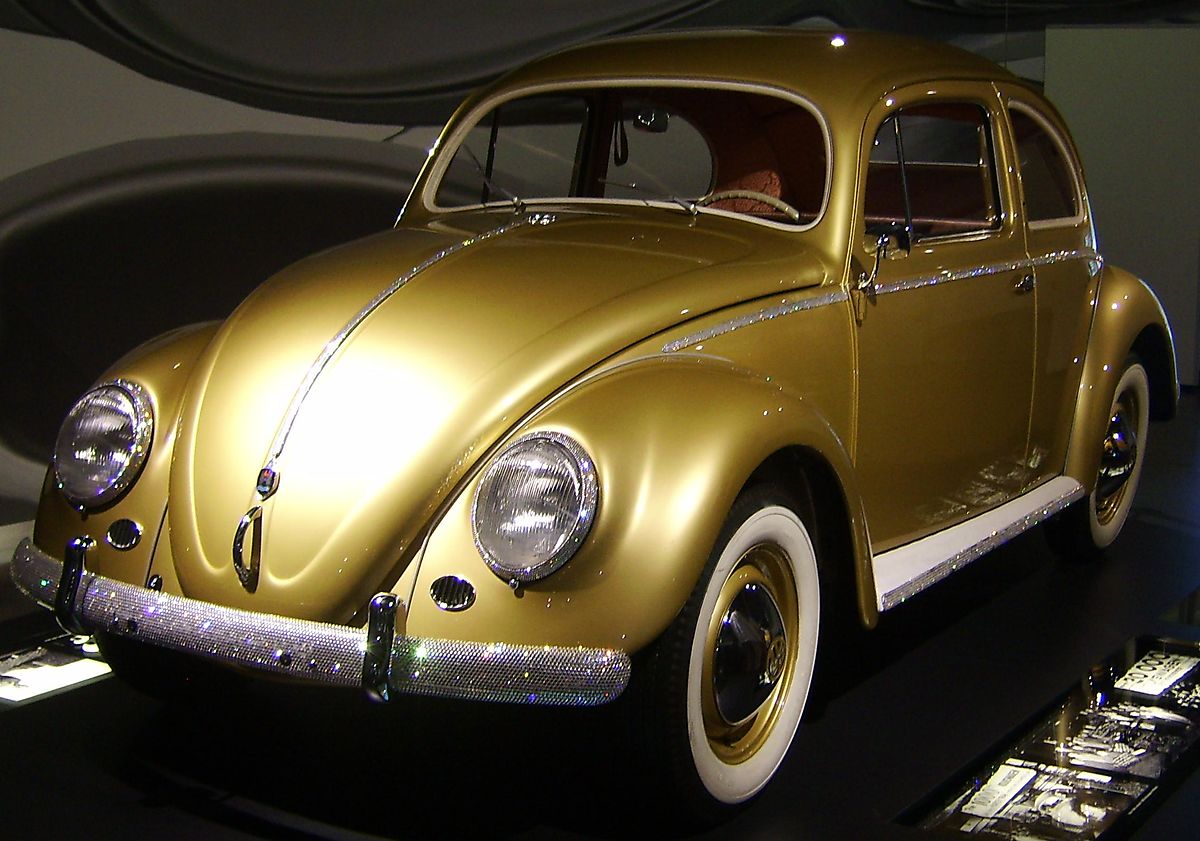
The millionth VW Volkswagen, all chrome parts are loaded with edged glass beads
The term Wirtschaftswunder ("economic miracle"), also known as the Miracle on the Rhine, describes the rapid reconstruction and development of the economies of West Germany and Austria after World War II.
Beginning with the replacement of the Reichsmark with the Deutsche Mark in 1948 as legal tender, a lasting period of low inflation and rapid industrial growth was overseen by the government led by West German Chancellor Konrad Adenauer and his Minister of Economics, Ludwig Erhard, who went down in history as the "father of the German economic miracle."
In Austria, the Schilling was re-established and efficient labor practices led to a similar period of economic growth.
The era of economic growth raised West Germany and Austria from total wartime devastation to developed nations in modern Europe. At the founding of the European Common Market in 1957 West Germany's economic growth stood in contrast to the struggling conditions at the time in the United Kingdom.
The expression referring to this phenomenon was first used by The Times in 1950.
Beginning with the replacement of the Reichsmark with the Deutsche Mark in 1948 as legal tender, a lasting period of low inflation and rapid industrial growth was overseen by the government led by West German Chancellor Konrad Adenauer and his Minister of Economics, Ludwig Erhard, who went down in history as the "father of the German economic miracle."
In Austria, the Schilling was re-established and efficient labor practices led to a similar period of economic growth.
The era of economic growth raised West Germany and Austria from total wartime devastation to developed nations in modern Europe. At the founding of the European Common Market in 1957 West Germany's economic growth stood in contrast to the struggling conditions at the time in the United Kingdom.
The expression referring to this phenomenon was first used by The Times in 1950.
Wirtschaftswunder adapted from Wikipedia and licensed by The Cultural Me under CC BY SA 3.0