
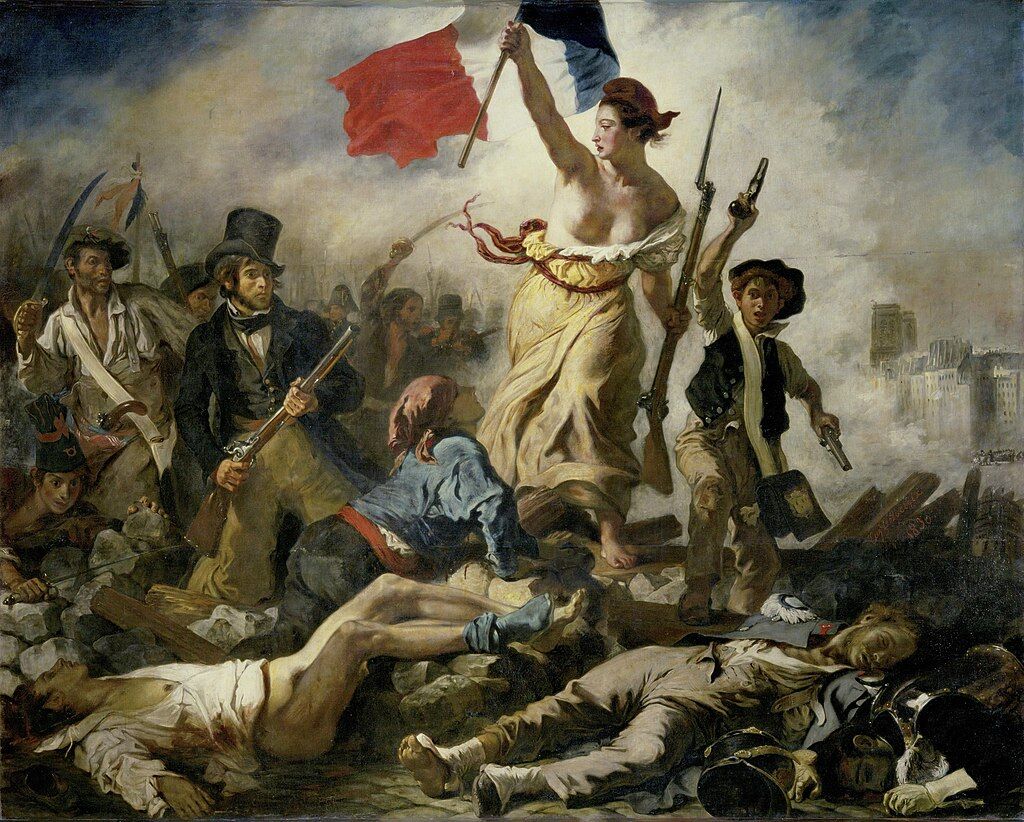
Eugène Delacroix, Liberty Leading the People, 1830
Gérard Rancinan’s ‘La liberté dévoilée’ (2008) and the French Constitution
In Eugène Delacroix’s La liberté guidant le peuple (1830), a woman in a torn dress and Phrygian bonnet is shown storming a barricade at the head of a militia, with the Tricolour in one hand and a musket in the other. The painting (which means ‘Liberty guiding the people’) is an icon of Western art.
Delacroix started work on the painting in 1830 when over the three days 27–29 July the French had taken to the streets in protest, erecting barricades and fighting running battles with the royal army. The sovereign, King Charles X, had taken steps to dissolve the elected chamber and to curtail the freedom of the press leading to the violent uprising. This became known as La révolution de juillet (the July Revolution), or Les trois glorieuses (the three glorious days).
Forty-one years earlier, the French Revolution of 1789 had won the people many freedoms, and it was these freedoms that were at risk in 1830. At that time, the hereditary monarchy had been toppled and replaced with institutions rooted in the principles of the Enlightenment: a focus on rationalism and scientific enquiry, as well as a move towards questioning the authority of hereditary and religious institutions.1 In turn, the July revolution of 1830 marked the start of ‘political ideologies’; forms of governments now had to be justified as being beneficial to society in order to be legitimate.2
The revolutions of France went on to influence political thought on the international stage; for instance, Article One of the United Nations Universal Declaration of Human Rights (adopted on 10 December 1948) has clear parallels with the 1789 Declaration of the Rights of Man and of the Citizen: ‘All human beings are born free and equal in dignity and rights’3 in the former versus ‘Men are born and remain free and equal in rights’4 in the latter. The 1789 declaration is also cited in the preamble to subsequent drafts of the French constitution.
In 2008, the French photographer Gérard Rancinan (b. 1953) reinterpreted Delacroix’s painting, creating a piece called La liberté dévoilée (Liberty Unveiled). The central character is replaced by a woman wearing a burqa, and instead of the French flag she holds aloft a black veil in her right hand. Although her face is masked, parts of her upper chest, an arm and a leg are exposed in a disorderly fashion, in contravention of Islamic practices. She is surrounded by a motley of carefully modelled characters; a rap artist, a topless woman with flaming red hair, a gagged Tibetan monk, and a child soldier holding up a can of cola, amongst others.They are surrounded by urban detritus: tyres and concrete blocks, as well as prominent symbols of the media: broken television sets and crumpled newspapers. Three dead bodies lie in the foreground, one of them a distinctive Christlike figure. In the background, on the right, we see the Manhattan Twin Towers in a cloud of dust and smoke, and the shattered Berlin wall to the left, from which a McDonald’s restaurant signpost sticks out grimly. The composition serves to accentuate the central figure of the woman in burqa, and perhaps the boy soldier, as rallying a cause, surrounded by indifference, oppression, death and destruction.
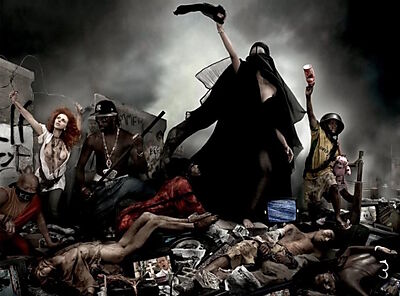
The symbolism embodied in the woman relates well to the French socio-political landscape of the time. In 2004, the French government had enacted a law (Law 2004–228 of 15 March 2004) which prohibited students in public schools from wearing conspicuous religious symbols.5 Although the law banned all religious symbolism including crucifixes it disproportionately affected young Muslim women and their wearing of headscarves.
In this photograph Rancinan highlights the hypocrisy of France, a country which has built its legacy on human rights and freedom of expression, passing laws that go directly against those rights. The 1789 declaration states that the ‘free communication of ideas and opinions is one of the most precious of the rights of man.’ Subsequent constitutions have fully adopted these principles. Delacroix’s painting of 1830 stands as a cornerstone to these hard-won liberties. By choosing to reinterpret Delacroix’s iconic work with a woman in a burqa instead as its focus, Rancinan raises questions that go to the very heart of the idea of French liberty. The crumpled newspapers and broken television sets seem to bear testament to a nation where freedom of expression has all but been destroyed.
In 1830, the French took to the streets to fight for their freedom. The revolutions of France supposedly brought Enlightenment ideals of freedom and universal human rights to the forefront, but Rancinan shows that France today is no better than two centuries ago, and no better than any other country in the contemporary world for the woman in burqa is shown to share her fight with oppressed people from around the world.
In France, two years after Rancinan’s artwork, another law was passed (Law 2010–1192 of 11 October 2010) this time prohibiting face coverings in public.6 Once again, the law overwhelmingly affected Muslim women — those who wear the burqa.
References
- Jack Censer, and Lynn Hunt. "The Enlightenment and human rights". Liberté Égalité Fraternité: Exploring the French Revolution. 2019
- Jack Censer, and Lynn Hunt. "Legacies of the Revolution". Liberté Égalité Fraternité: Exploring the French Revolution. 2019
- United Nations. "Universal Declaration of Human Rights". United Nations. 1948
- French National Constituent Assembly. "The Declaration of the Rights of Man and of the Citizen". Élysée. 1789
- République Française. "Loi n° 2004-228 du 15 mars 2004 encadrant, en application du principe de laïcité, le port de signes ou de tenues manifestant une appartenance religieuse dans les écoles, collèges et lycées publics". Légifrance. 2004
- République Française. "Loi n° 2010-1192 du 11 octobre 2010 interdisant la dissimulation du visage dans l'espace public". Légifrance. 2010

Rancinan’s artwork caught my attention because it is a striking photograph with a powerful message on equality, oppression, and secularism in France. I wanted to write this piece because it combines my interests in art, politics, and religion. I want the reader to be able to discover the work of an important artist, while simultaneously learning some French history and contemporary politics.— Inès Stamatiadis