
A Sunday on La Grande Jatte
Georges Seurat and the Figures Emblematic of late 19th Century Parisian Life

Paris of the late 19th century was a world of mystery, sensuality, and artistic spirit. The art of the time represented this aura of mystery by depicting enigmatic figures, often with controversial overtones.
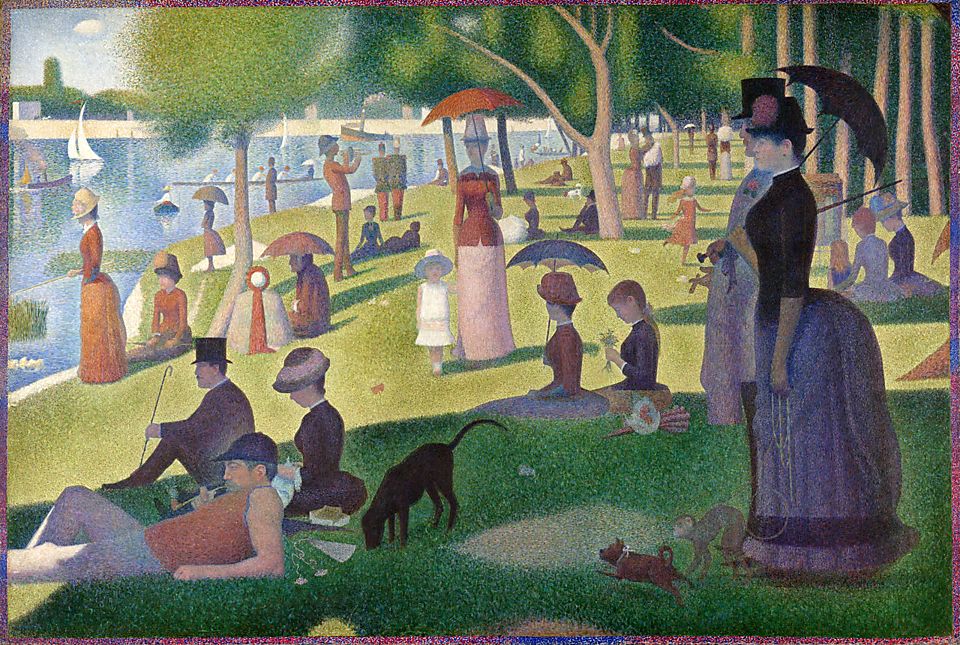
One of the most controversial paintings of that period is Georges Seurat’s Sunday Afternoon on the Island of la Grande Jatte (1884). The artist endeavoured to depict not simply a usual gathering of the bourgeoisie on a Sunday afternoon, but unique figures emblematic of Parisian life, shown engaging in commonplace leisure activities. These activities, however, may not be so innocent upon reflection.
One of the enigmatic figures symbolised by Seurat is the woman fishing with a rod on the left of the painting. At that time, an unaccompanied lady was considered a demimonde (a woman with questionable morals). Additionally, the fishing rod also featured in jokes on prostitution of the period, since the verb “to fish” in French (pêcher) is pronounced the same as “to sin” (pécher).
The island of la Grande Jatte had developed a reputation for sexual impropriety, whether couples having affairs or prostitutes loitering in search of clients. As a result, the island had been subjected to police raids seeking to halt the clandestine prostitution. Thus the guise of fishing arose in order to create legitimacy. Seurat’s lady with the rod was surely there with the aim of fishing…for business.
One of the most controversial paintings of that period is Georges Seurat’s Sunday Afternoon on the Island of la Grande Jatte (1884). The artist endeavoured to depict not simply a usual gathering of the bourgeoisie on a Sunday afternoon, but unique figures emblematic of Parisian life, shown engaging in commonplace leisure activities. These activities, however, may not be so innocent upon reflection.
One of the enigmatic figures symbolised by Seurat is the woman fishing with a rod on the left of the painting. At that time, an unaccompanied lady was considered a demimonde (a woman with questionable morals). Additionally, the fishing rod also featured in jokes on prostitution of the period, since the verb “to fish” in French (pêcher) is pronounced the same as “to sin” (pécher).
The island of la Grande Jatte had developed a reputation for sexual impropriety, whether couples having affairs or prostitutes loitering in search of clients. As a result, the island had been subjected to police raids seeking to halt the clandestine prostitution. Thus the guise of fishing arose in order to create legitimacy. Seurat’s lady with the rod was surely there with the aim of fishing…for business.
Do you want to learn to write like this?
References
- Brettel R.. Modern Art (1851-1929). Oxford University Press. 1999
- Smith, P.. Seurat Re-viewed. The Pennsylvania State University Press. 2009