
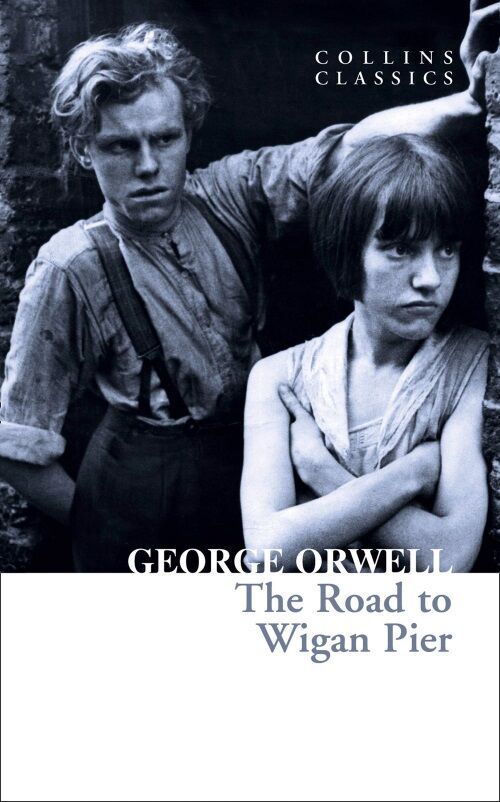
The Road to Wigan Pier (Front Cover)
George Orwell’s ‘The Road to Wigan Pier’ (1937) — An Evocative Portrayal of Northern Working-Class Life
In January 1936, the 32-year-old writer George Orwell, having secured a commission from the publisher Victor Gollancz, travelled to the north of England to investigate the reality of the unemployed in Yorkshire and Lancashire. There he found communities who had ‘grasped that unemployment is a thing they cannot help’,1 and Orwell watched them face a daily psychological struggle to find stimulation under the ‘dull evil cloud’ of unemployment.2
He published his observations in The Road to Wigan Pier (1937), a book of two parts. In part one, he recounts his first-hand experiences of northern working-class life, before considering how socialism might solve chronic unemployment in part two.
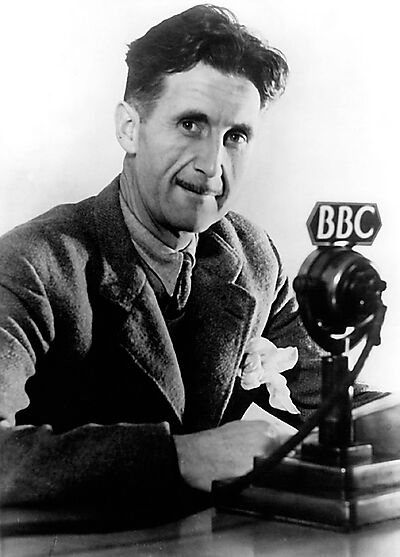
The end of the First World War had caused demand for heavy industry to plummet, driving millions out of work. The south, with its economy centred around agriculture and the service industries, was relatively well cushioned from these shocks.3 By contrast in the north, where coal mining and shipbuilding were the largest employers, the nosedive in industry was more acutely felt. The shock would prove long term and would continue into the following decades.
By the mid-1930s, Ramsay MacDonald’s Labour government had begun to recognise that those listless men of the north were victims of a phenomenon which became known as structural unemployment: unemployment caused by industrial reorganisation in an economy. This new understanding was formalised in the Unemployment Act of 1934, which clearly distinguished between policies intended to combat short-term versus long-term unemployment.4 No longer would the long-term unemployed be dismissed as ‘lazy idle loafers on the dole’.5
Orwell paints an evocative picture of northern working-class life of the time in the wake of structural unemployment. In Sheffield, he finds a public lecture hall heaving with the unemployed, in spite of it being ‘by a long way the silliest and worst-delivered lecture’6 he had ever heard. And at occupational centres men ‘do nothing but sit round the fire and occasionally play a game of dominoes’, or find sanctuary in ‘the public library’ or, at best, ‘the pictures’ (the cinema), seeking a ‘warm place to shelter in’7 from the ‘bugs and leaking roofs’8 and the severe overcrowding of their corporation housing.
From the window of a train winding through the northern mining towns, Orwell witnesses the acuteness of the poverty inflicted by the industrial north’s structural decline. Amidst the ‘monstrous scenery of slag-heaps [and] piled scrap-iron’, he locks eyes with ‘the exhausted face’ of a slum girl tasked with unblocking a waste-pipe, and wearing ‘the most desolate, hopeless expression’ Orwell had ever seen.9
As it turned out, Orwell alluded to the eventual solution for chronic unemployment in Wigan Pier, writing ‘several million men in England will — unless another war breaks out — never have a real job this side the grave.’10
References
- Selina Todd (ed.). , The Road to Wigan Pier. Oxford: Oxford University Press. 1989. p.59
- Selina Todd (ed.). The Road to Wigan Pier. Oxford: Oxford University Press. 1989. p.56
- John Bachtler. "Regional Disparities in the United Kingdom". in Helmut Karl and Phillipe Rollet (ed.). Employment and Regional Development Policy: Market Efficiency versus Policy Intervention. Oxford: Blackwell Publishing. 2004. pp.36-49. p.38
- Prakash Lougani. "Structural Unemployment and Public Policy in Interwar Britain: A Review Essay". Journal of Monetary Economics. 28, no. 1. 1991. 149-159. pp.7-8
- Selina Todd (ed.). The Road to Wigan Pier. Oxford: Oxford University Press. 1989. p.58
- Selina Todd (ed.). The Road to Wigan Pier. Oxford: Oxford University Press. 1989. p.57
- Selina Todd (ed.). The Road to Wigan Pier. Oxford: Oxford University Press. 1989. p.55
- Selina Todd (ed.). The Road to Wigan Pier. Oxford: Oxford University Press. 1989. p.35
- Selina Todd (ed.). The Road to Wigan Pier. Oxford: Oxford University Press. 1989. p.12
- Selina Todd (ed.). The Road to Wigan Pier. Oxford: Oxford University Press. 1989. p.57

Much of the interwar history studied in schools and universities examines the years 1918–1939 through the lens of international relations, as context for understanding the origins of the Second World War. However, The Road to Wigan Pier provided me with a stepping-stone into Britain’s rich social history through this period. Orwell’s evocative descriptions of his first-hand encounters with the long-term unemployed in northern England offer an impression of the destitution that these communities endured and the psychological turmoil that the individuals faced, thereby adding a new angle to my understanding of these seminal years in twentieth-century history.— Harry Morris