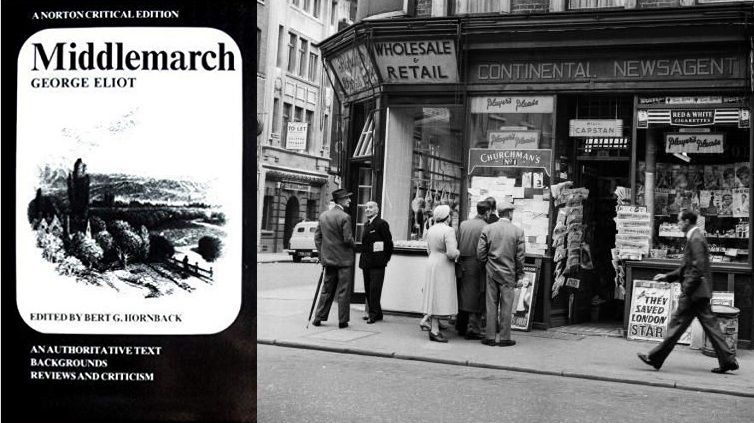
In early 1870, George Eliot was 236 pages into writing Middlemarch (1871) when she realised the novel was too long for the three-volume standard of the time. In her diary of 19 March 1871, Eliot (whose real name was Mary Anne Evans) wrote “My present fear is that I have too much matter, too many ‘momenti’”1.
For most of the 19th century, novels were published in one of two ways. Works by popular writers, such as Charles Dickens, were printed on one sheet of paper folded 8 times (making 32 pages) and sold in cheap monthly instalments for one shilling. Alternatively, longer novels, such as Eliot’s Mill on the Floss (1860), were published in the three-volume “three-decker” format. These were bought by libraries and were more often borrowed than bought.
Eliot had written Romola (1863) in instalments but was loath to publish Middlemarch in the low quality format.2 Instead, her lover George Lewes recommended splitting the novel into eight volumes, each volume to be issued every two months. The format retained the prestige of the three-decker but with a smaller price tag, encouraging readers to buy rather than borrow.
Middlemarch was successful in generating a new readership paying five-shillings per volume, with publisher Blackwood saying the sales “make a very pretty show.”3 The structure of the publication accounts for the structure of the narrative: each volume acts as a stand-alone story, generating suspense and encouraging the reader to purchase the next instalment. The final effect is a book comprised of many plots whose threads merge to form the tapestry of a whole town and its people: the fictional Middlemarch.
Frost, Simon. The Business of the Novel. Routledge. 2015. 15
Frost, Simon. The Business of the Novel. Routledge. 2015. 17
Frost, Simon. The Business of the Novel. Routledge. 2015. 22
Anna Middleton
London
George Eliot is one of my favourite Victorian authors. I love her conversational style and skill of characterisation: to the sympathetic portrayal of even the most detestable of villains. Her books, however, are dense and so rich in themes that summaries are always reductive. Instead, given my interests in print history, I provide an insight into Victorian printing practices, and explain why many texts from this time seem impractically long.